Video
Speaker Summary
(66 speakers)
| Speaker | Words | Time |
|---|---|---|
| Councilmember Ellen Kamei | 7,309 | 29m |
| Councilmember Chris Clark | 3,517 | 18m |
| Councilmember Pat Showalter | 3,162 | 11m |
| Councilmember John McAlister | 3,832 | 10m |
| Councilmember Lucas Ramirez | 3,000 | 9m |
| Councilmember Alison Hicks | 1,922 | 6m |
| Councilmember Emily Ramos | 1,827 | 6m |
| Councilmember Margaret Abe-Koga | 682 | 2m |
| City Manager Kimbra McCarthy | 842 | 2m |
| City Attorney Jennifer Logue | 285 | <1m |
| City Clerk Heather Glaser | 57 | <1m |
| Community Development Director Christian Murdock | 3,163 | 9m |
| Principal Planner Diana Pancholi | 2,110 | 9m |
| Assistant Public Works Director Ed Arango | 2,441 | 7m |
| Julie Barnard | 1,326 | 5m |
| Kristen Lenhardt | 1,736 | 4m |
| Ruth Shikada | 1,596 | 4m |
| Allison Stern | 193 | 2m |
| Stephen Goldstein | 421 | 1m |
| Amanda Rotella | 593 | 1m |
| Alex Brown | 519 | 1m |
| Sophie Yeh | 406 | 1m |
| Daniel Hulse | 353 | 1m |
| David Watson | 415 | 1m |
| Dr. Kohinoor Chakravarty | 327 | 1m |
| Wendy Sarathy | 316 | 1m |
| Pradeep Bardia | 356 | 1m |
| Leila Abazari | 227 | 1m |
| Mark Azzopardi | 349 | 1m |
| Rev. Kim Dortch-Tilley | 318 | 1m |
| Matthew Marting | 323 | 1m |
| Cliff Chambers | 330 | 1m |
| Kim Lydon | 400 | 1m |
| Nhung | 256 | 1m |
| Andres | 364 | 1m |
| Frank | 294 | 1m |
| Victoria Lim | 417 | <1m |
| Housing Director Wayne Chen | 273 | <1m |
| Joshua Dylan | 341 | <1m |
| Alex Shukhman | 317 | <1m |
| Camila | 311 | <1m |
| Eric Knoff | 307 | <1m |
| Peyman Mogharabi | 213 | <1m |
| Finance and Administrative Services Director Derek Rampone | 258 | <1m |
| Noam Lorberbom | 260 | <1m |
| Cynthia Palacio Newman | 324 | <1m |
| Hala Alshahwani | 222 | <1m |
| Jiao Luo | 333 | <1m |
| Sanjay Voleti | 315 | <1m |
| Francois B | 350 | <1m |
| Brent Bell | 362 | <1m |
| Andy Turner | 305 | <1m |
| James Cuzomal | 311 | <1m |
| David Abazari | 230 | <1m |
| Peng Zhang | 205 | <1m |
| Manuel Salazar | 302 | <1m |
| Bruce England | 231 | <1m |
| Lana Shukhman | 46 | <1m |
| Juliet Jamgrot | 217 | <1m |
| Isabelle Augustin | 88 | <1m |
| Nicholas Hargis | 84 | <1m |
| Lorenzo Lopez | 101 | <1m |
| X J | 114 | <1m |
| Fire Chief Juan Diaz | 128 | <1m |
| Ella Lenhardt | 226 | <1m |
| Public Speaker | 463 | 1m |
Transcript
Pledge Of Allegiance
[00:01:07] Councilmember Ellen Kamei: All right everyone, I hate to start the meeting on time, but here we are. Um, all right, it's 6:30, so I'll like to uh call the meeting to order. Good evening everyone. Welcome to the special meeting of the Mountain View City Council of December 16, 2025. Uh please stand and join me in the Pledge of Allegiance.
Roll Call
[00:01:27] Councilmember Ellen Kamei: All right. Great. The uh, we'll move on to roll call. The City Clerk will take attendance by roll call.
[00:01:30] City Clerk Heather Glaser: Councilmember Clark? Councilmember Clark: Here. City Clerk: Councilmember Hicks? Councilmember Hicks: Here. City Clerk: Councilmember McAlister? Councilmember McAlister: Ho ho ho! City Clerk: Councilmember Ramirez? Councilmember Ramirez: Here. City Clerk: Councilmember Showalter? Councilmember Showalter: Here. City Clerk: Vice Mayor Ramos? Vice Mayor Ramos: Here. City Clerk: Mayor Kamei? Mayor Kamei: Here. City Clerk: We have a quorum.
Public Comment
[00:01:35] Councilmember Ellen Kamei: Great, thank you. Um, so tonight we uh get to begin with a festive oc- our festive occasion, we have our presentations. Please note that these are presentations only. The City Council will not take any action. Public comment will occur after the presentation items. If you like to speak on these items in person, please submit a blue speaker card to the City Clerk now. And um, we will begin with this evening with our proclamation in recognition of Fire Chief Juan Diaz on his retirement. So I will come down to the podium and ask uh the Chief to join me.
[00:02:02] Councilmember Ellen Kamei: I see a lot of people for you, so I want you to stand here while we uh, so everyone can see you. Um, so before um, uh, we start tonight, I just want to say it's an honor and pleasure to uh recognize our outgoing Fire Chief Juan Diaz tonight. Chief Diaz has served our city for nearly 12 years. During that time, he has provided our community with steadfast and innovative leadership of our top notch fire department. I'm going to read Chief Diaz's accomplishments shortly, uh, which will be in um his proclamation. But before I do so, I just wanted to add my own personal thanks to Chief Diaz. Chief Diaz is a proud immigrant and has shared his story as a refugee to United States uh openly. And I think this really ties in to our Mountain View culture of being a community for all. And I will say this has been his superpower. Over the last four decades, through resilience, perseverance, and a deep commitment to service, Chief Diaz has built a distinguished career centering all of that on his lived experiences. And yo quiero decir algo sobre el jefe, right? Que fue ah, una inspiración para mi, y yo se para la comunidad aqui en Mountain View. Que cuando tiene un deseo, tu puede ah hacerlo. So, this isn't goodbye. This is we will see you around. And being that uh Cuba and Puerto Rico, we are we are cousins, right? We're we're in the uh Caribbean Sea together. Uh we say pa'lante. Ever forward. So I just want to uh say all that and now I will read the proclamation.
[00:02:57] Councilmember Ellen Kamei: Whereas, where as Chief Juan Diaz will retire from on December 30th, 2025, concluding a distinguished 40 year fire service career, including five years as a Reserve Firefighter in Santa Clara, 25 years with the San Jose Fire Department, rising to Deputy Chief, and nearly 12 years with the Mountain View Fire Department, and the last 10 and a half years as Fire Chief. And whereas under his leadership, Mountain View Fire earned three consecutive Insurance Services Office Class 1 ratings, the only such distinction in Santa Clara County. Implemented full advanced life support services across all fire companies, built a Type 1 Urban Search and Rescue team, enhanced the Hazardous Materials emergency response team to Type 2 certification under the California Office of Emergency Services, and significantly expanded public education programs. And whereas Fire Chief Diaz championed diversity, equity and inclusion, advancing pathways for underrepresented groups and promoting MVFD's first female Battalion Chief, first female Fire Marshal and first Chinese American Battalion Chief. A 2020 Santa Clara County Grand Jury report recognized MVFD's notable progress in gender diversity. And whereas he established the MVFD California Joint Apprenticeship Program and the Department's first fully funded annual recruitment committee, helping MVFD achieve the highest per capita number of women firefighters in the county, as noted by the 2024-2025 Civil Grand Jury. And whereas Fire Chief Diaz strengthened the department's culture by introducing The Mountain View Way, creating a formal career development plan, launching annual awards and recognition programs and expanding peer support and cancer screening initiatives. And whereas he built a robust Community Emergency Response Team, also known as CERT, program, expanded training to more than 1,000 residents, enhanced neighborhood preparedness, and established seven portable Emergency Operations Center buildings throughout Mountain View. And whereas he advanced innovation by securing modern fire apparatus and specialized equipment, including an electric vehicle battery extinguishing team, a Type 6 wildland engine, and MVFD's first advanced life support transit ambulance. And whereas he founded MVFD's first Honor Guard, created the county's first tactical paramedic program embedded with Mountain View Police Department SWAT, and developed the department's swift water rescue capability. And whereas Fire Chief Diaz strengthened regional cooperation through mutual aid, and support of the Santa Clara County Type 3 Incident Management Team. And whereas during the COVID-19 pandemic, he partnered with Santa Clara County Health Officials to provide free testing and vaccination services for first responders, teachers, vulnerable residents, and communities in both Mountain View and San Jose. And whereas in 2024, he led the MVFD's 150th annual celebration, drawing more than 10,000 attendees. And whereas Fire Chief Diaz holds an associate and bachelor's degree in fire science, a master's degree in leadership with an emphasis in homeland security and emergency management, and numerous Chief Officer and specialty certifications. And whereas he served as the president of the Santa Clara County Fire Chiefs Association, liaison to the Santa Clara County Operations Section, representative to the State Homeland Security Program, and contributor to regional radio interoperability and mutual aid planning. And whereas an avid collector and restorer of unique fire apparatus, Fire Chief Diaz led the full restoration of MVFD's 1925 American LaFrance engine, returning it to service for display after more than 50 years of deterioration. And whereas Fire Chief Diaz leaves a lasting impact on the Mountain View Fire Department and will always be appreciated and missed by the membership, his executive team colleagues, and fire service. Now, therefore I, Ellen Kamei, Mayor of the City of Mountain View, along with my colleagues on the City Council, do hereby express gratitude and appreciation to Juan Diaz for his leadership, service, and dedication to the residents of Mountain View. Can I invite you to stand and give Chief Diaz a round of applause?
[00:05:25] Councilmember Ellen Kamei: Yes? Um, the the mic is is yours or I can continue on with more presentations for you? Okay, we'll continue with the presentations. All right.
[00:05:30] Councilmember Ellen Kamei: Well we uh have um members of our distinguished uh California uh legislative delegation here. So we'll now hear from Isabelle Augustin on behalf of Senator Josh Becker's office and Kevin Fong on behalf of Assemblymember Marc Berman's office. I'll invite them up to the podium to uh present.
[00:05:47] Isabelle Augustin: Hi, uh, we just wanted to on behalf of the California State Legislature and Assemblymember Marc Berman and Senator Josh Becker, thank you for your dedication and your decades of commitment to the people of Mountain View uh and the health and safety of our community. Uh, and we want to extend our appreciation for the many accomplishments listed by Mayor Kamei, and we wanted to wish you the very best on the next chapter and we hope we'll still get to see you around in Mountain View.
[00:06:14] Councilmember Ellen Kamei: We will now hear from Nicholas Hargis on behalf of Congressman Sam Liccardo's office.
[00:06:20] Nicholas Hargis: On behalf of Congressman Sam Liccardo and his entire office, it's my honor to present this congressional resolution to Chief Juan Diaz. And uh, thank you Mayor Kamei for that beautiful proclamation stating his accomplishments. I will just read the the final sentence from this resolution. I am proud and honored to celebrate Chief Juan F. Diaz for his extraordinary career with the Mountain View Fire Department and express deep gratitude for his many contributions to the well-being, health, and safety of our community.
[00:06:47] Councilmember Ellen Kamei: We'll now hear from Supervisor Margaret Abe-Koga on behalf of the Santa Clara County Board of Supervisors. And I believe last week you were honored at the County Board.
[00:06:55] Councilmember Margaret Abe-Koga: Thank you Mayor. Well good evening everyone. It's really uh wonderful to be back. I get nostalgic thinking a year ago I was sitting there in my last city council meeting and it's always wonderful to be home, but um it's really an honor today to be able to be here to honor a dear friend of mine, Chief Juan. And uh yes, we did uh do this presentation at the county last week but it was a day that um Chief had to escort Santa uh to the tree lighting and we had a big long meeting and so it was cut a bit short so I'm glad to be able to um have a second opportunity to uh do this honor. But um as the Mayor read in the proclamation, I won't go over the all the amazing accomplishments and accolades that the Chief has uh accomplished in his 11 years uh here in Mountain View, almost 12, and uh his over 40 years of service to our community in the fire industry. But I guess I I wanted to just share maybe a little bit more personal um comments and and insights. Um when I uh I was coming off my uh second term on the council when we brought uh the Chief um into our uh organization here. And to be frank, um our fire department over the years, my two terms, um had some tumultuous times and we were really in need of steady leadership. And um the Chief with you know his 40 years of service, he lives and breathes the fire service. And I I think it might be attributed to his um you know being an immigrant, fleeing uh his home country to come here, but he exudes patriotism, his true and genuine love for the community. Um he cares about everyone. And um you know I I have the deepest respect for all of our firefighters. Uh they put their lives on the line to protect us and to to you know to protect our community. And the Chief really exemplifies that to his core. He I I love it if you follow him on Facebook, you know he's always posting about him going to calls, which most Chiefs don't really do, but it really comes from his love of of the of the service. And I'm just so grateful that we have had such an incredible leader uh for our fire department. Um you know you he has helped to diversify the organization to better reflect our community. Um he's led and really nurtured our firefighters. I I love seeing how they have promoted over the years um really due to his encouragement, his mentorship. And he's really treated the the the the department as a family. We've had some tragic losses over the last two years and um it's you know really deeply affected all of us um and and he's really helped to help us you know come out and heal from all of that. But it's really because of his heart. Um I it's just bittersweet. I'm you know grateful and congratulate you Chief for your retirement. Um but we will certainly miss you here. Uh I have the fortune I've had the chance to work with him at the county these last year because we do uh EMS emergency medical uh service response. Um I know that even though he's retiring, he's going to be around and directing all of us um from the background and maybe we'll see him pop up in in the forefront again too. But um just personally uh he's been like a big brother to me watching over me, showing me what the fire service is about, what public service what public service really means and I'm just deeply grateful. So thank you so much for everything you've done and congratulations on your retirement and on behalf of the County Board of Supervisors for the second time, and I'm going to do this again on Thursday, but we present to you a commendation.
[00:09:07] Councilmember Ellen Kamei: I think before Chief you leave, would you like to say a few words?
[00:09:10] Fire Chief Juan Diaz: I'll be very brief. Thank you Honorable Mayor Kamei and distinguished members of the City Council and our City Manager Kimbra McCarthy. The proudest day of my career was becoming a Fire Chief and serving this community. I am immensely proud of the men and women of the Mountain View Fire Department. Day in and day out, the Mountain View firefighters make sacrifices to protect our community. I'm extremely thankful to our City Council and to our City Manager that during the past and current City Council who have supported our firefighters so that we can have the tools and equipment to serve our residents. It's been truly an honor and a privilege to serve each and every one of you through our firefighters. Thank you very much.
[00:09:35] Councilmember Ellen Kamei: So we're... I think um since we have so many um from our fire department and I know your family has traveled very far to come and be with us, so we'll ask our Council to stand and maybe if fire doesn't mind coming here and your family and all those who presented uh proclamations to Chief, we could take one large picture before we go on. I think it's would be great. Thank you.
Item 3.2
[00:10:32] Councilmember Ellen Kamei: All right, and we have another presentation, item 3.2 is Mountain View plans for Super Bowl and World Cup activation. So I'm going to go back to um my seat but we're happy to be joined this evening by Ruth Shikada, Vice President of Government and External Affairs for the Bay Area Host Committee, and Amanda Rotella, the City's Economic Vitality Manager, to share about local plans. So I'll let them come up here.
[00:10:47] Ruth Shikada: Good evening Mayor Kamei and members of the City Council. Um can you hear me okay? Yes. Okay, very good. Um so I have a very very short presentation because I know you've got a full agenda tonight and so I I just wanted to provide just some um brief comments about uh the Bay Area's Host Committee and the events that are coming to um to our region in 2026. Um to lay the the foundation for the item that's um coming forward to you tonight. So next slide please. Um the Bay Area Host Committee is a...
Item 3.1
[00:11:10] Councilmember Ellen Kamei: Okay, Ruth, I'm so sorry. I'm going to need to interrupt you. Usually we take public comment after all the presentation items, but I believe um we have our uh our chief and his family um... we're going to give them the op- uh opportunity for Council and uh staff to be able to do their public comment now. We're changing it up. Great. Thank you. I am I apologize. Ruth Shikada: No problem. No problem. Mayor Kamei: Okay great. Um so um why don't we ask, do uh members of the Council have comments on item 3.1? Councilmember Hicks.
[00:11:27] Councilmember Alison Hicks: So I'll keep it brief because we do have a uh packed agenda tonight. But I I have to say I've long been impressed with Chief Diaz's work, but perhaps I was most impressed, in addition to all the fancy things that the Mayor said you did, um I was reminded in detail of the of kind of the the basic work that you do during the Pal- the huge Palisades fires um earlier this year uh in LA where my son was living and we were talking about it all the time. But in addition my neighbors would come up to me frequently during that period and ask "Is Mountain View in the same kind of danger?" And so I asked the City Manager and she said to talk to you, and you gave me a good probably 45 minutes of information on why we're not in as much danger, um the tools we have and the here and the work you've been doing which I'll now recount... no, I I I'll spare people that, but it was it was truly educational and it was um it was impressive enough that I asked that it be printed in summary in our uh city paper, The View. Um much I have to say to the relief of a lot of residents, I would refer residents to um to that information. So um and it again reassured me that you and the fire department were doing a great job. So thank you.
[00:12:15] Councilmember Ellen Kamei: Great, thank you. Councilmember McAlister.
[00:12:16] Councilmember John McAlister: Chief, 11 years ago I was Mayor and I had the privilege of swearing you in. I didn't expect to come back and see you go, so um I wish we could continue this saga for a few more years, but it was a great honor then to have met you, worked with you, swear get you sworn in, get you settled, and serve alongside you for eight years and now for a few more. Um everything that everybody said was true. You're a man of uh great character and that's uh something that no one could ever take away from you. So I am honored that one of my great events as Mayor was to swear you in and bring you on board. So my congratulations to your retirement, you well earned it.
[00:12:45] Councilmember Ellen Kamei: Councilmember Showalter.
[00:12:46] Councilmember Pat Showalter: I just wanted to kind of echo what everybody has said and a big thank you. And also to mention just the incredible leadership during the COVID pandemic. I mean that was just a um you know a once in a century event for all of us and the fire department with you in leadership stepped up to provide emergency medicine um in a way that was just thoughtful and effective. I mean you went to people's houses when they needed you to bring a vaccine and you helped set up vaccinations and I mean that was just an incredible response. So thank you so much.
[00:13:07] Councilmember Ellen Kamei: Great. City Manager McCarthy.
[00:13:08] City Manager Kimbra McCarthy: Thank you Mayor. So I just want to publicly give my sincere appreciation and thanks to Chief Diaz for his amazing years of leadership and service to our city and to our organization. I've had the pleasure of working alongside Juan for the last six years. It feels a lot longer than that going through the pandemic. Um and I'll just recount a story of one of the first things that Juan and I had to do together as a team, being a new City Manager and having uh Juan as the Fire Chief. So I started in March of 2020, so you can do the math there, and in my uh second week on the job we declared a state of emergency. And at that time we didn't know what was going on really. And we had been hearing reports that there was going to be a run on the gas stations, that there would not be any gas at all. So I remember calling you very very late at night, maybe it was around 11 at night, and he and I talking about making sure that the fire engines and every single vehicle was fully filled up with with gasoline at that point - we did not have we do not have electric engines at this point. Um and also with with our then Police Chief at the time. And you and I just talking about what this means, you know, for the community and how we were going to serve the community and be there and make sure that we could. So that was really my first start um with this partnership with Chief Diaz. And since then I've really appreciated his ability to collaborate with his peers and his other executive team members to give me great counsel and great advice when I needed it, when I asked for it, sometimes when I didn't ask for it. Um which is a very good thing. And as you all heard, uh Chief Diaz has many firsts. He has created many firsts as Fire Chief, which is something to be very proud of. Uh first ambulance, Honor Guard, so on and so on, water rescue, um so so many. So I just want to thank you on behalf of the organization for your tremendous efforts and leadership over the past 12 years and just uh wish you such wellness and success in your next chapter. And and also to say that his wife Leah is here and sister who flew from Honduras to be here, and so just you're surrounded by people that love and care about you and and wish you the best in your next chapter. So thank you for everything.
[00:14:30] Councilmember Ellen Kamei: City Attorney Logue.
[00:14:31] City Attorney Jennifer Logue: Thank you, I'll keep it quick. I just wanted to wish you all the best and I wanted to thank you for being one of the people that I remember as one of my first friends here in the City of Mountain View when I started. I appreciate the lunches and making me feel like I can handle a job that felt very big when I started and always reassuring me that I could handle it. So I just wanted to wish you all the best and say thank you.
Item 3.2
[00:14:42] Councilmember Ellen Kamei: Thank you. Thank you Chief for... And and thank you to the public um and to to Ruth for letting us pivot to do our comments now. Um we'll thank our special guest for for um joining us and we'll move back to item 3.2. Our the Mountain View plans for Super Bowl and World activation. Um and so we'll go back to you Ruth and Amanda.
[00:14:52] Ruth Shikada: Thank you Mayor Kamei and the City Council. Of course, that that was much more important than my little presentation here tonight and I'm so glad that uh Chief Diaz is uh retiring and um off to to new a new chapter. Um anyway, um I just wanted to say that uh off this side that uh we are a 501(c)(6) organization nonprofit organization. Um we re-established ourselves in 2022. Some of you might have known our previous iteration for Super Bowl uh 50 and then for the um College Football Playoff National Championship Game um in 2019, but in 2022 our Board of Directors which is made up primarily of the presidents of the um professional sports teams here in the Bay Area decided that a sports commission was needed on an ongoing basis to serve regional needs and to bring mega sporting events into into the area. Our um mission is really to drive um to bring mega sporting events into the area and drive lasting economic, cultural and social impact for the Bay Area. Next slide please. And so how we do that is that we um we respond to the needs of event owners or governing bodies of these mega sporting events whether it be FIFA, um the NFL, NBA. And so if we take um the NFL for example, um Super Bowl is their marquee event, their tentpole event. They put out requirements of what a community needs to do in order to host a Super Bowl. Um and Local Organizing Committees like the Bay Area Host Committee then looks at those requirements, responds to those requirements and hopes that the NFL might select our community as the place to host Super Bowl. When that selection is made, then um we are able to use um some of the um intellectual property associated with the Super Bowl um and um and sell some sponsorships in order to gain revenue to to enable the hosting of the event. Um in general all the tickets and all the broadcast revenues still belong to the NFL, all the rights associated with their intellectual properties belong to the NFL, um and that we do what we can to to bring in local sponsorships, to bring in the flavor of the San Francisco Bay Area into the Super Bowl and to promote our region. So uh next slide please. Um so for the Super Bowl, um these are the the major events um we uh the NFL announced uh these events uh uh within the last couple weeks, but just for for tonight's purposes, um the team arrivals will take place on Sunday February 1st, they'll fly into San San Jose um at SJC. The media center which runs 24/7 uh for the for the duration of Super Bowl week from Sunday the the 1st through Monday the 9th um will be at the Moscone Center in San Francisco. Opening night will be uh Monday February 2nd, that'll be at the San Jose Convention Center. Uh that one will have some uh limited um general admission tickets there. It's it's an opportunity for the community to uh be introduced to the two teams, the community and the media. Um Super Bowl Experience is the NFL's uh fan fest, it'll be held at the Moscone Center from Tuesday the February 3rd to Saturday February 7th. At the end of the presentation I do have a discount code, um so for anyone that's interested in going to the fan fest, you can use the discount code at any time, there's no limitation on that. Um and uh we encourage our um local Bay Area residents to go in the earlier part of the week when it's um less expensive, less crowded. I know I went online um a couple days ago to Ticketmaster and then was able to get a Super Bowl Experience ticket for for like 20 dollars a piece. Um with a paid admission then uh kids under 12 are free and so it's it's um it's a it's a great way to celebrate football if you're you're interested in football and interested in um Super Bowl. The Pro Bowl will be held um uh in Flag Football uh this year, it'll be at the Moscone Center as well um on uh Tuesday the 3rd. And of course Super Bowl Sunday is on February 8th. So next slide please. As far as the planning coordination is concerned on a regional basis, we've been planning with um public safety. It is a SEAR 1 event, that means it's the highest uh security level that there is for events in the in the United States. There's been a lot of coordination between Federal, State and County partners. There's been regular um meetings and coordination on the transit and transportation side. Um been talking regularly with VTA, Muni, Caltrain, BART, ACE Capital Corridor, um and SamTrans. And um VTA has been pursuing partnerships for fare coordination with with Caltrain. Um they did that in Super Bowl 50 and we expect that they're doing that um uh again for Super Bowl 60. And then we're looking at what are the planning and transportation management uh needs in in the region. Of course we talked a little bit earlier tonight um about emergency management, and emergency management is also a key part of the planning coordination um that is looking at it from a regional or in other words Bay Area wide basis. Um next slide please. Um so uh the other sporting event that's going to happen in 2026 is the World Cup um on December, on December 4th our draw was announced. These are the five group games that are happen that five matches that are happening at the at the group stage. Um you'll notice that a lot of our times are um are later in the evening um and that they're on a lot of them are weekdays. Um we do have one um knockout round match which will be on July 1st. Next slide please. So one of the things that we've done is to try and create some engagement um on a local basis to allow fans to um to interact with the with these major sporting events, especially more so on the FIFA World Cup basis, is to publish this um public screening playbook which helps local communities understand what the dos and don'ts are with regard to viewing um these matches, these games in public. This uh playbook is is really meant for as a as a guide. And so on the next slide please. Um so we we try to provide some helpful hints on what you can do, um trying in other words avoiding the um intellectual property, so the use of the word Super Bowl or the use of the logos like the this one on on the right with Kansas City and the Eagles, and then instead what the NFL allows for is the use of the words like Big Game. Um but there are ways to advertise and and to bring people together um in what we would call a more authentic manner. Um so we we're encouraging communities such as Mountain View to come together and to bring people into places where they already celebrate. So in downtown Mountain View, people come to celebrate. You have your Art and Wine Festival, you have your bars and restaurants, um people come out and regularly and create that create those moments again uh for Super Bowl and for FIFA World Cup. Um the Bay Area Host Committee wants to um to encourage that and figure out ways how we can uh support those efforts whether it be, you know, bringing some kind of element in on World Cup basis that would kind of add that extra that extra fun and and more bring it more celebratory. Um so we really really appreciate Mountain View leaning forward on these events and um including your community and engaging your community and um and that's what these are these things are all about and um and we want to support that. So next last slide please. So as I mentioned to you, um that there are um discounts available for Super Bowl Experience um and this is the code here, so PARTNER15. Like I said, it's not limited, um it's usable at any time. Um we really want to encourage as many of the people in the Bay Area who are interested in football and want to participate in the fan experience to get out there and um we want to encourage that with these with this discount code. So um that's all um I that's it for my presentation and um Amanda did you have something? I'm sure you had something more to say, but I wanted to thank you for your time. Thank you for your your collaboration, cooperation and partnership.
[00:19:22] Amanda Rotella: Thank you Ruth. And and yes, I just have three super quick slides um just talking about what we're going to be doing here in Mountain View and our plans. Um we're obviously collaborating very closely with the Bay Area Host Committee, they've been an amazing resource. Um and we're working closely with the Mountain View Chamber, um collaborating with them as well. So really our goals um as we're we're thinking about what we're hoping to achieve with these events coming to Mountain View, we really want to boost the local economic activity. Um so really driving foot traffic, bringing uh bringing people into Mountain View Mountain View businesses to generate sales tax revenue, TOT, bring bring resources both to the City and to businesses so that we can benefit from the opportunity. Um we want to provide opportunities for community engagement, so really bringing people together around sport. And then lastly to really elevate uh the City's visibility. Uh we see this as an opportunity to really market Mountain View, market our downtown, market our businesses and um really establish ourselves as a key des- destination for visitors and sports fans. And so we're taking a three-pronged approach with our activation. Uh the first is around branding and placemaking, so bringing elements into the downtown and throughout the city. Um this like side- sidewalk decals, banners, other fun elements, uh just creating a festive environment. Uh the next is would be activation, so the City led opportunities to generate fun and and uh encourage people to come to Mountain View, uh looking at events for that. And then lastly, the third approach is really around business promotions. So we're going to be working closely with the Mountain View Chamber, and I see Peter Katz is here, uh to really help businesses um take advantage of the opportunity and as Ruth said, there's rules around you can't say Super Bowl but you can say Big Game. Uh so we want to, you know, be that resource to help businesses understand what they can and can't do and to really help them think creatively about what might draw people into their businesses. Um and then we the City of Mountain View are going to use our marketing experience and power to uh promote what businesses are doing. And just as a little bit of a business engagement piece, we've already started, you know, prom- um reaching out to businesses. We have a survey up where we're encouraging any business that wants to do some activations around Super Bowl to fill out our the little survey that we have up on the economic development website and we'll be adding them to our fan fest map which will be promoting um out to the community. And that's all. Thank you.
[00:20:37] Councilmember Ellen Kamei: Great. Thank you so much. Uh do any members of uh Council have uh any questions on this presentation item? All right, not seeing any. We'll now Oh. Sorry, Councilmember McAlister.
[00:20:42] Councilmember John McAlister: Uh being a small business man, uh this this uh website of yours, other than someone looking for it, well how will it be broadcast so that I hadn't heard about it, so how are other businesses going to hear about it?
[00:20:50] Amanda Rotella: Yeah, it's a great question. So um we started off initially, we put it into our newsletter, the Chamber is um putting it out through their newsletter, and then we're going to start doing door-to-door engagement um in to the best of our capacity. Um I started walking the downtown and had a conversation with a business owner who similarly wasn't aware that there was an opportunity and um had a conversation with him about how he might be able to lean in and and participate.
[00:21:00] Councilmember John McAlister: Will you be reaching out to uh businesses outside of the downtown to collaborate?
[00:21:02] Amanda Rotella: Absolutely. Yeah, the the downtown's an easy place to start cause our offices are here, but um we're we're hoping to really collaborate with the Chamber to broaden our capacity and ability to reach as many businesses as possible.
[00:21:07] Councilmember John McAlister: Okay, thank you.
Item 4
[00:21:10] Councilmember Ellen Kamei: Great, thank you. Uh we will now take public comment on the two presentation items. Would any member of the public joining us virtually or in person like to provide comment on the presentation items listed on the agenda? If so, please click the raise hand button in Zoom or submit a blue speaker card to the City Clerk. I am not seeing any. So we'll close public comment on presentation and move on to item 4, which is our Consent Calendar. These items will be approved by one motion unless any member of the Council wishes to pull an item for individual consideration. If an item is pulled from the Consent Calendar, it will be considered separately following approval of the balance of the Consent Calendar. If you'd like to speak on these items or the next item, Oral Communications on non-agenda items, in person, please submit a blue speaker card to the City Clerk now. Would any member of the Council like to pull an item? Councilmember McAlister, is that a carryover or do you have something?
[00:21:40] Councilmember John McAlister: No, I just want to make a comment on it.
[00:21:41] Councilmember Ellen Kamei: Okay great. Okay, can you just tell me your item number?
[00:21:42] Councilmember John McAlister: I think it's 4.6.
[00:21:43] Councilmember Ellen Kamei: Okay, 4.6. Okay, I'll come back to you. Councilmember Showalter.
[00:21:45] Councilmember Pat Showalter: I'd like to make some comments as well.
[00:21:46] Councilmember Ellen Kamei: Okay. On which i-
[00:21:47] Councilmember Pat Showalter: Uh 4.2, 4.3, 4.5, 4.6 and 4.9.
[00:21:50] Councilmember Ellen Kamei: Okay. Uh Councilmember Clark.
[00:21:52] Councilmember Chris Clark: I'd like to pull 4.7 please for discussion.
Consent Calendar
[00:22:00] Councilmember Ellen Kamei: Okay. All right. So 4.7 has been pulled. So we'll go over the um balance of the Consent Calendar and we'll start with Councilmember McAlister and then we'll come back to you Councilmember Showalter. All right, Councilmember McAlister.
[00:22:05] Councilmember John McAlister: Yeah, um on 4.6 is uh Council Priorities and I want to, when I came on board I was always emphasizing uh the pavements and the road conditions. And I would like to thank my Council for seeing that over the years and like in 2022 our PCI pavement condition index was at 69. The next year it was at 68. The next year it was 67. So for the last three years it had been going down, where 70 is the minimal enough to say it was good. And so I appreciate the staff uh Council recognizing that this was the time to invest back in Mountain View. And so I just want to say that uh we're in the right direction and hopefully you will see roads improve, but it's going to take a while, but uh it it's something that we've been looking for for a long time. Thank you.
[00:22:25] Councilmember Ellen Kamei: Great, thank you. Councilmember Showalter.
[00:22:26] Councilmember Pat Showalter: Well, as we get to the um end of the session, you know this is sort of the end of our fall session tonight. There's always a lot on the consent calendar and um...
Item 4.2
[00:45:00] Councilmember Pat Showalter: It's a lot of work behind it. So I just want to mention a few things. Item 4.2 is an emergency water intertie agreement with Cal Water. We get water supply from Cal Water, most of it comes from SFPUC and from Valley Water and we also have some wells. And it's really just good practice to have interties between all of these systems so that we can operate them as effectively as possible and particularly in emergencies. So this is just really a good practice. I want to thank the Public Works Department for going forward with that.
Item 4.3
[00:45:20] Councilmember Pat Showalter: Item 4.3 advisory boards. We, I always want to thank everybody who applied. We had a good group of applicants this time. And if you applied and didn't make it, I hope you'll try again. But congratulations are due to Sharon Sue to the Board of Library. We're reappointing Jonathan Davis and appointing Ida Rose Sylvester to the Parks and Recreation Committee. We're reappointing Marisol Malara, Mike Kasperzak, Peter Katz, and Jamil Sheikh, and appointing Peter Writer to the Downtown Committee. And we're also appointing Irena Cone to the Performing Arts. So I want to thank all of you in advance for all the hours you're going to put in for the city.
Item 4.5
[00:45:42] Councilmember Pat Showalter: Item 4.5, these, this was an auditor's report. And if you're interested in finding out about the way the city is spending your tax dollars, this is the council report for you to read. It's fairly short, but it gets very much to the point and I thought attachment one was particularly informative.
[00:45:54] Councilmember Pat Showalter: Then 4.6, that's an update on our council priority projects. The council report and attachment two are particularly good for getting caught up on what is happening with the projects that this particular council put in our work plan last year. And attachment two has a description of each one. I also just wanted to thank the staff who prepared this. This was really well organized and easy to understand. I know that takes a lot of effort.
[00:46:09] Councilmember Pat Showalter: And then the last one is 4.9. This is really about improvements we are making to city, oh, this one, it's called a heritage tree removal, but really what it's about is the solar improvements that we're putting in many of our city facilities. And we have an extensive climate action plan and part of that is making sure that our city facilities are modernized and have solar and heat pumps and that sort of thing wherever is possible. So this is a project about that. And not only will these projects add solar to a number of our city facilities or jointly operated school district facilities, but they're going to save a lot of money in energy costs over the long term. And I think that that's something that's really worth noting. So thank you.
Item 4.5 (Public Comment)
[00:46:37] Councilmember Ellen Kamei: Great. Thank you. So seeing no other councilmembers in the queue, we'll do public comment. Would any member of the public joining us virtually or in person like to provide comment on these items? If so, please click the raise hand button in Zoom or submit a blue speaker card to the City Clerk now.
Consent Calendar
[00:46:47] Councilmember Ellen Kamei: All right. I am not seeing any public comment on the balance of the consent calendar. So I'll bring the item back for council action and note that a motion to approve the consent calendar should also include reading the title of the resolutions attached to consent calendar items 4.1, 4.2, 4.3, 4.4, and 4.8. I see we have a motion by Councilmember Showalter. May I get a second? Thank you Councilmember Hicks. We'll turn it over to Councilmember Showalter.
Item 4.1
[00:47:02] Councilmember Pat Showalter: All right. I move the balance of the consent calendar. Item 4.1, adopt a resolution of the City Council of the City of Mountain View authorizing the City Manager or designee to amend the City of Mountain View's salary plan for hourly employees for all classifications to comply with Mountain View's minimum wage to be read in title only, further reading waived.
Item 4.2
[00:47:14] Councilmember Pat Showalter: Item 4.2, adopt a resolution of the City Council of the City of Mountain View approving an emergency water intertie agreement with California Water Service Company at 3645 Grant Road to be read in title only, further reading waived, and authorize the City Manager or designee to execute the emergency water intertie agreement with California Water Service and to execute all necessary documents to effectuate its purposes.
Item 4.3
[00:47:27] Councilmember Pat Showalter: Item 4.3, adopt a resolution of the City Council of the City of Mountain View reappointing Sharon Sue to the Library Board of Trustees, reappointing Jonathan Davis and appointing Ida Rose Sylvester to the Parks and Recreation Commission, reappointing Marisol Malara, Mike Kasperzak, Peter Katz, and Jamil Sheikh, and appointing Peter Writer to the Downtown Committee. Appointing Irena Cone to the Performing Arts Committee and appointing David Kim and Michelle Mcguire to the Senior Advisory Committee to be read in title only, further reading waived.
Item 4.4
[00:47:44] Councilmember Pat Showalter: Item 4.4, adopt a resolution of the City Council of the City of Mountain View authorizing temporary closure of parking lots 4 and 8 from 7:30 a.m. through 2:30 p.m. on select Sundays occurring between January 5th, 2026 and February 8th, 2026, not to exceed four Sundays for use by the California Farmers Market Association to be read in title only, further reading waived.
Item 4.8
[00:47:59] Councilmember Pat Showalter: Item 4.8, adopt a resolution of the City Council of the City of Mountain View amending the fiscal year 25-26 budget to appropriate the following funds for the general non-operating fund to the Community Development Department of activations and promotions related to the 2026 Super Bowl and World Cup in the amounts of one, 295,000 for city activations and promotions, and two, 30,000 for a grant to the Mountain View Chamber of Commerce to support Chamber and Mountain View Business Associate activations and promotions to be read in title only, further reading waived.
[00:48:16] Councilmember Ellen Kamei: Great. Thank you. Let's vote.
Item 4.7
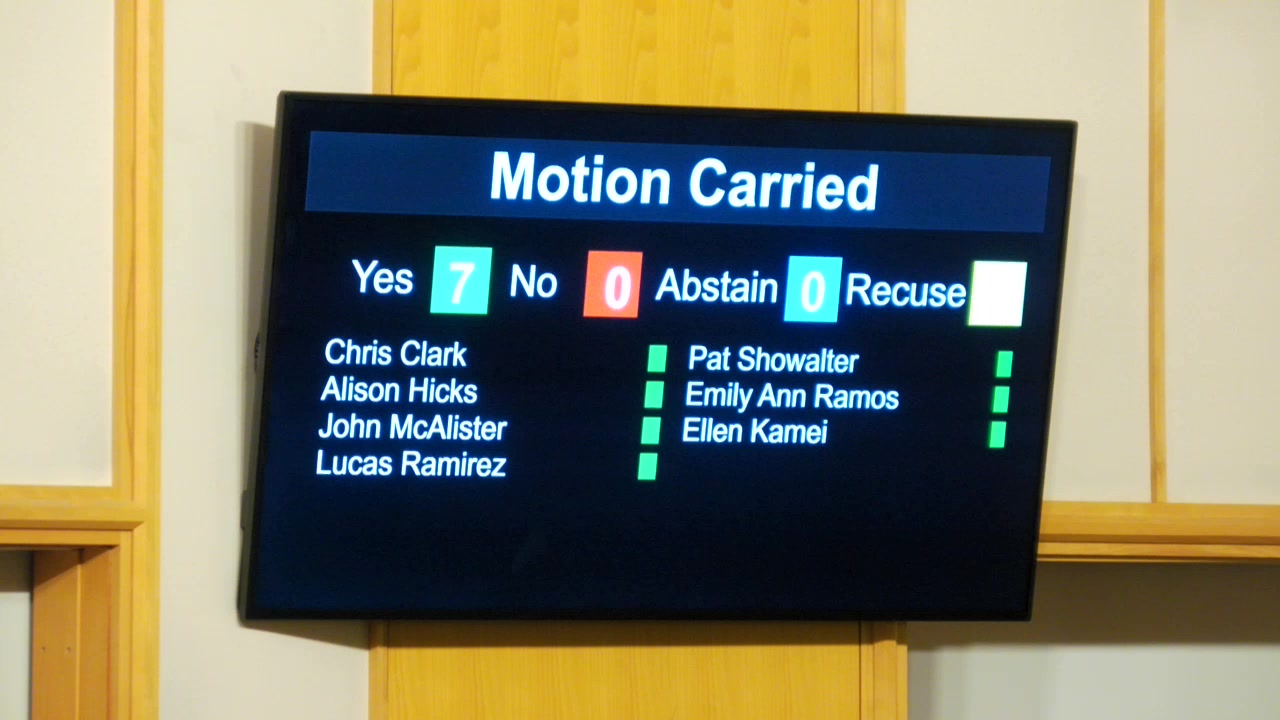
[00:48:21] Councilmember Ellen Kamei: All right, and that passes unanimously. So we'll go back to consent calendar item 4.7 and I'll turn it over to Councilmember Clark.
[00:48:25] Councilmember Chris Clark: Thank you. I just wanted to, I'm the chair of the Investments Review Committee. And I just wanted to, first of all, our investments are all doing quite well and we moved forward with the staff recommendation and some of the recommendations of the IRC committee members. Taking off my chair hat, I did want to just raise another recommendation in here that was made by the committee, but I wanted to make sure that the full council was aware of it and had a chance to chime in.
[00:48:43] Councilmember Chris Clark: One of the recommendations that was raised was in response to some community members who attended the meeting, and that was to essentially conduct additional research and consider adopting additional social responsibility concerns. Essentially, we already have some social responsibility language in there, and the proposal was to broaden that a little bit further. And the proposed language was quite broad, and I had some reservations about it, and I just wanted to make sure that my colleagues were aware of that discussion.
[00:49:01] Councilmember Chris Clark: And I've actually thought more about it and I've heard some additional concerns from community members, particularly our Jewish community members, about the additional restrictions that are being proposed. And so I had a chance to do a little bit more research and I think staff did as well and they can answer questions, but I think the additional restrictions that we were looking at studying are so broad that one, there's a concern about the breadth of those restrictions, but two, we also, despite the breadth, confirmed that none of our current investments would be covered by that so there wouldn't be any immediate changes even if we were to adopt that language.
[00:49:23] Councilmember Chris Clark: And then second, because of our requirements on bond ratings that we would invest in, it's highly unlikely that any of the companies or investment opportunities on those lists that were proposed by the community members would ever be something that we would invest in. So it's a very long way of saying in a year where we're potentially looking at revenue measures and staff is going to be tied up with a lot of that, plus everything that's gone on recently with world events, I just don't think this is the best use of staff's time because it won't really impact either our current investments or any of I think our near-term investments.
[00:49:43] Councilmember Chris Clark: So I think my preference would be just to adopt the staff recommendation, but without the study of the additional restrictions because I just don't think they're going to move the needle for us in the near term and I think staff's time would be better spent on the revenue measure and other things. So just to get us started, I'll go ahead and move item 4.7 just without the additional review by staff of the investment restrictions that were identified.
[00:50:03] Councilmember Ellen Kamei: Great. Thank you. Vice Mayor Ramos?
Item 4.7 (Public Comment)
[00:50:05] Councilmember Emily Ramos: Um, so largely, this was an item we did have some public comment in our investment review committee. We usually don't get public comment in our investment review committee, one because it's like in the morning and the subject matter is generally very dry, for lack of a better term. But we did have a number of residents reach out and they want our way of how we do our investments to be reflective of our values.
[00:50:29] Councilmember Emily Ramos: I know that Councilmember Clark is concerned about staff time, but we weren't asking, well they were kind of asking for it immediately, I don't think the people in the committee were asking for it immediately. We just wanted to open that conversation to see what it would look like to make sure that we don't invest in weapons companies or private prisons or mass surveillance technologies. This is something essentially the community was starting to ask for.
[00:50:44] Councilmember Emily Ramos: I don't believe it's, as long as we don't pressure staff to be very quick on it, to do it something in their own kind of time, I don't see why we wouldn't be responsive to a community ask like this. So, I'm not entirely sure, I think like a good number of us, not necessarily directed staff, but asked like what would it look like? What would, how much, we don't even know the scope. We just wanted staff to start looking at it.
[00:51:03] Councilmember Emily Ramos: And I totally understand that this may be a long process. When we first made our statement that we wouldn't invest in fossil fuel companies, it was a long process as well. We just wanted to get started on it. So I'm not entirely sure basically if Councilmember Clark's motion is just to kind of shut the door on it. I don't want us to shut the door on it. I don't mind if it takes a long time. I just want us to actually just be responsive to our community.
[00:51:18] Councilmember Ellen Kamei: Councilmember Ramirez.
[00:51:19] Councilmember Lucas Ramirez: Thank you Mayor. So for the council's benefit, the recommendation from the IRC was unanimous, all five of us. It feels weird to use this as an opportunity to shut down that dialogue, but it's also not a personal priority for me so I don't have a strong investment in the outcome of this vote. But because we do have the benefit of having the director of the finance and administrative services department here, it might be helpful to ask how much staff time do you anticipate moving forward. There's been it sounds like a little bit of staff time invested in this investigation. Do you feel like there's a significant amount of work or a trivial amount of work? How would you characterize the remaining work?
[00:51:42] Finance and Administrative Services Director Derek Rampone: Thank you for the question. Good evening Mayor Kamei, Vice Mayor Ramos and Councilmembers. Derek Rampone, your Finance and Administrative Services Director. We have taken a preliminary look. We've worked with our investment management firm, Chandler, to take a preliminary look. It will take some additional time. I don't have an estimate per se. I don't think it's a ton of time, but it will take a little time to work with them and come up with possible scenarios and recommendations.
[00:51:57] Finance and Administrative Services Director Derek Rampone: I will say that currently, based on the parameters that were spoken about at the IRC meeting, we hold zero investments in what was discussed currently. We already have, as was stated earlier, good governance, social governance that was put into the investment policy years ago. And we are governed not only by the city's investment policy but also the California government code. So we're pretty restricted on the investments that we can even take a look at. And so, but we're happy to take direction from the IRC.
[00:52:16] Councilmember Lucas Ramirez: Thank you very much. I appreciate that. I'm not going to make a motion but maybe what I'll suggest as an attempt at a compromise would be rather than just take it off the table entirely, that that work be suspended until after the conclusion of the work necessary for the revenue measure. So it's on the back burner, it's not we're killing it today, but rather once staff has completed the work needed for the revenue measure, then they can pick up the work whatever remains to complete that investigation. Thank you.
[00:52:32] Councilmember Ellen Kamei: Councilmember Hicks.
[00:52:33] Councilmember Alison Hicks: Yeah, that actually sounds good to me. I am not on the committee so I haven't done a deep dive into this subject, but I have to say when I've gone to sustainability conferences people have approached me and been very impressed with the fact that we don't invest in fossil fuels. I think these kind of measures are important to people.
[00:52:46] Councilmember Alison Hicks: And also just kind of randomly, I know people going to University of Colorado Boulder who, these are nieces of mine who phoned me and asked because I'm on the City Council here, how they would interact with their finance committee in Boulder to get a very similar set of parameters for their investments. And I told them how to look it up, and when they looked it up their city had already made that pledge. So I know it's possible. And it seems like since we now hold zero investments in this arena, it sounds possible here too. And it sounds like it would not ruffle too many feathers. But I would be behind suspending it until after the revenue measure.
[00:53:13] Councilmember Ellen Kamei: Thank you. Councilmember Clark, we'll go back to you.
[00:53:15] Councilmember Chris Clark: Just to provide a little bit more context and to be just a little bit more blunt than I was earlier. So we already have language adopted around fossil fuels and pretty standard I think progressive social, socially responsible investing. What was proposed, the community members who wrote to us and came to the meeting are I think from a particular activist community and I think if some of the other community members of our community had known that they were going to propose that they would have shown up in force.
[00:53:37] Councilmember Chris Clark: And so I think that if this moves forward, for example, adopting language that says investments are prohibited in subsidiaries that facilitate the violation of human rights, things that are that broad, you can probably guess the concerns that would be raised around some of those things. And I think there will be a lot of community discussion if we move forward with studying this particular breadth of socially responsible investing.
[00:53:54] Councilmember Chris Clark: So that's why I wanted to flag it. I did vote to move it forward in the committee, Councilmember Ramirez is correct. But I've heard from folks in the community since then that this is something that they feel quite strongly about. And it's just something that I wanted to make sure my colleagues were aware of. It's because I don't think it's going to affect any of our current or any near-term future investments, I don't think it is worth the time and the potential breadth of the community discussion that will occur to move this forward. And I think I would prefer not to just push it off, I would prefer to just not do this right now and we can always look at this in the future if for some reason there's a proposal for us to invest in companies that might trigger any of this. But I just don't foresee that happening. So just a little bit more context.
[00:54:26] Councilmember Ellen Kamei: Great. Thank you. I just had a question. Yes, thank you. So it sounded like that staff had already done a preliminary search and that none of the businesses that we associate ourselves with in Mountain View fall under this category. Do we need to take specific language like we did with fossil fuels since it's already not a practice? Is there something that council can do if it sounds like we're already doing it? So I'm trying to understand why staff would be investigating and putting staff time into something that the city is already practicing, which is not engaging with these types of companies. So I seconded Councilmember Clark's motion because I did research into this as well and it sounds like we do not do those practices. So perhaps staff can help illuminate for Council and the audience a little bit more. Thank you.
[00:55:00] Finance and Administrative Services Director Derek Rampone: The community had provided input that was rather broad. And we feel like there's no list, official list that our investment firm can compare to and go off of. So some of the recommendations or proposals that they were putting together is not feasible, while maybe a small section could be. But it's relatively new to this area I would say as having some restricted specific wording. So there is no index officially that we can follow. So the research was basically to come back with that information.
[00:55:19] Councilmember Ellen Kamei: City Manager McCarthy, thank you.
[00:55:21] City Manager Kimbra McCarthy: Thank you Mayor and to our finance director. So to be clear, the city does not have investments in the broad categories that were outlined by some of the folks that showed up at the committee meeting. And I think staff has struggled a little bit in trying to figure out what the broad categories would mean because we have a highly restrictive way that we can invest, and it's not just Mountain View, it's any local government agency governed by certain California rules and legal restrictions. And then we place our own restrictions that are even more conservative, I would say, on how we can invest.
[00:55:43] City Manager Kimbra McCarthy: So I think the struggle that we have or that we've talked about even with the firm that works with us is we would essentially be searching for what corporations might even fall under these categories, which we do not believe we have any investments of that nature or from any of those categories. So it's highly likely that staff would be coming back with kind of nothing to report, that there's nothing that we would find or have investing in now or in the future, especially because we have the social responsibility policy already in place with some broad caveats in the policy already.
[00:56:06] Councilmember Ellen Kamei: Right, and every item is governed by our budget equity lens, which I know the council adopted. So is this something that maybe staff would be able to tackle as part of, next year we'll be starting to talk about mid-year budget and the budgeting process and maybe this is something we can add to our budgeting brief or just letting people know, confirming what it sounds like we already know.
[00:56:19] City Manager Kimbra McCarthy: So I think that the best path forward might be to just have staff come back with a recommendation on the best time to discuss this. We don't normally incorporate our investments into the process, but we can certainly look at the best avenue for doing that and then bring that back to council.
[00:56:29] Councilmember Ellen Kamei: Okay, great. To the motion maker, would that be amenable to you?
[00:56:31] Councilmember Chris Clark: That would be fine. Whether it comes back to the full council or the investment review committee either way, whatever is easiest for everyone.
[00:56:36] Councilmember Ellen Kamei: Okay, well I can second that if it comes back. Perhaps since it became a discussion at full council it can come back to the full council. Councilmember McAlister.
[00:56:38] Councilmember John McAlister: Yeah, could they come back in a written memo instead of bringing it to a full presentation? Would that be helpful?
[00:56:44] City Manager Kimbra McCarthy: Absolutely, we can do that. Should that be the desire of council?
[00:56:45] Councilmember John McAlister: I mean, that would be a better use, maybe to Councilmember Clark's... it would just give us an idea before we start spending time on city staff, and I agree with Councilmember Clark that staff time is valuable and so unless we see a real outcome out of something, I'd rather see them spend their time on other issues.
[00:56:56] Councilmember Ellen Kamei: Councilmember Hicks.
[00:56:57] Councilmember Alison Hicks: So I just want a recap of what we will be voting on because it was to accept the report, take out the part, not do what Councilmember Ramirez said of visit it later, but now people are adding back in things to do later so I've become confused.
[00:57:05] Councilmember Ellen Kamei: Sure, I believe it's a revised motion. So the revised motion, I can turn to Councilmember Clark which I think is just to have staff return.
[00:57:12] Councilmember Chris Clark: It sounded to me and city manager can correct me if I'm wrong, it sounded to me like we're basically, we're approving, we're accepting the committee report which was the staff recommendation except what we're doing is we're not doing the additional study of investment restrictions today. But it sounds like staff, if and when there's any possibility that we might be looking at investing in a company that might fit some of these criteria that it sounds like the full council would get an update or a memo on that.
[00:57:38] City Manager Kimbra McCarthy: Yes, thank you Councilmember Clark and Mayor. So I think it would be if something were to ever surface or if our consultant or firm that we work with were to raise something for us to say hey this investment might be getting into you know whatever line of business that we would not want to align ourselves with, then at that point that would be something that we could bring to the investment review committee or let council know in an off agenda memo. But proactively right now there's nothing to proactively remove at this point. So it would be more if something were to come up.
[00:57:58] Councilmember Pat Showalter: Just as a reminder, could you send us out sometime in the next few weeks, I know you're busy, but what the social responsibility policy is? Not serving on the finance committee, I just know sort of generally about it. I'd love to actually read the text.
[00:58:09] City Manager Kimbra McCarthy: Sure.
[00:58:10] Councilmember Ellen Kamei: Great. Thank you. Councilmember Hicks.
[00:58:12] Councilmember Alison Hicks: Yeah, so I think I'm going to abstain or vote no just because I'm not clear on what our current statement is. It sounds like possibly we could just use our current statement because members of the public are concerned if we're not. So I would prefer to look in it a little more the way Councilmember Ramirez said. But maybe this will get the votes.
[00:58:24] Councilmember Ellen Kamei: Okay. No one else is in the queue so we can call the question and then we can have more discussion. Okay. Sure, so my understanding of the motion is approving the staff recommendation. Let me read. So the recommendation for the staff report says accept the annual report of the investment review committee for fiscal year 2024-2025 as well as attachment one to the council report. But I think there was a specific call out in the recommendation about looking into, I'm trying to find the language. Does staff have the language or Councilmember Clark?
[00:58:48] Councilmember Chris Clark: I think what we're voting on tonight is to accept the report and then there was separate direction to staff that if there's ever a change in the environment to where some of these broader criteria might end up applying to some of our future investments, which I think is unlikely but if they were that we would proactively be, either both the investment review committee and maybe the full council would be made aware of that just so we can look into it at that time.
[00:59:04] Councilmember Ellen Kamei: Yes, that was why the item was pulled, to change the motion. And I think what's also included in that is sharing internally and externally our social responsibility guiding principles. All right so let's see, we can vote.
Item 4.7 (Oral Communications)
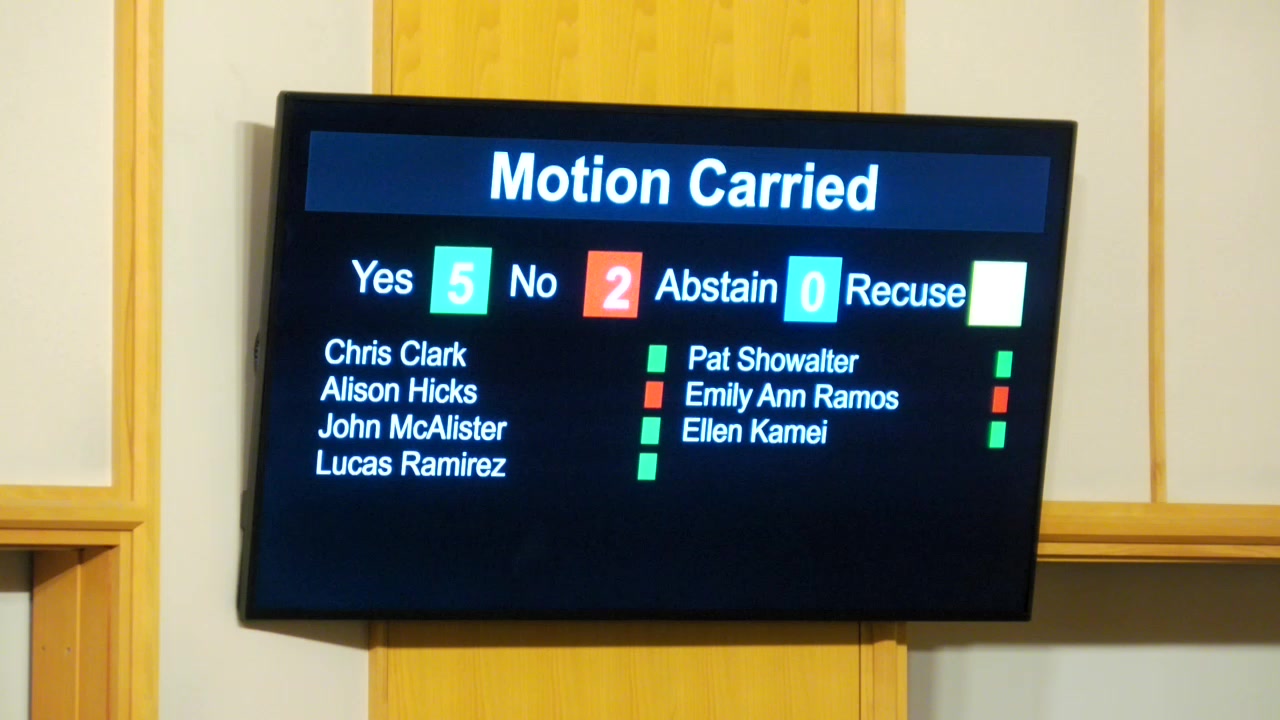
[00:59:14] Councilmember Ellen Kamei: All right and that passes 5-2. So we will move on to oral communications. Oral communications, this portion of the meeting is reserved for persons wishing to address the council on any matter not on the agenda. Speakers are allowed to speak on any topic within the city council's subject matter jurisdiction for up to three minutes during the section. State law prohibits the council from acting on non-agenda items. If you'd like to speak on this item or the next item, please submit a blue speaker card to the city clerk now. Would any member of the public joining us virtually or in person like to provide comment on this item? If so, please click the raise hand button in Zoom or submit the blue speaker card to the city clerk now. We'll take in-person speakers first and each speaker will have three minutes. Steven Goldstein.
[00:59:41] Stephen Goldstein: Thank you for your time. I really appreciate it. I went through two years of homelessness due to the fact that a city employee made a comment in court saying that he could not find anything that would render my apartment unsafe. However, it turns out that the building I was living in had no building diagrams in the city record. No initial building code permit for building it. It was non-conforming at 184 Center Street as an R31 zone when the building was an R4 type building. And at the same time I could easily document severe cracking in the foundation, severe cracking in the elevated walkway and even sinking in my floor.
[01:00:06] Stephen Goldstein: And what happened, a city employee went to the court and testified upon visual observation he could find no observable uninhabitable problems. However, that is not what the law allows. A letter also said that the city was assuming that it was in compliance regarding the building code at the time it was built. Turns out the building drawings were burned in a fire in 1958 and yet the building was built in 1960. And yet there has never been any action taken to rectify the fact that the building records were incomplete in the city, thus violating the State Health and Safety Code 19850, which says that the city must have the records in order to have some kind of proper operation of the rental property.
[01:00:37] Stephen Goldstein: Finally, at the same time, the state clearly states that no government agency can assume safety without evidence. And what I understand is that the city has done everything it took to prevent any inspection of the property. Again, I wound up being homeless because of these actions. And I'm not giving up. I'm saying that the city should have had this corrected. The state law says that the city should be demanding that property owners be providing these records to the city before anything can be approved, including importantly a certificate of occupancy. Without these records being in place, a certificate of occupancy under those circumstances would be not valid. And I think at this point in time what's going to happen is I'm now in contact with the State Housing Department to arrange a audit of the city's practices. And if the city is found to have a significant amount of records missing in the housing department, that could render a lot of problems for the city. I suggest the city does something to correct it. Thank you.
Item 4.7 (Public Comment)
[01:01:14] Councilmember Ellen Kamei: All right. Any other public comment in person on item five? Okay not seeing any we'll go virtual. Bruce England.
[01:01:19] Bruce England: Thanks Mayor. Good evening everybody, council members, members of the public attending. I'll be short. I just want to, I figure we're getting close to the end of the year and I want to bring up the Community for All policies of the city and praise the city and members of the community and all stakeholders who are upholding those goals and those positions regarding Community for All. Now it's very focused on our own city, but you know our country and our world is built of a collection of communities and we're one of them. And if other communities also have their equivalent of Community for All policies then we're in a good position. So I think that altogether what this means is that we're not divisive in what we do, that we care about all people and that we don't try to put wedges in between one group of people versus another. Mountain View represents diversity and care for all members of the community, obviously including people who don't even have homes to live in. We try to take care of everybody. And so once again I want to just praise the city and I want to praise everybody who works on this and holds these values to be as important as I think they are. And I hope that they will continue forward as they are. Thank you.
[01:01:57] Councilmember Ellen Kamei: Thank you. Hala Alshahwani.
[01:02:00] Hala Alshahwani: Yes, good evening. Thank you Mayor, good evening council members and city staff. My name is Hala Alshahwani. I'm an old resident, old residing member of the community in Mountain View. Just wanted to comment on last week's council meeting. Last Tuesday December 9th there was an outpouring of public concerns and grave fears regarding having their properties designated as historic buildings. And I believe this is justified. In all the city's outreach community meetings on downtown historic preservations that I have attended, there was very little information if any regarding the benefits and the responsibilities of owning historical buildings.
[01:02:26] Hala Alshahwani: There was no mention of tax benefits, subsidies for repairs or replacements, the ability to modify, to update historic buildings. None of this was covered generally or thoroughly. This information is vital for the public as well as the policy makers to know and understand so that everyone can make informed decisions. The city should also state the benefits of retaining our historic downtown to the economic vitality programs and the significant tax revenue that it generates. Fiscal impacts and otherwise are important to mention. Moving forward I hope that the city staff and or the hired consultants can provide a full disclosure of what is entailed in owning a historic residential or commercial buildings in Mountain View. Thank you so much.
[01:02:51] Councilmember Ellen Kamei: Thank you. Sophie Yeh.
[01:02:55] Sophie Yeh: Hi there. My name is Sophie and speaking to the council, thanks so much for hearing me. I just like to voice support for what was discussed earlier around the investment report. I think I concur with what Bruce was saying earlier. I think as a community Mountain View really thrives based on diversity and you know moving towards treating everyone as a human and ensuring the rights that people have and I feel like as a city we have the ability to make a powerful stand and the fact that we already do not support investments such as those in weapons, private prisons and mass surveillance should be seen as a good sign and we can continue to move forward with that going in the future. Thank you.
Item 6
[01:03:24] Councilmember Ellen Kamei: All right, that concludes public comment and we'll move on to item 6 which is our public hearing. Item 6.1 is our Housing Element Program 1.1G Zoning Precise Plan and General Plan Amendments. Principal Planner Diana Pancholi and Community Development Director Christian Murdock will present the item. If you'd like to speak on this item, please submit a blue speaker card to the City Clerk now.
[01:03:43] Principal Planner Diana Pancholi: Good evening Mayor and Councilmembers. My name is Diana Pancholi, Principal Planner with the City's Planning Division and I'm joined here tonight by Community Development Director Christian Murdock. At tonight's meeting staff is presenting the proposed amendments to implement Program 1.1G of the Housing Element.
[01:03:57] Principal Planner Diana Pancholi: Program 1.1G aims to ensure consistency with zoning and general plan for all sites in the Housing Element site inventory and identified housing opportunity sites. The Housing Element rezoning sites and densities are shown here. As a reminder, the Moffett Boulevard zoning changes will be completed separately through the Moffett Boulevard precise plan process. And just as a reminder, the program has a Housing Element deadline of December 31st of this year.
[01:04:11] Principal Planner Diana Pancholi: A little bit of the background on this, on the Housing Element itself. The sixth cycle of Housing Element developed between 2021 and 2023 included several outreach activities to create programs to meet the city's RHNA requirements and for further the housing production. Two key policy considerations from community input were equitable distribution of housing sites across the entire city and the viability of sites based upon quality, age, size, and use of the buildings as well as the property owner interest. Other Housing Element programs such as Program 1.4 and 2.6 also address other sites with viable development in the city's highest opportunity neighborhoods.
[01:04:35] Principal Planner Diana Pancholi: At previous meetings, the Environmental Planning Commission and the City Council reviewed the proposed amendments and approaches presented here tonight. City Council expressed support for a General Plan Mixed-Use Village Center land use approach for the sites as shown in blue on the map here to help preserve locally serving businesses. The City Council also supported a flexible precise plan approach for the remainder of the sites as shown in orange which would allow site specific code requirements to allow the densities and the character appropriate for the area.
Item 6 (Public Hearing)
[01:04:54] Principal Planner Diana Pancholi: On November 6th earlier this year, the EPC held a public hearing to discuss the proposed amendments. At the meeting the EPC recommended council approve the General Plan and zoning amendments at the Miramonte and Cuesta sites with a 6-0 vote and one recusal, and the remainder amendments were unanimously recommended for approval with a 7-0 vote.
[01:05:06] Principal Planner Diana Pancholi: As described in the staff report, some of the proposed amendments introduce the General Plan Mixed-Use Village Center land use in existing regulations to achieve the Housing Element program. The General Plan Mixed-Use Village Center land use is a set of existing mixed-use development policies that preserve the existing commercial zoning but allow opportunities for multi-family housing. The locations for these developments are determined by the General Plan through mixed-use designations. However, the zoning district remains commercial and the General Plan Mixed-Use Village Center developments are the only residential use allowed in these commercial zones. The development standards for this approach utilizes existing mechanisms to preserve existing commercial businesses
[01:30:00] Principal Planner Diana Pancholi: ...to create a new mixed-use district. This does not change the underlying zoning, avoids non-conformances for existing developments, and creates a pathway for residential development consistent with the General Plan's Village Center policies.
[01:30:09] Principal Planner Diana Pancholi: So in summary the table here presents the proposed General Plan map and text amendments to allow the residential uses as described... at densities prescribed by the Housing Element. The cells shown in blue are amendments intended to facilitate the General Plan Mixed-Use Village Center land use, and the orange cells reflect the remainder sites. Details of the amendments are further discussed in the staff report.
[01:30:22] Principal Planner Diana Pancholi: One key difference is the 1949 Grant Road amendments, which proposes densities to allow 35 dwelling units per acre, which is slightly greater than the 30 dwelling unit per acre allowances of the Housing Element. And similar to the General Plan amendments, listed here are the proposed Zoning and Precise Plan amendments to make the sites consistent with the Housing Element and to allow residential uses and development standards to allow existing office businesses to return to these sites if redeveloped.
[01:30:58] Principal Planner Diana Pancholi: Other minor code amendments are proposed to update outdated code references in the Precise Plans for consistency with the City Code and the State Law, and zoning amendments to clarify Avigation Easement requirements which relates to restrictions on the use of property and incidental effects such as noise, and the height restrictions on any new structures.
[01:31:09] Principal Planner Diana Pancholi: Based on the previous Council directions, staff reviewed existing resources to help small businesses return to sites if redeveloped as listed here on the slide. Additionally, the Economic Vitality Strategy also includes an action item for tools such as rent caps and commercial rent subsidies to help bridge market gaps, however further work is needed to identify a stable funding source to ensure success of this program.
[01:31:42] Assistant Public Works Director Ed Arango: Good evening Mayor, Councilmembers. Ed Arango, Assistant Public Works Director. As Principal Planner Pancholi noted, the City received public feedback regarding the intersection at Miramonte and Cuesta. Continuing on this topic, I'll briefly be going over the existing conditions and concerns we heard, near-term solutions staff is reviewing and long-term strategies that could look at this in more detail.
[01:31:43] Principal Planner Diana Pancholi: Specifically around Evandale Precise Plan Area A, staff studied several zoning options to retain small businesses. There are limited land use zoning tools as restrictions on the residential development conflicts with the Housing Element goals to create more housing opportunities or may be difficult to implement under the current State Law.
[01:31:55] Principal Planner Diana Pancholi: As part of the environmental assessment for the project, staff reviewed the proposed amendments to understand if there were new significant environmental effects or a substantial increase in the severity of the impacts, and found that the project was already analyzed as part of the City's Housing Element Update Program Environmental Impact Report adopted in 2023. Therefore, no additional environmental analysis is needed under California Environmental Quality Act.
[01:31:57] Assistant Public Works Director Ed Arango: In this view, Miramonte is running north-south and Cuesta is running east-west. Along Cuesta through this intersection, there is an offset, and Sladky, a T-intersection, is in very close proximity to the Cuesta intersection.
[01:32:06] Assistant Public Works Director Ed Arango: Some concerns that we heard include the movement along the northbound Miramonte turning left onto Sladky movement. As vehicles are waiting to turn... I'm sorry, can you go back? As vehicles are waiting to turn, this can cause a queue backup. This can be further exacerbated for those vehicles turning onto northbound Miramonte from Cuesta. Additionally, exiting Sladky, vehicles turning left onto northbound Miramonte have to negotiate southbound vehicles coming down Miramonte and the previously mentioned movements from northbound Miramonte vehicles. Lastly, there are some parking concerns about businesses... parking spilling into the neighborhood.
Item 6 (Public Comment)
[01:32:29] Principal Planner Diana Pancholi: Staff would like to note that we received several written public comments prior to this meeting. A few supported the proposed amendments and several voiced concerns related to the proposed amendments for the 1702 Miramonte site and the impact of high density residential developments on single-family residential character of the neighborhood. Now I will pass it on to my Public Works colleague for the next slides.
[01:32:30] Assistant Public Works Director Ed Arango: So staff is currently looking at some near-term solutions from the comments that we received. Some preliminary options we've discussed is the possibility of restricting the left turns into and/or out of Sladky at Miramonte. This would help address the concerns previously mentioned, and if pursued would require to conduct public engagement with the neighborhood.
[01:32:43] Assistant Public Works Director Ed Arango: The Miramonte paving project which is... limits are from Cuesta to Castro, will be starting construction in March. If the turning restrictions at Sladky are pursued... going through the public engagement process, the modifications could be incorporated into the project, but could also be incorporated independently.
[01:32:53] Assistant Public Works Director Ed Arango: For the traffic signal at Cuesta and Miramonte, staff will be observing the signal timing and seeing if there's adjustments needed during specific times of day that may help with operations. And then lastly, staff is always available for public requests and the public can request... reach out to staff, Public Works specifically, via Ask Mountain View, calling Public Works directly, or sending us a message, requesting evaluation of any specific locations or request for red curbs including concerns about sight visibility.
[01:33:09] Assistant Public Works Director Ed Arango: So moving on to the long-term strategy, in January of 2026 Council will be reviewing considering the Miramonte Corridor Study. The study presents potential multimodal improvements along the entire corridor. As part of the Capital Improvement Program process, staff can review establishing a project to do a deeper dive and study these two intersections more closely. We do recommend this be done in the context of the CIP process to provide the information regarding other projects that may be proposed in workload. But a new study could be a future project that would review the configuration and identify if there's anything feasible to improve the operations. I'm going to be handing it back to Principal Pancholi to conclude the presentation.
[01:33:34] Principal Planner Diana Pancholi: So in conclusion, staff recommends the City Council to approve the proposed amendments, to implement the Housing Element Program 1.1G goals and increase the housing opportunity in the sites. Please note that Assistant Community Development Director Blazenski and Project Manager Krisha Penolar are also present here tonight if Council has any questions, along with our environmental consultant as well. Thank you.
[01:33:47] Councilmember Ellen Kamei: Great, thank you. And just for the public, apologies we didn't say from the front, so staff's going to do their presentation, Council will ask questions, and then it will be everyone's turn to provide public comment to Council. So we'll go to Council questions. Councilmember Ramirez.
Item 6 (Public Hearing)
[01:33:57] Councilmember Lucas Ramirez: Thank you Mayor, and thank you staff for responding to the numerous questions that were submitted in advance of the meeting. The first question under this item, question 29, reveals that 1702 Miramonte and 777 Cuesta Drive are subject to Senate Bill 6 and Assembly Bill 2011, which allow housing at 30 units per acre ministerially, right? So it wouldn't even have to go to a City Council public hearing for a vote and approval, is that correct?
[01:34:19] Community Development Director Christian Murdock: Good evening Mayor, Vice Mayor, City Council. Christian Murdock, Community Development Director. In part the answer is yes. AB 2011 creates a ministerial approval process for qualifying commercial sites based on adjacent roadway width. The site would qualify both under AB 2011 and SB 6. SB 6, just to distinguish, does not create a ministerial approval process, but does create a pathway to submit an application to approve commercial development through the normal discretionary review process.
[01:34:32] Councilmember Ellen Kamei: And apologies, I just... for those that may be attending our meeting that don't know what AB and SB means, maybe we can just say that those are some state laws, Senate Bill and Assembly Bill, and just add some color and some background. I think that was just signed. So I just want to make sure that we're allowing the public to understand that State Law has been enacted and signed by our Governor. I'll turn it back to you, Director Murdock. Thank you.
[01:34:44] Community Development Director Christian Murdock: Thank you Mayor. Yes, for those that don't work in this space every day, these are state laws that are part of a series of laws that the legislature has enacted in recent years to expand housing development opportunities. These two laws, Senate Bill 6 and Assembly Bill 2011, passed by the legislature and signed by the Governor maybe two or three years ago at this point, expand housing development opportunities in commercially zoned areas by overriding local zoning in areas that may be commercial only, to allow residential development if certain physical characteristics and other use components are present on a site. Notably the width of the roadway adjacent to the site in question. And so these two sites that are identified for action tonight have... or exceed the minimum roadway widths to be subject to these laws.
[01:35:09] Councilmember Lucas Ramirez: Thank you Mayor. And thank you Director for walking us through. So two separate pathways under State Law today that override local control, allowing for housing at a minimum of 30 units per acre on each of these sites. And the 30 units per acre is also the density that is proposed in the staff recommendation, right? So it's the same.
[01:35:22] Community Development Director Christian Murdock: That's correct.
[01:35:22] Councilmember Lucas Ramirez: And then on top of that, projects that use the two state pathways, Assembly Bill 2011 and Senate Bill 6, whichever way you choose to go, also can use the State Density Bonus Law on top of that. Is that accurate?
[01:35:31] Community Development Director Christian Murdock: That's correct.
[01:35:32] Councilmember Lucas Ramirez: Including the use of waivers from development standards and concessions as well.
[01:35:35] Community Development Director Christian Murdock: Correct.
[01:35:35] Councilmember Lucas Ramirez: Okay. That's helpful for us to understand. So even if the Council decided to take no action or we were to deny the staff recommendation, housing would still be allowed under State Law pursuant to Assembly Bill 2011 and Senate Bill 6.
[01:35:46] Community Development Director Christian Murdock: Correct.
[01:35:46] Councilmember Lucas Ramirez: Okay. That was something that was, for the benefit of the public, new to the Council. I think all of us just in seeing the responses to the questions today learned about that. So that's something I think the Council may want to sort of talk through and understand. Are there certain advantages to having... so we have a commitment under the Housing Element program to conduct the rezonings. The responses to other Council questions disclose some amount of risk in not following through. And I won't delve too deeply into that, but maybe another way of looking at that could be, are there certain advantages, even if we already have to allow housing at these sites, are there certain advantages to having local development standards governing those properties?
[01:36:20] Community Development Director Christian Murdock: So I think in general, yes, there's a benefit to having local standards. It can communicate to a developer the types of development that the City wants to see as opposed to development that the State mandates to occur. And some developers are sensitive to that and try their best to design projects to be locally acceptable and to integrate better into the community. And so to the extent that the City could adopt local regulations that achieve those outcomes, it is advantageous to have local standards in most cases.
[01:36:35] Councilmember Lucas Ramirez: Thank you. And my last question will be, can staff sort of walk through, from your perspective, maybe a couple of examples in the staff recommendations for proposed development standards where you might work with a developer to communicate certain expectations?
[01:36:47] Community Development Director Christian Murdock: Sure. We'll need a moment to pull up those standards that are proposed for this site. Yeah, thank you Mayor.
[01:37:12] Principal Planner Diana Pancholi: So without taking too much time, I think the proposed amendments that we have presented in here have looked at certain specifics such as the setback requirements, or where the setbacks are measured from, or the allowed height, or the amount of FAR that is allowed on a site which can then result into the desired densities to align with the Housing Element. That would be some of the examples of the standards that are being proposed in order to bring the sites in compliance to allow a development that can come in and produce the amount of densities that are prescribed in the Housing Element.
[01:37:34] Councilmember Lucas Ramirez: Thank you.
[01:37:35] Councilmember Ellen Kamei: Councilmember Showalter.
[01:37:37] Councilmember Pat Showalter: Thank you. Okay. I'd like to just hear from Mr. Arango. Hi. Nice to see you again. I'm interested in this Miramonte traffic study. You mentioned it and discussed it starting in 2026. And so I'm kind of interested in hearing a little more about what the components of it are and also the duration. Because as you know, we're doing a big project on... Miramonte, a big repaving project and of course we want to include any improvements in it. So can you just describe the traffic study and what it's made up of and how long it takes?
[01:38:02] Assistant Public Works Director Ed Arango: Sure, absolutely. Again, Ed Arango, Assistant Public Works Director. So we had sort of a two-prong approach that we were looking to do here. The first is sort of this near-term elements that the staff can do at staff level with the resources we have, evaluate what the implications would be and what it would look like. Again, this is... we just recently started these discussions, so we need an opportunity to evaluate the feasibility of this. Is closing the access from... left turn movements coming out of Sladky going onto northbound Miramonte, and then coming into Sladky from northbound Miramonte. And so we see this as an opportunity to address some of the concerns with the congestion in that specific area. These two intersections are very close together and traffic can back up into the intersection as soon as other movements start being introduced.
[01:38:27] Assistant Public Works Director Ed Arango: So this is something that we can introduce with our staff in early 2026 to start evaluating what that looks like, see if it's feasible, and then we, again, we would have to do public engagement with this. It would impact circulation through the neighborhood, so we want to be sure that we're giving the opportunity for the neighbors to be able to weigh in and give us some feedback. But if supported, we could move forward with that with the Miramonte project and do modifications with that, but the implementation isn't all that difficult and we can do this independently. So the modifications for Miramonte Drive, they really are kind of matching up the existing conditions at the Cuesta intersection because that's sort of the beginning of the project or end of the project. So we need to match those existing improvements that are coming into that intersection. So effectively it's going to look pretty much the same at that location as it does today because it really does have two lanes that are going in each direction coming from the south.
[01:38:59] Assistant Public Works Director Ed Arango: So that's sort of the first approach. Again, we're going to look at the traffic signal timing as well to see if that can be adjusted at the Cuesta/Miramonte intersection. But the actual traffic study, we would need consultant support help for this part. And that's where we're proposing to... if Council directed us, we could include that as a proposed project in the next Capital Improvement Program review cycle. Come back to Council to evaluate what that would look like for workload, and whether that would be a 26/27 project or a future project depending on the other priorities that we have on the projects in the Capital Improvement Program.
[01:39:17] Councilmember Pat Showalter: Okay so essentially there's sort of a short-term version and a long-term version, and the short-term version could definitely be incorporated into the repaving project, and the long-term version we don't know what it would say we needed to do so you can't answer that. Did I get that?
[01:39:25] Assistant Public Works Director Ed Arango: That's correct, yes.
[01:39:25] Councilmember Pat Showalter: Okay, got it. All right. So then in addition to that... I used to take these turns very very frequently when I had children... but that was a while ago, young children driving around. And there used to be a sign there that limited the times you could turn left out of Sladky. Is that still there? I see nodding heads. Okay. That was a very odd sign, it was sort of small. You had to take some time to read it. I'm sure the people who live in the neighborhood go by it hundreds of times, they know it by heart, but for people who were just driving there occasionally you would kind of see it and go 'What?'.
[01:39:46] Councilmember Pat Showalter: Anyway, we've been putting in a lot of pedestrian sort of temporary signals. You know, they don't function when nobody's walking there, but when they do function, there's all these lights and stuff. Is there any... Do we ever put in a stop light that only works for like three hours a day? Or something along those lines?
[01:40:02] Assistant Public Works Director Ed Arango: So I'm going to try to start off this response and then actually I have Lorenzo Lopez, the City's Traffic Engineer, he's on Zoom and is available to answer responses questions, but let me start off and see if he has anything to add to this response. We do implement traffic signal equipment as you mentioned that really is... it's not necessarily times of day as much as it is sort of pedestrian actuated, so on demand. So recently Caltrans installed the pedestrian hybrid beacons on El Camino Real. These is an example of an on-demand traffic signal where it's really free flowing traffic on El Camino until somebody decides that they want to cross the street. So they push the button and then that notifies traffic that there's somebody here wanting to cross, and then it turns red. And that is a true traffic signal stop. So the traffic has to abide by that red light and that allows the pedestrian to cross. So it's sort of on demand. And then it turns off once we have the timing to allow enough travel time for the pedestrian to get across the street.
[01:40:34] Assistant Public Works Director Ed Arango: So that's one element that we're introducing. We're doing this at the Grant/Sleeper intersection as well. It's currently under construction but a current example is the El Camino site. We also implement pedestrian... we call them rapid flashing beacons. So this is also on demand. These are smaller poles that flash at the vehicles when a pedestrian pushes a button, indicating that there's a pedestrian wanting to cross. Creates more visibility and attention to the crosswalk and the intersection that we've identified so that vehicles are aware that somebody wants to cross here, 'I better slow down and stop so that to allow them to cross' rather than not having it. So we're selective on where we put these, usually in the high volume areas really provide good...
[01:40:56] Councilmember Pat Showalter: And they are all pedestrian oriented?
[01:40:57] Assistant Public Works Director Ed Arango: They're all pedestrian on demand by pedestrians. So pedestrian pushes a button or if a bicyclist... and then they cross. But again it's not necessarily times of day as it is by the user. So... and then I want to offer an opportunity for the Traffic Engineer Lorenzo Lopez to provide any additional input unless... if he can be promoted.
[01:41:09] Lorenzo Lopez: Hi everyone. Lorenzo Lopez, City Traffic Engineer. Ed summed it up pretty well. Those signals that you are mentioning that are not on all the time is a pedestrian hybrid beacon, and those have the actual red lights that serve like a traditional traffic signal. Those are along El Camino right now. We don't have any on City streets yet, but as he mentioned Grant/Sleeper is the first one. We do have others that are proposed in the future at other locations on City streets. And again, as he stated, those are all pedestrian or bicycle activated, so not vehicle activated.
[01:41:35] Councilmember Pat Showalter: Thank you, that's very informative. All right. So I have a couple more questions. This one is more about what can we do to preserve small businesses or, you know, or the dental offices. Clearly everybody needs a dentist, right? We need... it's one of the land uses we need in our community. And these are, you know, these buildings have been there a long time so there might be differences of opinion about whether they should be redeveloped or not, but we do need that land use for sure. And you mentioned that there wasn't much in land use law that we could do to protect those small businesses, but what else could we do? I mean we've had some situations where for instance at the corner of El Camino and Castro Street where we preserved the Rose Market and the coffee shop. So I just wondered if there are things that can be included or are they included in our zoning to support businesses or other programs.
[01:42:17] Community Development Director Christian Murdock: Thank you for the question. I'll start first with talking about sort of what the tools are at the legislative action level that we're talking about, and maybe how that's distinguished from a project level action, right, of the example as you noted. And then ask Principal Planner Pancholi to just talk about the care and the thought that went into selecting the zoning tools to ensure there are ongoing commercial operation opportunities with these rezonings, so sites don't end up as non-conforming commercial uses that could restrict ongoing operation.
[01:42:34] Community Development Director Christian Murdock: So to start, it's challenging from a legislative zoning and general plan policy level, in light of State Law, to achieve the kinds of small business preservation outcomes that you're describing. Typically that would require discouraging other uses such as residential that might have different economics that lead to development of those uses, in a way to protect the desired use, right, in this case the small business commercial opportunities. Because of State Law and the responsibilities the City has in the Housing Element, we're not able to discourage residential uses in this case to preserve commercial uses. And so I think the sort of balance of the tools that are available is challenging in that regard.
[01:42:56] Community Development Director Christian Murdock: Where the City may have additional opportunity to work with an applicant is on a specific project, which is not the stage we're at tonight. Tonight is a zoning and general plan action. In the future there would be a project action where there's an actual developer with a project, impacts that are known and a timeline, where the City has the opportunity to encourage the applicant to work with those businesses to minimize the impacts in that specific project level situation. And so, you know, the lack of additional tools tonight doesn't mean that further opportunities are foreclosed in the future to continue to work towards that business preservation.
[01:43:15] Councilmember Pat Showalter: Okay. And then my final question is just to ask you to remind us how long the Blossom Valley Center across the street from there, where the Safeway is, has been zoned Village Center.
[01:43:25] Principal Planner Diana Pancholi: Um... can we get back to you on that in... during this meeting?
[01:43:27] Councilmember Pat Showalter: Yeah, but I guess the point I want to... Yes, I would like you to get back to me. Thanks.
[01:43:30] Principal Planner Diana Pancholi: And just adding to the other part of the question is, you know, there is the numbers game and then there is where are you going to put those numbers. These were... these are the two things that we are constantly trying to bring a balance to when we are trying to get a Housing Element. And so the specific rezonings where we have selected General Plan Mixed-Use Village Center land use is, we looked at a lot of different ways to rezone this, but this one would allow residential while also keep allowing commercial. That was one of the zoning tools that we used. And then there are some minor modifications that we are proposing to our existing code where you cannot convert the existing ground floor commercial into an ADU and lose that commercial space. That is another example of the specific things we considered.
[01:43:50] Councilmember Pat Showalter: Thank you. That's all my questions for now.
[01:43:51] Councilmember Ellen Kamei: Great, thanks. And we'll let staff will let us know when they've found that as we go through the questions. Councilmember Hicks.
[01:43:55] Councilmember Alison Hicks: Thankfully many of my questions have already been asked on the importance of small businesses, and then the one Councilmember Ramirez asked on the state bills that kind of conflict with things we may try to do here. So I think my remaining questions are regarding the site at 1702 Miramonte that there's been some concern about. I guess my question is going to be around some of the kind of conflicting or overlapping legislation that could affect that site. So one is my understanding, and please confirm or not, that if we were to remove it from our Housing Element, there is a buffer, so it would be possible to remove it. Is that true? Buffer of... in terms for the public, in terms of meeting our required number of units in that particular area for our Housing Element requirements.
[01:44:29] Community Development Director Christian Murdock: Right. I'd say that there are a number of considerations the Council should keep in mind when thinking about removing this as it relates to the buffer consideration specifically. I think we would be okay in terms of our Housing Element capacity and buffer in the event that the Miramonte site was removed.
[01:44:39] Councilmember Alison Hicks: Okay. But... so we would be okay, but there is already, as Councilmember Ramirez went over, there is State Legislation that says even if we removed it... this would be what, Assembly Bill 2011 and Senate Bill 6... the housing development would still be allowed without Council review... anyway... so we'd remove it but in some ways it would still be there. Not in the Housing Element but available for the same type of development.
[01:44:56] Community Development Director Christian Murdock: That's correct. And in one instance potentially a ministerial approval that does not even come to the City Council, it would just go through a staff level review. And perhaps under Senate Bill 6 some sort of city review process that might go to a public hearing. But in both cases requiring the City to allow residential development.
[01:45:05] Councilmember Alison Hicks: And do those allow you to retain or preserve the existing businesses? Or they don't... it's something that you would have to work on but they...
[01:45:11] Community Development Director Christian Murdock: We would need to double check both laws to see if there's a required commercial component in either case. I think our initial sense is that there's not. And so the City may have fewer options to impose those other sensitive qualitative components about commercial use ongoing.
[01:45:20] Councilmember Alison Hicks: And then also, would there be... if we were to remove it, would there be additional work for City staff such as additional CEQA review?
Item 6 (Public Comment)
[01:45:27] Community Development Director Christian Murdock: So the simple answer is yes, there would be additional work for staff if Council opted not to complete the actions as recommended by staff tonight. We think that ultimately the City would need to amend its Housing Element, which is a pretty substantial effort that's not currently planned for in our work planning and staff resourcing. You know the Council may remember the initial Housing Element process and how involved it is. Much of that is required to amend the Housing Element as well. Engaging with the state, preparing public review drafts, responding to public comments, conducting environmental review and obtaining state certification. We estimate it would take the better part of a year or more to conclude that process. You know an option short of that is to not complete the action tonight if the Council is interested in doing that so that additional study could be done related to the traffic concerns and the scope of improvements that could be made are better understood. But in either case there are risks to the City from not completing the action tonight, given the Housing Element deadline that's in the Housing Element for this program.
[01:46:00] Councilmember Alison Hicks: So let me see if I understand. We could potentially remove those properties, not be in a better place legally because the other laws would allow the same type of development, but give staff a lot of extra work.
[01:46:07] Community Development Director Christian Murdock: Correct.
[01:46:07] Councilmember Alison Hicks: Is there any advantage to doing that? To removing them? It seems like when... the series of questions I've asked we come up with a lot of disadvantages. Are there any... do we get in any better place in any way?
[01:46:14] Community Development Director Christian Murdock: I can't think of any advantage to the City relative to trying to shape the outcomes of future residential development at the site by removing these from the Housing Element.
[01:46:19] Councilmember Alison Hicks: Okay. There's an answer. I'm finished with my questions.
[01:46:22] Councilmember Ellen Kamei: Okay, we're going to get to public comment pretty shortly. I apologize I know it's been two hours since our meeting started. Thank you very much. This is our public meeting process and Council will have an opportunity to finish their questions and then I promise we will get to public comment. Thank you everyone. Vice Mayor Ramos.
[01:46:32] Councilmember Emily Ramos: Thank you Mayor. Can I see the slide about the traffic improvements again? I have some clarifying questions relating to that. More of the action, so I think it's the slide after this. There we go. So out of all these items, do any of these require any Council action today to move it forward?
[01:46:54] Assistant Public Works Director Ed Arango: No, none of them require any Council action. This is all elements that staff can do at staff level, and we will begin as I mentioned the evaluation of that first point on the restriction of the turning movements is something that we're going to start in early 2026. And the traffic signal observation is something that staff will be doing. And then again the last point I can't... I don't want to beat a dead horse but the public always can reach out to us, contact Public Works for any site specific requests and staff will evaluate that on a site specific level to see if there's a red curb request or some sight visibility that needs to be evaluated.
[01:47:17] Councilmember Emily Ramos: So as you evaluate the Sladky turning movements, say that somehow you determine that the no left turns is what is the best thing to do, what is the timeframe on this?
[01:47:25] Assistant Public Works Director Ed Arango: I don't have a good answer for you right now on the timeframe. The element that we would need to include is this public engagement process. If we were to restrict those left turn movements in and out of Sladky, it would affect neighborhood circulation and just how people get in and out of their residences. So we want an opportunity to have the neighborhood hear this if we decide to pursue it, get their feedback before we would recommend doing any further implementation. That piece is sort of the question mark that I don't have a good answer on timing, but again early '26 is when we would start evaluating that. We may have some kind of survey that goes out maybe by spring to identify what that looks like. Assuming we would want to pursue this. Again at staff level we would need to feel that this is something that's feasible before we'd reach out to the residents because we feel that after evaluation if it's not feasible we would stop there.
[01:47:54] Councilmember Emily Ramos: Okay, so if it's determined not feasible what are some of the other options to improve that intersection? I see the traffic signal and I'm not entirely sure what would be included in the paving project to...
[01:48:02] Assistant Public Works Director Ed Arango: We only included the element of the paving project that if we decided to move forward with those left turn restrictions, we have a contractor already working in the vicinity and on that exact location that we can request to do modifications to close those restrictions. But this is what we came up with on the near-term. It's a tricky intersection to be able to do anything more at the staff level. And so that's the second part of what I mentioned on if there is a study that Council want us to look at, we'd suggest that that be evaluated as part of the Capital Improvement Program process because that is an actual project that would need to get funded, we need to bring a consultant on board, time and effort. Again at Council's direction we would absolutely do that, but kind of weigh the other projects that are being proposed for the next fiscal year and future fiscal years as well.
[01:48:26] Councilmember Emily Ramos: All right. And this might be for the City Manager. When would our public get the first crack of an opportunity to advocate for something in our CIP?
[01:48:31] Assistant Public Works Director Ed Arango: So I can answer that question. Sorry I did not... our Capital Improvement Program process is sort of a... it's an annual evaluation but it's a full-blown evaluation of the entire program every other year. This last spring was that. We did a full-blown evaluation, we mapped out the next five years. We're already in year one, so the next four years after. But then in the spring, on the off years, we evaluate the next fiscal year. So the 26/27 projects that we have identified in the Capital Improvement Program right now will be evaluated at that time. That's the work program that we would look to come to Council, identify if we wanted still to do all those projects, or if there's any new projects that we wanted to include, and then it really is a workload balance, which projects would need to be removed in order to insert new projects. And we would do that with a conversation with Council.
[01:49:06] Councilmember Emily Ramos: Sorry, did you give me an actual time?
[01:49:07] Assistant Public Works Director Ed Arango: Sorry I did not. I think we're looking at April of 2026 to come to you as a study session for the Capital Improvement Program.
[01:49:14] Councilmember Emily Ramos: All right. Thank you. That's all my questions.
[01:49:15] Councilmember Ellen Kamei: Thank you. Councilmember McAlister.
[01:49:16] Councilmember John McAlister: Ed while you're sitting there... or standing there... couple quick questions. How many accidents have been recorded in that intersection?
[01:49:19] Assistant Public Works Director Ed Arango: I don't have that data in front of me. We'd have to return at a later date with that information.
[01:49:22] Councilmember John McAlister: If you did the recirculation of that area, normally we send it out to 750 feet or so... but that would impact the whole neighborhood from Miramonte all the way to Springer. So would you expand that public notice to a much greater population?
[01:49:30] Assistant Public Works Director Ed Arango: So you hit the nail on the head. On this one, the 750 radius would be insufficient. We recognize that completely. We would have to expand the notification area to a much wider neighborhood. Likely... I'm kind of thinking through, the neighbors know the streets... Fordham Road also parallels Miramonte, so at least that far if not further, and then up to Barbara. Again, at least that far if not further because that's the neighborhood that really would be affected.
[01:49:46] Councilmember John McAlister: Okay. And here's another one. How about... I love roundabouts. And I've seen 'em in Europe. Now this is one heck of a... it sort of fits that criteria because there's roads coming all around. Would a roundabout be... whoa whoa okay. Let's just keep an open mind on that.
[01:49:57] Councilmember Ellen Kamei: I'm just going to... thanks everyone. I'm just going to ask for point of order... Councilmember McAlister ask your question and we'll have Assistant Public Works Director Arango answer the question. Because the longer that this continues, the longer it takes for us to get to public comment. So I'd just like to proceed. Thank you everyone.
[01:50:06] Assistant Public Works Director Ed Arango: So the specific implementation of anything more significant at that intersection would require an evaluation and a study. And so that's where I mentioned we would have to get consultant support to kind of really look at that... have them implement a study, evaluate that. And again with that study there's a public engagement component as part of that too. Identify alternatives and then kind of bring it to the public and the Council to identify if this is the path forward. But right now I don't have an implementation tool that could be done at that intersection.
[01:50:23] Councilmember John McAlister: Okay. So you do have traffic counts on those roads, right?
[01:50:25] Assistant Public Works Director Ed Arango: We have traffic counts at this intersection. I don't have them in front of me, but we do do counts.
[01:50:27] Councilmember John McAlister: Would you know offhand are the traffic counts increasing?
[01:50:29] Assistant Public Works Director Ed Arango: I wouldn't know that offhand.
[01:50:30] Councilmember John McAlister: Okay. Thank you Ed. Appreciate that.
[01:50:32] Councilmember Ellen Kamei: Thank you. Councilmember Clark.
[01:50:33] Councilmember John McAlister: Oh no.
[01:50:33] Councilmember Ellen Kamei: Oh you have more?
[01:50:34] Councilmember John McAlister: That was for Ed.
[01:50:34] Councilmember Ellen Kamei: Oh sorry. Apologies. I thought you were 'Thank you, done'. Okay.
[01:50:36] Councilmember John McAlister: Okay so... I was not here in '23, so a lot of these decisions were made and so it's... I'm taking a longer time to get up to speed than I initially thought. But to follow up on Councilmember Hicks' thing, the advantage of taking it out would sort of help determine housing throughout the city or throughout south of El Camino?
[01:50:51] Community Development Director Christian Murdock: So one of the objectives for identification of this site was to advance objectives in the Housing Element related to equity and distribution of housing development sites. The City has a lot of identified housing opportunities in areas north of El Camino Real Precise Plan, and in the past has seen a lot of development along the El Camino Real corridor, but not significant development of this type south of El Camino Real. And so the objective of this package of rezonings includes in part expanding those opportunities to areas south of El Camino Real Precise Plan. So to remove this, I think the natural alternative would likely be to find some other suitable site or sites that meet or exceed what the rezoning objective was for these sites at Cuesta and Miramonte.
[01:51:17] Councilmember John McAlister: Okay. I have to applaud the Council, they asked some great questions. And one of the great questions was, if it was based on buffers, that we could remove this, the building site at 1702, and still have enough units based on our buffer... the no net loss. Is that correct?
[01:51:30] Community Development Director Christian Murdock: That's correct, but the buffer is generally intended to be for instances when the Council approves a project that has fewer units than were anticipated in the Housing Element, to prevent the City from tilting into a net loss scenario that triggers a rapid rezoning process for the City and the City Council to consider. It's not typically associated with other legislative actions of this sort that are prescribed in the Housing Element.
[01:51:44] Councilmember John McAlister: Well, back to the question. Since it's not intended but it could resolve the issue of... if we decide to remove it, because we have the no net loss there's plenty of units in the south of El Camino... would... could the City staff says you have to reevaluate the Housing Element etcetera etcetera, but you're still in compliance based on the buffer, there's enough space in there because I was reading the following your answer saying something about the buffer. So if there's... remove it, it doesn't affect the buffer, why would it affect the Housing Element?
[01:52:05] Principal Planner Diana Pancholi: Thank you. So I'm going to try to answer this from a different angle. So what Director Murdock was trying to tell you is, you know, there is the numbers game and then there is where are you going to put those numbers. These were... these are the two things that we are constantly trying to bring a balance to when we are trying to get a Housing Element.
[02:15:00] Principal Planner Diana Pancholi: accepted and approved. And when we tried to do it and, um, right around January and February of 2023 when we were really struggling to have that conversation with HCD, uh, we were given, you know, pretty direct input from HCD to find these back pocket sites.
[02:15:09] Community Development Director Christian Murdock: And HCD being the California Department of Housing and Community Development. They're the state agency responsible for reviewing and certifying city housing elements.
[02:15:14] Principal Planner Diana Pancholi: So these, uh, Miramonte being one of the sites and the Blossom Shopping Center, um, were some of the sites which were identified through that direct coordination with HCD. So although we might have the buffer number, uh, still there in terms of the capacity, but in terms of where we are distributing those or getting those numbers from, that might not meet HCD's qualification criteria.
[02:15:27] Councilmember John McAlister: Okay. Were was the city staff initially looking at these properties or were there, uh, influences to say do it this way?
[02:15:35] Community Development Director Christian Murdock: Right. So, um, these sites were not initially identified, uh, by staff in work on the housing element. They came up in later stages of the housing element development process, uh, in response to, uh, the review comments, if we'll call it that, from the state and others, um, during the process.
[02:15:44] Councilmember John McAlister: Okay. Um, another confusing part that I had was I asked about, um, medical and, uh, you know, since we have a major hospital there that is a, uh, I think anything around that area is considered a major medical center cause it's a hub, I should say. And so with this medical, uh, where's that question I asked about... 37... oh, "Why are medical buildings considered different than commercial ones?" And you said because they need special use, there are special requirements, regulations, impact, different types of commercial retail. And then on another one you say they are part, uh, number 40, "Dental offices are considered medical offices use and are permitted in the CN neighborhood." Um, but sort of says that they are special animal type of business. So does that give us any consideration of saying, okay, well they're medical, we want to keep them and therefore they're ex- could be deferred, exempt from including in other parts of this, uh, housing element?
[02:16:19] Community Development Director Christian Murdock: So I think, you bring up a an important consideration for local zoning and including housing element site identification. I think the challenge here is that the city has gone through that process to vet sites and identified this site at 1702, 1704 Miramonte for housing element purposes. And so, um, you know, as discussed earlier, there is a process to amend the housing element if the Council has reconsidered that site selection criteria and process. It's a very involved process that we haven't yet budgeted staff time and resources for, uh, and would take likely the better part of a year to complete. And so it would be a very involved process to revisit the site selection to, uh, discourage development, um, as it were in the housing element for a site that has uses that the Council wishes to preserve.
[02:16:44] Councilmember John McAlister: I was sort of... Okay, that's a comment. Um, I'll save that later. Um, so the other one, so let's go on this, uh, well let's go to go about saving business, a small business. As a small business owner I've, uh, very concerned about redevelopment and how many small businesses we're losing. And when, when this came up in, uh, earlier in the year, I was very concerned about losing small businesses. And, um, there's not much we can... Is there more than what you put in there under the small business preservation that actually says we can do something because according to, I mean, to follow up on, uh, Councilmember Showalter, over at Castro and El Camino, they did when they built, we required them to put, uh, business in there. We didn't give them enough parking, but we said you had to put them in there. Can we do that with all these new state laws that say, can you say we require that you maintain or re- uh, save space or build space for these medical units to go back in?
[02:17:16] Community Development Director Christian Murdock: Right, so I think, um, you know, the example you noted was a project level sequence of events. Um, there was an opportunity to have a dialogue with applicants at the project phase that's different than this sort of generic rezoning phase that's a legislative action. Um, the city would have limited opportunity in the case of a development at this site to require those kinds of actions, uh, but the city can ask. Sometimes there are other, um, allowances or exceptions or deviations developers seek in part, uh, as part of the development review process that we would have an opportunity then to talk about small business preservation activities. Um, so it's hard to say specifically, um, because the circumstances are always different and unique at the, the project phase. Um, and that those are factors we can't know now at this legislative phase.
[02:17:39] Councilmember John McAlister: Okay. Uh, so we're going to go into a hypothetical, uh, scenario. So if this, if a project was allowed and it's 30 units to the acre and it's a little under an acre, I understand. How many units are you saying proposed there? Was it 100... How many units are proposed that could be built here under the scenario that you have right now? 30? No, just 15.
[02:17:54] Community Development Director Christian Murdock: So I think the figure that's estimated in the housing element is 15 units, and that includes some discounting for, um, site development factors, um, to have a realistic capacity in the housing element. Um, the actual project that could come in would be evaluated on a 30 dwelling unit per acre, um, times the project area, uh, basis.
[02:18:02] Councilmember John McAlister: Okay. So with a density bonus, so you're saying 15 if you went without any, uh, allocations, but if you went with a density bonus, you could get up to...
[02:18:09] Community Development Director Christian Murdock: So I, I think we estimate the base density at approximately 20 units. And so whatever density bonus that a project would qualify for would be applied to that. Um, and they can range from, you know, 13, 17, 22, 25. Um, it really depends on the amount of affordable housing that they include in the project.
[02:18:19] Councilmember John McAlister: And how many, uh, how many stories would you need to get up to 20 units?
[02:18:20] Community Development Director Christian Murdock: Uh, I think that depends in part on whether there would be ground floor commercial associated with the project, you know, two or three stories potentially.
[02:18:24] Councilmember John McAlister: Okay. So we were talking about traffic earlier and there is a lot of young people going in there and so forth. So would they be, would the setbacks be, uh, I like wide sidewalks. So was the setbacks, they would, they would be closer to the sidewalk? And is one question? Yes? Okay. The, the next question is, would they be allowed to have limited parking?
[02:18:42] Community Development Director Christian Murdock: So I'll take the parking question while Principal Planner Pancholi is looking up the setbacks that would apply. Um, this is a project site that is not located in a, uh, high transit service area that would have exemptions from parking requirements under state law. Um, a density bonus project could utilize reduced parking standards, um, as provided in state density bonus law. They still would be required to include parking. And so that's a difference from those higher transit service areas that the Council's encountered previously. So, um, those parking standards are prescribed in state density bonus law and they, um, in some cases would be less than the city's base code requirements for parking, but parking would still be required.
[02:19:01] Councilmember John McAlister: Would parking be, um, required for every unit or could they, some units I've seen that they're only putting in 50% or less?
[02:19:07] Community Development Director Christian Murdock: Yeah, I'm not aware at this moment of any, uh, allowance to not provide parking for, um, units of any size under state density bonus law parking standards.
[02:19:16] Councilmember John McAlister: Okay. And...
[02:19:17] Principal Planner Diana Pancholi: And regarding the setbacks, it's 15 feet street side setback and then, uh, 25 feet from the residential adjacent sites.
[02:19:22] Councilmember John McAlister: So would there be an exemption where they could go closer to the street?
[02:19:23] Principal Planner Diana Pancholi: If a, uh, if a future developer wants to come and utilize the state density bonus law, uh, and waivers allowed under that, they can.
[02:19:27] Councilmember John McAlister: Okay. How many projects have we seen in the last two years where somebody did not use the state density bonus law?
[02:19:33] Community Development Director Christian Murdock: Um, my team is telling me one project. That was a housing development project.
[02:19:37] Councilmember John McAlister: Okay. Um, if we wanted to, uh, bifurcate this motion and take out those properties, how would we do that, City Attorney?
[02:19:42] City Attorney Jennifer Logue: So I do not recommend making a motion to take out the properties tonight because I don't believe that Council has the authority in of itself to just amend its housing element without going through the process that is set forth in housing element law. What I think you could do is you could direct staff to take the steps necessary to work with HCD, to consult with HCD, to see what would be required in order to amend the housing element to take those sites out. So rather than actually just removing them yourselves, I think the direction is for staff to work with us and we would just reach out to HCD and explain the situation and figure out if we need to go through a full public process and then comment period. Um, the law talks about substantial amendments. I don't know if this would be considered a substantial amendment, would require extensive process or if HCD would advise that it was something less. But I think really the direction should be to explore that with HCD rather than to remove it tonight.
[02:20:15] Councilmember John McAlister: Under that scenario, how would that work if you were able to justify it?
[02:20:19] Community Development Director Christian Murdock: Um, so I think as noted earlier, right, there would be a, a process staff would have to undertake, um, with staff work, uh, technical analysis, environmental review, public engagement, public review and comment, and coordination with the state agency, uh, in order to effectuate that. Um, also in such a scenario, we would need to come back to Council with, um, a list of options for Council to deprioritize to allow that work to occur. Um, and Council may be aware that, um, on January 27th we're also intending to present implications of Senate Bill 79 and Assembly Bill, um...
[02:20:45] Principal Planner Diana Pancholi: Maybe 130.
[02:20:45] Community Development Director Christian Murdock: 130. Um, and, uh, potentially to undertake a local alternative planning process that would also require similar, um, deprioritization of other work to accomplish that. So, um, there are potentially, um, you know, more than one upcoming planning effort that the Council would want to undertake and require deprioritization of other identified work that's currently prioritized.
[02:20:46] Councilmember John McAlister: Okay. And I have one more, like an environmental question. We have medical services, sometimes they use chemicals, sometimes they leak into the ground. We have a gas station, sometimes they have tanks that leak and leak into the ground. We have a creek over there. So how, is there any way to sort of be proactive and saying to, I don't know, I guess it cost for the city just do, uh, chemical sampling to say, hey, this is site is already deemed a federal hazard site or whatever you want to call it. Uh, and this is not practical to build on there. Is, has that been done in Mountain View?
[02:21:05] Community Development Director Christian Murdock: I'll just start by saying I don't think we have any information that suggests, uh, this site's contaminated and I want to be clear about that on the record. Um, Principal Planner Pancholi, maybe you can talk about what our typical development review process is, areas that we know are, um, typically contaminated from historic industrial operation and what our process is in the project review process.
[02:21:16] Councilmember John McAlister: Before you start, there also was a dry cleaner in that area. So you got a dry cleaner, medical offices, and a gas station. Triple play.
[02:21:19] Principal Planner Diana Pancholi: Yeah, so thank you for the question. And, uh, typically during the development review process, we do ask the applicant to provide us with the phase one study depending upon the result of the phase one, they have to provide us the phase two studies. Um, I am not aware of a situation where city has done the, um, environmental assessment of a site. Um, we did do a programmatic EIR for the, um, housing element, uh, at the time of adoption and, uh, we assessed the, the conditions at that point of time. When a specific suppose we move forward with the rezoning, when specific development proposals will come up for a site specific development, at that point of time more site specific issues, um, are reviewed. We are aware of areas, you know, we know about, um, the contamination along the Leong properties, uh, under our MEW, um, Superfund sites. Um, these are the areas which we know, you know, to stay away from or ask them like, hey, these are the concerns. Please assess it before you come forward with a development proposal. Uh, so that's our typical process at this time.
[02:21:54] Councilmember John McAlister: Okay. Thank you. That's my questions.
[02:21:55] Councilmember Ellen Kamei: Great, thank you Councilmember Clark.
[02:21:56] Councilmember Chris Clark: Thanks. Just briefly, um, a follow on to earlier, um, because it's, uh, the web of state laws does is ever evolving, uh, in a very, uh, quick manner and I'm feeling extra dumb wearing this sweater. So maybe I'm just not fully, fully grasping, um, or maybe I, maybe, maybe something didn't click before tonight or maybe, um, I, I just didn't fully grasp it. So it sounds like, um, based on your earlier answer to Councilmember Ramirez's question, um, something that I didn't fully recognize until tonight is that existing or recent state laws, what, what's proposed tonight is to rezone this to, to mixed use, one not full residential because we wanted to make sure that we were able to preserve the building, the, the offices and the medical offices and they wouldn't be, um, under mixed use they're allowed, they're not non-conforming. Um, but the, the rezoning that we had previously agreed to the state through the housing element on was 30 units per acre. Um, it sounds like since then state law has evolved to already allow 30 units per acre residential on this site regardless of what we do tonight. Is that correct?
[02:22:34] Community Development Director Christian Murdock: Uh, just looking at the, um, statutes. I mean, it was roughly the same time, so Assembly Bill 2011 was, um, enacted in 2022. Um, so it's, it's all converging in roughly the same span of time.
[02:22:41] Councilmember Chris Clark: But, but essentially if we were to rezone the property tonight, we're not increasing the density that is already allowed under state law. That's something I didn't fully grasp.
[02:22:54] Community Development Director Christian Murdock: Correct.
[02:22:55] Councilmember Chris Clark: Okay. So someone can do a ministerial application today for 30 units per acre residential on that site and they can wipe out the dentist office under, today, if they wanted to, if they wanted to do a full residential application at 30 units per acre.
[02:23:12] Community Development Director Christian Murdock: I think that's likely correct. Yes.
[02:23:12] Councilmember Chris Clark: Okay. Um, so then, um, so then, uh, the, I think I'm guessing there's a benefit to us of applying the general mixed use zoning to that site because presumably we have objective standards and other things that would apply if someone were to come forward with a, there's no development proposal today, but if someone came forward with a development proposal under general mixed use, they can't just go through the ministerial process with no objective standards. They would have to go through our process with a general mixed use zoning and all of our objective standards would apply.
[02:23:34] Community Development Director Christian Murdock: Correct.
Item 6 (Public Hearing)
[02:23:35] Councilmember Chris Clark: Okay. So it sounds to me like, uh, unlike what I thought before tonight, there's really no, if I were, if I lived, I don't know, uh, 500 feet from this, um, there's really no advantage to me. There, there's an advantage to me of having this zoned as mixed use because now objective standards apply, whereas if we just do nothing tonight and let state law apply, there's someone can just go through a ministerial process without a public hearing presumably and wipe out everything and build a 30 unit to the acre residential complex with, with, with no parking. Um, because I think, I think right now the way state law stands for residential project you don't have to apply parking. Um, it might depend on the transportation aspect of it.
[02:24:06] Community Development Director Christian Murdock: I'd say generally yes, I would need to follow up more specifically on the point of parking under AB 2011 and SB 6. Uh, and then just clarifying in both cases, uh, projects would be eligible for state density bonus law, which could cause deviation from objective standards that the city has adopted.
[02:24:14] Councilmember Chris Clark: I see. And then the, the final question is, um, um, so let's say we, if, if we wanted to defer this to do additional study of traffic and other things, at the end of the day, that's not going to matter because 30 units an acre is already allowed without any traffic improvements or anything. So that's not to say we shouldn't or may, maybe we'll direct staff to study additional things here, but delaying this really, really doesn't materially change anything other than putting us in a really bad position with the state because previously our housing element was denied and the reason why some folks may have seen 15 story building proposals come to us was because the state denied our housing element and one of the key aspects that they noted was that we didn't zone for enough housing south of El Camino. Um, and that's what we ended up having to fix by finding some additional sites working with the state like this.
[02:24:47] Community Development Director Christian Murdock: Yes, I think I generally agree with that characterization.
[02:24:49] Councilmember Chris Clark: Okay. Thanks. Um, and then, and then just to refresh my knowledge, the reason we were, we were, we were able to require Rose Market and other businesses to stay at Castro and El Camino was because that was a gatekeeper project, I think, which unlocks basically allows us to require anything and everything we want. And in this case there's not going to be a, a gatekeeper process for this.
[02:25:06] Community Development Director Christian Murdock: Yeah, I think that likely was a gatekeeper project. I just didn't want to confirm that earlier. I would need to double check, but I think it likely was and that does give the city significant additional discretion.
[02:25:11] Councilmember Chris Clark: Okay. Thanks.
[02:25:12] Councilmember Ellen Kamei: Okay, thank you. Thanks to colleagues for all their great questions. I'm, I'm sorry, I have, I have a couple. So, um, just a quick question. So, uh, looking at the recommendation, um, but also hearing from our Assistant Public Works Director. So in your presentation you said you had near, there were the near term solutions and the long term strategy. So those are just staff FYIs. We don't need to add anything into the recommendation tonight. It sounds like colleagues may be interested and I'm just wondering procedurally how that might need to go forward.
[02:25:26] Assistant Public Works Director Ed Arango: Uh, thank you for the question. Um, that is correct. Um, on the near term, um, elements that we had identified, there's no council direction needed. We're going to be starting that effort. Um, on the, the long term strategies we've identified, um, we're suggesting that we come back to Council in the spring, um, again in April of 2026, we're going to start doing the, our first study session or I think we're just going to have one study session with Council to evaluate the capital improvement program. Um, and at the time the public can weigh in on projects and as council we have an opportunity to evaluate projects and and balance what the priorities are.
[02:25:42] Councilmember Ellen Kamei: And can you refresh our memories please on how, um, we share with the public that these projects are going on? So like for example the, uh, the Miramonte paving project. That's on our public works website I believe and do we keep a status there? I just want to highlight for the community that may be interested in what's going on if there's ways that they can kind of keep track on what the council will be doing.
[02:25:54] Assistant Public Works Director Ed Arango: Yeah, absolutely. Thank you for, um, identifying that. We recently, um, updated the public works, um, project status webpage. Um, we identified...
[02:26:01] Councilmember Ellen Kamei: Project status website. Okay. Public works project status website. Okay.
[02:26:03] Assistant Public Works Director Ed Arango: Yes. We, we call it the, um, the featured capital projects or featured projects list. Um, we've identified approximately 25 projects that are, um, we think are, um, interest to the community, to Council, um, on kind of ongoing status. The Miramonte paving project is on the, on that, um, webpage, um, as identified one of the projects with the information of, um, what it is, um, the current status, when it will be completed. Um, and then a contact, which is most important if there's a contact. We actually put the project manager's, um, contact information right on there so the public can reach right directly out and get a hold of who's actually working on the project.
[02:26:19] Councilmember Ellen Kamei: Great, thank you so much. That's my questions for you. Okay, turning to staff. So I just had a, a quick follow up. I think Councilmember McAlister asked an outreach question and I know there was one in the council questions. Can staff, uh, refresh our memory? So we do the 750 foot, uh, radius of potential project sites. Um, but this was also part of the housing element so maybe you can share what the outreach was like. Are we reaching out directly to our neighborhood associations? Um, I, I'd really like to, um, understand better. Thank you.
[02:26:37] Principal Planner Diana Pancholi: Yeah, so, uh, during the housing element process we sent out the mailers to the property, um, owners, um, and the tenants. In addition to that we also reached out to all the neighborhood associations, uh, leaders so that we can get more, um, um, you know, outreach to those, uh, folks. And also, uh, reached out to all the interested parties who had signed up as we went through a very long, um, housing element update process, uh, whoever signed up we sent out, um, um, email notifications to those, uh, parties as well.
[02:26:54] Councilmember Ellen Kamei: Right. However, these, this, some of these areas were added later. And so did we still do that process?
[02:26:57] Principal Planner Diana Pancholi: Yes, we did. Right before the, when, you know, when we were coming back to the decision makers for adoption, we did send out, uh, uh, notices to all of, all these parties that I just listed.
[02:27:04] Councilmember Ellen Kamei: Okay. And, and if staff, or um, if Council has feedback on expanding the, the radius, um, is that something that we can discuss tonight or we can give direction on or anything?
[02:27:12] Community Development Director Christian Murdock: I would defer to the City Attorney. I mean, that's not an agendized action item. I think we could hear some general feedback on that that might shape further action in the future.
[02:27:17] Councilmember Ellen Kamei: Okay. Mhm. Okay.
[02:27:17] City Attorney Jennifer Logue: Agreed. Um, you could give general feedback on that.
Item 6 (Public Comment)
[02:27:19] Councilmember Ellen Kamei: Okay. We've got, Council's received quite a bit of public comment about increasing the radius area or, um, letting people know in a greater re- region, um, especially those that may not, may be affected but not necessarily within that. So just trying to understand how to address that. So we would have to, can you just clarify? We'd need to do that as a future agenda item? Or just as general feedback? Sorry.
[02:27:29] Community Development Director Christian Murdock: I think we can answer questions about the process and hear if there are individual, um, thoughts on modifying it. I don't think the Council could give direction on that item tonight.
[02:27:32] Councilmember Ellen Kamei: Okay. Um, so I think for staff too, so I have questions on the small business preservation. This one is actually related to the, um, a site, an area where we haven't been talking about yet, which is, um, the Evandale Precise Plan. So I, I'm trying to understand the recommendation from staff. On page 10 we talk about, um, so the small business preservation, the three steps that we're trying to do. Kind of in summary, you know, we're looking at site selection, business development, small loan program and just how difficult small business preservation is. I think, uh, colleagues asked questions related to that. However, when we look down as underneath the alternative zoning, it's, it talks about how, um, you know, we looked at preventing small business displacement, that there are these, um, businesses on Leong that, that serve the community that we could not include, but you still want them included. So I, I don't really understand why we talk about how difficult small business preservation is, but we have an opportunity to pr- uh, to preserve them. And I understand it's a citywide issue, but I just was, because it, there's also a statement about how, um, you know, we would still be able to meet our, our obligation and just trying to understand, you know, people are going to need dentists, dry cleaners, just trying to understand. Thank you.
[02:28:22] Community Development Director Christian Murdock: Of course. I think it, you've hit on a, a really difficult policy question and tradeoff that the Council has to make, um, all factors considered in balancing the significant importance and obligations the city has for housing development. The staff recommendation was to shift the balance in favor of, of housing production, but flag this as an opportunity for Council in light of that specific interest on this item, um, related to small business preservation that there is an option if Council finds the balance to be some place different than staff to, um, withhold the rezoning on, uh, those parcels that are identified.
[02:28:37] Councilmember Ellen Kamei: Well, my understanding of all the parcels we're talking about for this item, you know, we can, we can rezone them and we can try to create opportunities for the small businesses to come back. But unlike the gatekeeper process, there's, um, kind of no measure other than perhaps, uh, applicant goodwill to try to bring them back. Am I understanding that issue correctly?
[02:28:48] Community Development Director Christian Murdock: Yes, I think that's fair.
[02:28:49] Councilmember Ellen Kamei: Okay. All right, great, thank you. All right, well thank you for, um, letting me ask my questions. Uh, looks like we have another question from Councilmember Ramirez. Is that right?
[02:28:52] Councilmember Lucas Ramirez: Thank you, Mayor. A quick follow up. I think the, the mayor asked a, an important question about Leong, um, and I wanted to see if staff had a chance to evaluate whether, um, AB 2011 or SB 6 also applies, uh, to that corridor and those properties.
[02:29:02] Principal Planner Diana Pancholi: Yeah, so, um, we lived into that, into that question and, uh, it my, the Leong, um, sites would probably not qualify, um, under the AB 2011, but it, they may qualify under SB 6.
[02:29:10] Councilmember Lucas Ramirez: Okay. Thank you. That's helpful.
[02:29:12] Councilmember Ellen Kamei: All right. Thank you for everyone's patience. We're going to move on to, um, that concludes the questions from Council and we, uh, will move on to public comment. So if you're a member of the public, um, joining us in person, we'll start with in person public comment first and then we'll move on to virtual. If we have anyone, um, virtual or in person that still has not submitted their blue speaker card or raised their hand, please do so now. Um, given the, the volume of speakers we have, uh, we're going to do, um, two minutes, but we have someone who's made special arrangement to speak on behalf of I believe quite a few community members and that's Kristen Lenhardt who will have 10 minutes. So please come to the podium. You'll, you'll start our public comment. You'll see a 10 minute timer here and then it will chime. And then I'll just ask folks if they don't mind starting to queue up for after Kristen, which is Wendy, Sarathy, apologies if I'm pronoun- mispronouncing, Ella Lenhardt, Lana, uh, Shukhman, Eric Knoff. Pull up your presentation now. And you, you can just say next slide if you'd like and, and staff can work with you to do that.
[02:29:48] Kristen Lenhardt: Okay. Okay. Great. Okay. All right, thanks so much. Um, uh, there was some new news tonight, um, that we were just talking about. Um, I do, um, it does feel partial builders remedy-esque, um, if there's no controls and there's no choice and, um, but anyway, I, uh, I, uh, wanted to basically say thank you for all, everyone here today because the questions are amazing, the attention you're giving this to this topic is really important. Um, I do think that in this presentation we do have a proposal that seems to meet a bunch of the needs of the people, protecting, um, the city from non-compliance and negative consequences. Although in light, I'm not sure. Um, prote- protect the number of affordable units that we're trying to maintain. I think that's an important concept and protect the safety of our children, um, at this location and protect local establishments that the, that our community anchors for us. Um, next slide. Um, Mountain View is changing and I think if we, well, if we all work together, we can grow together. I think more housing does mean that the costs will get, go down and we need this and changing zoning laws is an effective way to do this. And I want to say that change can be good but inclusion is key. Um, and thanks to the Council for including us in the decision making, um, because you guys all have a hard job. Next slide please. Um, so I think we want to focus the conversation in this presentation on the intersection of Sladky, Miramonte and Cuesta. The data that we have in this proposal shows that approving the housing element as is actually increases the risk of non-compliance and triggering the no net loss law and potentially SB 35 and adds more risk of not, um, getting houses built. And so I'd like to share that data with you. Our specific ask is to not rezone at Cuesta Sladky Miramonte intersection as it is not a viable spot and shift the units to what is a viable spot. Next slide. The four main issues that we have are the dangerous traffic and safety of our chil- children. Um, it's very dangerous already to walk and bike and there are certain physical characteristics that cannot be changed. Um, and a lot of them were spoken about tonight, so I don't need to mention that. Um, but more housing here will create more cars and more conflict points and greater risk to the safe and health of our kids and community. The businesses, they're not just local businesses. I mean they're, they are local businesses, but they're women owned, minority owned. They have like 300 plus clients in, um, in the neighborhood. Um, and the owner has no intent to sell and they're discussing 10 year leases. And so in addition to the fact that, um, under construction, they would be permanently displaced and that can be discussed more. Um, the outreach, um, did not match the significance of the scale of this change. Notices were went out, we mentioned 750 feet. I live exactly nine feet away and I never received one. And half of our working group lives within a five house radius and half of them did not get it. We have not been included in this conversation. We have a petition, we have almost, um, we have 1134 people who have signed it in the last four weeks, strongly opposing this, having lots of concerns because we've lived with, uh, the, the safety issues and we've lived with, um, the accidents and the almost accidents. We know people who've died, we know people who have gotten hurt. Like it is a very, very systemic serious issue that we need to take seriously. And here, us representing 1100 people who are trying to speak up and say, please, please hear us. Next slide please. Uh, of the 27 comments written, 23 were on traffic, parking, safety, uh, the two lane streets, worried about overflow parking, slower emergency response, not wanting to let their kids walk alone, walk and cross streets, not bike. My own children have expressed fears of biking, um, when there's lots of parked cars where they're pulling out and crossing the road and crossing Cuesta and, and it's extremely dangerous. Um, next slide please. Um, I think I want to explain a few reasons why this is a huge impact and they are physical, um, inherent, um, issues or situations of where we are located. Here you can see Miramonte and Grant and you can see that it's a major thoroughfare between 280 and all the way up to, to the 101 and 85. So they're huge thoroughfares and having change on Miramonte has more impact than on Grant. Grant is a four lane road. Um, when we go north of Cuesta, there is going to be the road diet, which will push cars even more into a more narrow cor- corridor, um, that is already struggling with congestion and safety. Next slide please. This is where the children are traveling. The circles represent schools. There's five major schools on the west side of Miramonte is where we go down to the schools down in red on the other side of the street they go north. There's almost 2,000 children that travel down here and back and forth either biking, walking or in cars. And this shows that this is a very particular intersection with very, very high traffic coupled with the issues on the, um, the traffic patterns. There's, um, it took 17 minutes to drive from Cuesta to Covington, 32 car backup, um, during school time. And so there are some very serious patterns that, um, make biking along all of those cars also very unsafe. And when you have, um, St. Francis, um, I don't know if you've been, but if you go to Safeway at around 3:00 PM you'll see about one or 200 cars picking up their kids and about two or 300 kids, uh, crossing the street, not in a crosswalk. Um, this is a, this is a over, um, uh, it's a, it's a, it's a, it's over trafficked and there's people and lots of, um, uh, lots of, um, people walking in traffic and you know what I'm saying. Next slide please. Um, this, we've talked about this before is Sladky is the main ingress and egress. Um, the stars represent huge amounts of traffic flow for children. So the traffic flow is also on top of the cars and we've talked a lot about this, so I'm going to say next slide. Okay. This is where I think it also gets especially interesting. So essentially at the 1702 site there are physical constraints. This site is small and oddly shaped and about point, it's exactly 0.56 acres. It's not 0.75 acres. The housing element is incorrect and it has, um, misrepresented the number of units by nine units. If you look at this chart, if you look at blue, that rep- represents the number of units for the density bonus. And at this site there's 15 moderate income. That is a, that is a ratio of 15 of 26. That's a point, that's a 58% ratio of affordable housing to the total number of units. If you don't have the density bonus, it's 15 of 17. You can see the red lines there where which is the error in the housing element suggesting that you could have more units than you can. The yellow is 100% affordable, so you can likely ignore that because that, that may not be, um, a possibility. Next slide please. I went and I looked at all of the, the sites. I went looked at l- everything in the housing element and all of the sites, um, from the other proposals, which was, uh, Grant Road, Grant Shopping Center, Knob Hill. I looked at all of that, um, dwelling units per acre and, um, allowed and I looked at the assessment site and looked at the exact sizes. So we know now how are they going to meet the 100 affordable units? If you look at the small blue box, you can add up those all those numbers, you get to about 105. What happens when you the first and the fourth column of data have moderate income, um, units assigned to that and what happens is you are, you are changing the ratio of the number of units at that site to the total number of units possible. And why that's a problem is because it doesn't net out or pencil out, um, economically it's not as feasible to build on something when you have such a high percentage of that. Where you have more units possible, you can distribute these units, um, to sites and not, and have almost no impact into that, um, ROI that a developer would look at when they're looking at if this is even financial. So because we care about the 105 units, the 100 and five units, we care about the 100 units. We understand that that is something that we have to meet, although maybe there's some buffer. Um, moving the units gives you a higher level of assurity that these units will actually get built and you are preventing the net, um, the no net loss law and SB 75. Next slide please. Our ask is to move these units to the other sites with that and when we do it this way, it doesn't require rezoning. You're not destroying the financial model for the developers. Um, and it gives us the best chance of being built. Next slide please. We're asking the City Council to see these issues from a more holistic view. Every decision has an impact. Narrowing Miramonte may help us with bikers. That's great. But it's going to shrink the, these roads that can't, cannot handle it. It's squeezing the balloon. You can cut off a not let us turn left onto Sladky, but you're going to funnel traffic to, um, Fordham. So eight or 900 people are the people, um, who are saying that we have a terrible problem here. Please hear us. Please don't zone here. Take this intersection off the list and find alternatives. Thank you.
[02:34:09] Councilmember Ellen Kamei: Thank you. All right. Next speaker is Wendy Sharthe. Wendy, if you could come up. It's your turn to speak. All right, thank you. We have a long list of other people who are going to speak. Wendy, Ella, Lana, Eric, Joshua, Kim. You'll have two minutes. It's going to go really fast so if you don't mind queuing. Thank you.
[02:34:21] Wendy Sarathy: City Council Members, my name is Wendy Sarathy. I've lived in Varsity Park for 22 years and my children attended the local schools. You have the opportunity here to help avoid a potentially tragic traffic accident. The rezoning and potential housing complex will exacerbate existing well-known safety concerns for children going to school at the 1702 Miramonte. We are a walking and a biking neighborhood, packed with students and families. All the students in Varsity Park travel the same direction to school south. They all have to cross both Sladky and Cuesta, a major commuting thoroughfare. This parcel enters and exits into those very streets, Sladky and Cuesta, directly into the pathways of these children traveling to schools. The other sites on our list do not have that quality. They don't have so many children passing these major thoroughfares. At our recent neighborhood meeting, almost every person there had a story of someone in their family being hit, traffic accidents, close calls. These close calls aren't recorded anywhere. We are sharing them with you so you can understand the scope of this problem. These problems cannot be solved by public works. It's the layout of the streets. It's the fact that we have so many people living so close together. We have so many commuters. There are cars everywhere. Our neighborhoods were not built for this kind of density. To add more density is going to exacerbate these problems. The location of the schools, the fact that this property is steps from a major intersection, the strange layout of the parcel, which was incorrectly, the, the size was incorrectly, um, calculated. We'd like you to consider on the one hand, moving these units in south El Camino so that you're meeting the state's needs. Move these units somewhere else on the South El Camino area and or reduce the height. Reduce the height where you can.
[02:35:24] Councilmember Ellen Kamei: Thank you. Thank you. Yes. And everyone, if you could just please, um, speak thanks everyone. Um, if you could just speak directly into the mic because there's many people watching virtually and they can't hear you if you don't speak directly into the mic. Also the more of the clapping then we pause so, um, if you maybe want to just like put your hands up and then we can, that way people can keep going and I can say the names then I will know that you are in support. Thank you. Go ahead Ella.
[02:35:36] Ella Lenhardt: Hello City Council. My name is Ella Lenhardt and I am a freshman in college. My family and I moved into our house, the house directly next to the small businesses five years ago. Throughout this time I have experienced these streets from my middle school years during COVID to my last days in high school at Mountain View High. I have been biking to school for the majority of those years up until two years ago when I started driving. These streets have become more and more busy and more and more dangerous. Implementing a multi-story building would make biking more dangerous for children on an already packed street. The proposed solution of closing off the turns onto Sladky, um, and Miramonte does not solve the issue of having too many cars parked on the road and overpopulation that we already have. Finally, this decision single-handedly decides whether my family and I get any natural sunlight in our home during large parts of the day. All in all, adding this high rise will exacerbate the issue. It would make it even more hazardous for kids biking on our street. I'm asking you on a personal level if you would consider all the other spaces to put the high rise that would not endanger kids and students on their way to and from school. Thank you.
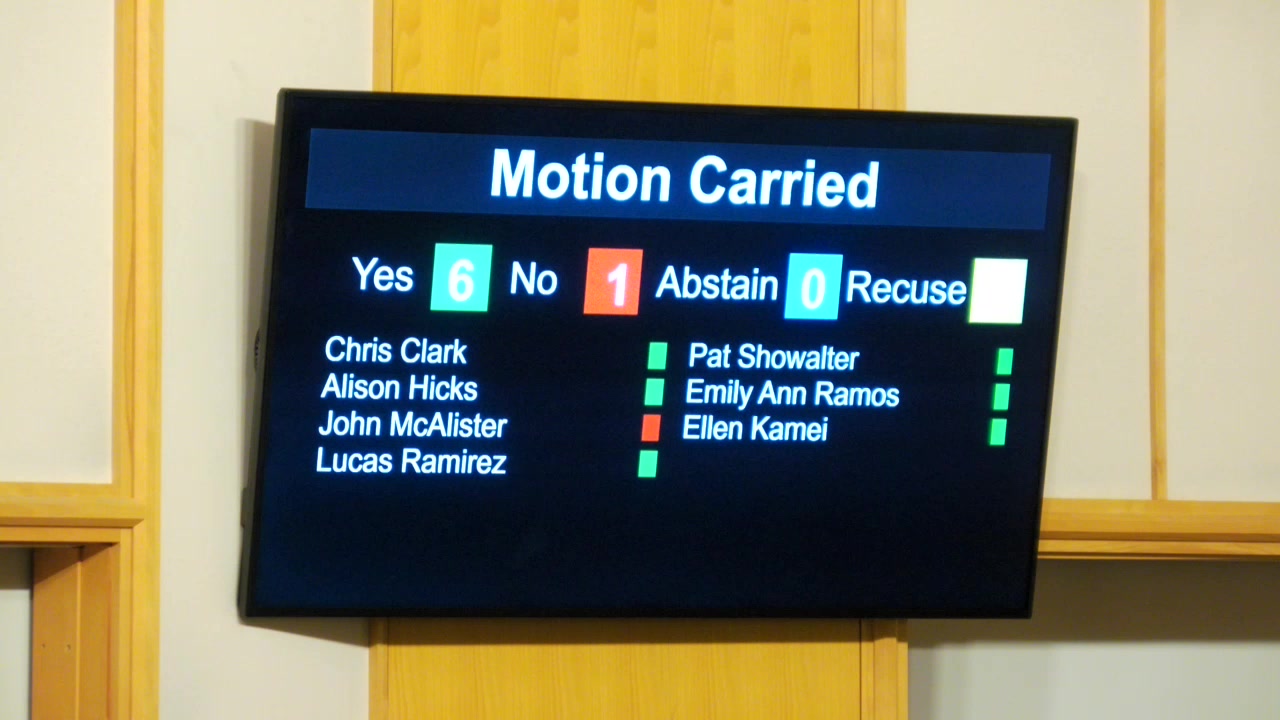
[02:36:12] Councilmember Ellen Kamei: Great, thank you. Eric. Oh, I love it. See, yes, great. Thank you. Uh, Eric, then Eric Knoff, Joshua Dylan, Kim Laden, Andreas, Lucas, Camila.
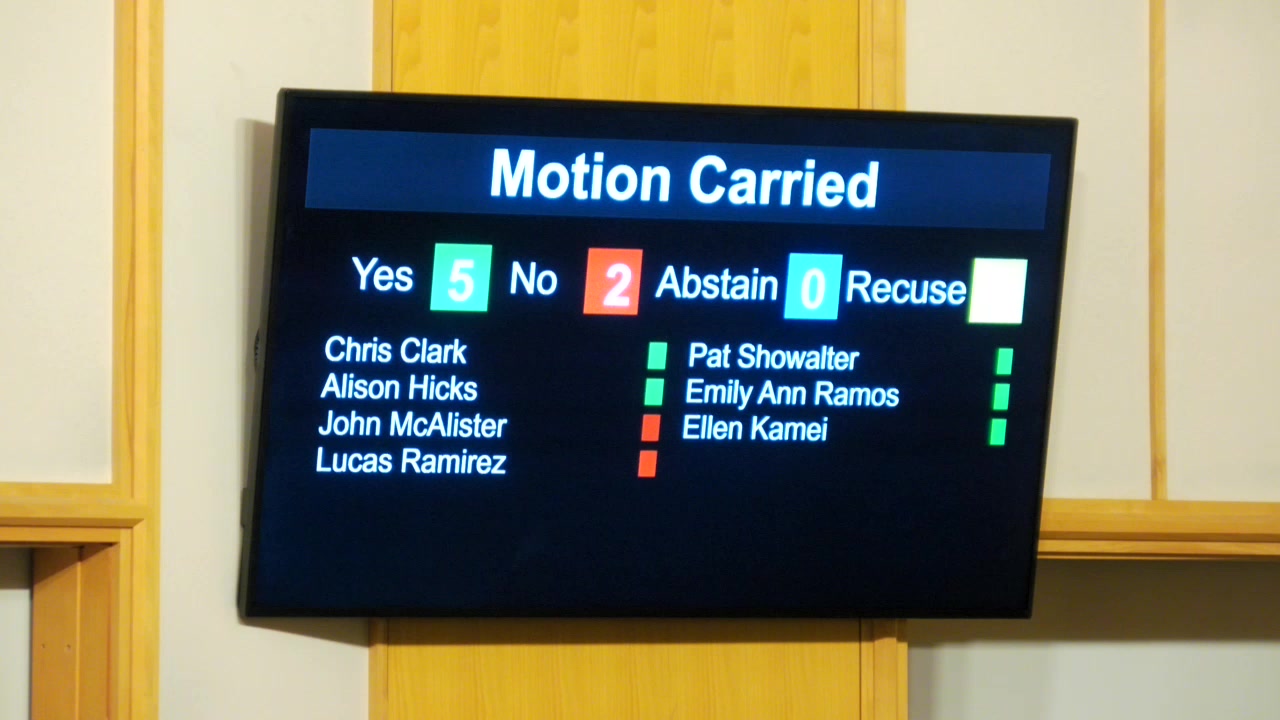
[02:36:22] Eric Knoff: Are you Eric?
[02:36:23] Eric Knoff: I'm Eric.
[02:36:23] Councilmember Ellen Kamei: Okay.
[02:36:24] Eric Knoff: Um, so, um, Mayor, Vice Mayor, uh, Council, thanks for hearing us out. Um, quick about me. My name's Eric Knoff. I've lived on Sladky Avenue for over 20 years. Uh, I live six houses down from the site in question. Um, I'm an engineer. I work in 3D CAD on a daily basis and so I'm experienced in creating concrete visual representations from ab- abstract specifications. Um, I find visualizations helpful in distilling and communication written proposals in a more understandable way. Um, I created the following images to satisfy my own interest of what a six story building would look like on the site, which is allowed by the current zoning requirements, and found the result fully out of scale with the neighborhood and surrounding area. Um, in addition to all the concerns highlighted yet this evening, this parcel seems like an exceptionally challenging site for such a large building given it is essentially on a peninsula of land jutting out into a four lane intersection. A unique way Cuesta jogs over to meet Sladky pinches off the frontage of the building, which even today creates a difficult traffic situation by stacking up cars at the light to block the Sladky exit. This leaves the neighborhood streets as a main entry and exit point into this parcel. Furthermore, current commercial parking on the site resulted in overflow of visitor car parking stretching down the length of Sladky. Adding additional residences and their respective vehicles in this area would only make this problem worse. Bottom line, if th- this image were built, it would seem to embody an oversight in zoning which is ideally intended to prevent. Um, we ask just that there be a comprehensive study to, um, address the concerns that are being brought out this evening. Thank you.
[02:37:17] Councilmember Ellen Kamei: Thank you. Lana.
[02:37:24] Lana Shukhman: Good evening. Uh, my name is Dr. Lana Shukhman and I've operated my general dentistry practice at this location for over 13 years. We provide care to thousands of children, adults, seniors, and patients with medical and mobility challenges. Many of whom live within walking distance.
[03:00:00] Principal Planner Diana Pancholi: Our practice also supports nearby schools and community programs. My team includes four long-standing full-time female employees, nearly all of whom grew up or attended school in this neighborhood. And rely on these jobs to support their families. Like the other six dental practices, I've invested hundreds of thousands of dollars in specialized improvements that cannot be relocated or recovered. This site has housed dental and medical practices for more than 40 years. Including throughout the pandemic, when we remained open to provide essential care.
[03:00:19] Principal Planner Diana Pancholi: These offices are not interchangeable commercial spaces. They're long-standing healthcare providers that deeply embedded in this neighborhood. I only heard about the rezoning a few weeks ago from a neighbor. Rezoning would incentivize redevelopment, likely triggering the sale and demolition of the property. Construction timelines would force all six dental practices to permanently relocate once our leases expire.
[03:00:39] Principal Planner Diana Pancholi: Given the high cost of the building out the dental space and the already elevated rents in Mountain View, these practices would not return even if allowed. Many would be pushed to more affordable cities, reduces reducing local access to care. Many long time patients, especially seniors, have already expressed that they will be unable to continue care if we are forced to move further away. Small healthcare practices like mine operate on thin margins and we can't absorb the dramatic rent increases that
[03:00:52] Councilmember Ellen Kamei: Thank you. Okay, Joshua Dylan, Kim Lydon, Andres, Lucas.
[03:00:55] Joshua Dylan: Hi, I'm Josh. Thank you for your time, Council Members. Um, I just wanted to kind of respond to some of the dialogue that we've had tonight. Um, so AB 11 is actually stuck in Senate Housing Committee still. Uh, it is a troubled bill and we don't know the outcome of it. SB 79 is a transit oriented housing bill that doesn't apply to this area. SB 6 does not create a ministerial process as was indicated here.
[03:01:09] Joshua Dylan: What's the point I'm trying to make? The point is clearly this decision is being made in haste. You don't have all the information. We don't have all the information. Let's work together to find a way where we can actually have a sustainable solution here. But let's not make choices under duress or threat. That's how bad choices are made and those bad choices will affect the fabric of this community for decades. Maybe a hundred years.
[03:01:22] Joshua Dylan: In fact, I moved to Mountain View with my family who, uh, by the way, probably the youngest members in the audience here, Ari and Zoe. Give a wave. Uh, who would obviously be affected by walking to blocks, Springer and the schools nearby. Look, this community is charming. And it's charming because of its downtown, which was thoughtfully planned. It's charming because of the community which went within which we live, because it was thoughtfully planned. That's what your job is to do.
[03:01:34] Joshua Dylan: Your job is to provide for the community to keep us safe, to represent us. You have a thousand people who within four weeks have been surprised, blindsided, and are coming and telling you that this is a decision being made in haste. You know it's being made in haste. You know as well as I know. Let's find a way to actually do this thoughtfully and do this right so we can accommodate the needs of the state, the needs that you have, and the needs we have. We don't have to just make a rash decision. Thank you.
[03:01:52] Councilmember Ellen Kamei: Thank you. Remember, uh, jazz hands. Um, so next up we have Kim. And then following Kim, we have Andres and Lucas.
[03:01:56] Kim Lydon: Hi. My name is Kim Lydon. I have been a resident of Varsity Park for over 10 years and I raised my son there. Um, I'm worried that my neighbors are going to be mad at me but I want to speak in favor of the rezoning. Um, I don't know as much detail as a lot of my neighbors do and maybe it's not the right time to do it and the laws and that sort of thing. But what I do want to say is that, um, I have a kid who tells me he's never going to be able to afford to live around here if I don't give him my house.
[03:02:13] Kim Lydon: And we are in a housing crisis in California and I think I want you to know that some of the neighbors in my area are cognizant of that cognizant of that and we don't want to stop housing development in our neighborhood. Um, California, as I think everyone knows, needs three and a half million more housing units built. Uh, the Bay Area needs another 700,000 housing units built. And we all say we're pro housing, but then when someone wants to build housing in our neighborhood, there's always reasons that ours isn't the right neighborhood.
[03:02:28] Kim Lydon: And that happens in every neighborhood, every time we try to build housing and that's part of the reason that housing is so incredibly unaffordable. And so hard for people to get. So it it breaks my heart that our children aren't going to be able to afford to live here. Nurses, teachers, firefighters, the people who clean our houses, who take care of our yards, who work in the stores and the restaurants. We need to find places for them to live. Um, and I know change is hard and it's scary, but um, our neighborhoods get bigger. Our cities get bigger, our children get bigger. Um, and we have to change.
[03:02:45] Kim Lydon: And I want to say that I'm proud to be a Mountain View resident in a city which takes its moral responsibility to develop housing for the people of California seriously. Um, and so, um, I thank you for that. Um, I know you'll make a good decision whether it's to approve or not approve this zoning tonight, but um, uh, and hopefully you guys won't be too mad at me for saying that. Thanks.
[03:02:57] Councilmember Ellen Kamei: Great, thank you. All right. Um, Andres.
[03:02:59] Andres: Hello, good evening. Uh, Mayor, Vice Mayor, Staff, Council Members. Thank you. My name is Andres Agarcavia. I live on Cuesta Drive. Uh, I have some remarks. But first, uh, we voted for you. You're here. You have agency. Your decision matters. If ministerial action were were to happen, it would have happened. There's a reason why Cuesta and Miramonte doesn't get to Sacramento or Newsom, right? It's because the decision is with you. It's a fallacy that this decision is unimportant.
[03:03:12] Andres: Uh, my two children bike to school every day, uh, from Cuesta to Middle and High School respectively. They press the button, they wait for the uh, rapid flashing beacon. The flow of traffic continues, right? Uh, they have to negotiate uh, careless drivers speeding through the crosswalk as they try to cross to school. This rezoning will bring even more traffic. This is fairly obvious. And create even more dangerous crossings. But this is not uh, a neighbor's or many neighbors' opinion.
[03:03:24] Andres: This is the memorandum issued by the city on March 27, 2024, Transportation Planner and Manager. It's an extensive list of recommendations on the Vision Zero Action Plan and Local Safety Plan. Uh, you can read it, of course, you know it. Uh, working group that put this together includes Public Works, City Manager, Community Development, Police, Fire, Library, uh, Bicycle and Pedestrian Advisory Committee. Page 4 of this report has a map of the city of Mountain View.
[03:03:37] Andres: You will see that the corner of Miramonte and Cuesta, uh, our discussion, is highlighted as a crash intersection for walking and biking biking. I'm citing verbatim from this. This is the ONLY intersection in the entire city south of El Camino that is designated as a crash site. So, we're looking here at a comprehensive report, commissioned and executed by the staff, commissioned by the Council, executed by the staff, by the city of Mountain View. One year later, the only and singular site isolated as a crash risk south of El Camino is the one proposed to fulfill a state deadline. So, my son will continue. He has a lot of things to say. Thank you very much.
[03:03:59] Councilmember Ellen Kamei: Thank you. All right, Lucas.
[03:04:00] Councilmember Lucas Ramirez: Uh. Uh, thank you. Eh, so, eh, to continue on. This seems like an oversight from part of the city to add more cars, congestion, and parking pressure to precisely the worst possible spot as stated, um, uh, by the memorandum. Um, it, uh, I have to question the purpose of and resourcing put behind these reports if we will simply ignore their recommendations and statements. Our concern does not end there. The area is already in a precarious state.
[03:04:11] Councilmember Lucas Ramirez: The infrastructure is not there to support growth, traffic improvement, or look after the safety of our bikers and walkers that report that the report is telling us to look after. We live close in uh, we live close enough to the intersection of Cuesta and Fordham. The knock-on effect of traffic congestion are a daily reality. We have witnessed close calls and collisions in front of our house. Um, and when the traffic recedes, speeding on Cuesta to and from Miramonte is considered normal by the many drivers, including red light crossings at the Springer School traffic light.
[03:04:24] Councilmember Lucas Ramirez: Eh, the proposed rezoning ignores factual risks to the neighborhood and seems to counter the city's own work and commitments to traffic safety. We support affordable housing, but not near a crash intersection for walking and biking. The city's leadership seems not to have a plan for traffic safety, but instead to have a deadline. Eh, so please, please do not rezone uh, 7 uh 1702 slash 1704 Miramonte Avenue and 777 Cuesta Drive. Thank you for your time and consideration.
[03:04:50] Councilmember Ellen Kamei: Thank you. Camila, then Andy Turner, then uh, Noam Lorberbom, and then Srikant Vellamkonda?
[03:04:56] Camila: Hi. My name is Camila and I am a middle school student that crosses Cuesta every day to get to school. I am here because I think that the high density rezoning that might be taking place in the local dental office will be a very unhealthy addition to our neighborhood. One of the reasons why I think this isn't a good idea is because there is already lots and lots of traffic on Miramonte and Cuesta. And adding more cars and traffic is not going to help with the safety of kids going to school on their bikes or walking.
[03:05:10] Camila: From my experience, I sometimes have to press the crosswalk warning device button three times because cars won't stop even when the people inside see me. Furthermore, on my way to school when I was crossing the street on that same crosswalk, there was a car that stopped, but the car behind it swerved around the first car so that the person inside didn't have to wait for me to cross the street. This happened while I was crossing the street. There have already been countless stories like this that I have experienced on the Fordham and Cuesta and on Fordham and Cuesta and this adds up to too many close calls and accidents happening on the streets that will be affected by the zoning.
[03:05:30] Camila: And adding more traffic by zoning this area will put kids like me in danger and only add more close calls and accidents that aren't needed. Today even there was a close call in the same intersection involving my brother and a few elderly citizens that were put in danger due to the to the traffic and the cars that won't stop. I hope these facts speak for themselves and show just how unhealthy this will be for our neighborhood. Thanks again for your time.
[03:05:51] Councilmember Ellen Kamei: Thank you. Andy Turner.
[03:05:55] Andy Turner: Madam Mayor, Madam Vice Mayor, Council Members, thank you for listening to us. My own background started when I was the same age as some of the young people uh who have just presented because when I was a kid growing up, I helped my dad and others keep the zoning laws from being changed where I grew up, which was not here. And we won. And we kept a high rise from being moved into where I used to live. I I reacted with horror when I saw the pictures of the high rise that the gentleman showed when he was a he showed some pictures of what it would look like.
[03:06:12] Andy Turner: I went to the front of Woo Dental, which is one of the three places. There's Woo Dental, Miramonte Dental, and Rosezen Dental. I'm sorry nobody's told you the names of them so far. But I went in front of Woo Dental and from there I was able to take a picture of my house, which is on the other side of Miramonte. I'm on Allison Avenue. My house backs on the church lot. I can see my house from there. If a high rise goes up, people in the upper stories will be able to look down into my backyard.
[03:06:26] Andy Turner: So I won't be in the shadow like was in the picture, but I and others will have people looking right into our backyards if this is built in. So the conclusion I'd like to make is I hope a decision can be reached not to zone this in this direction if possible because I know zoning work has to be done well in advance of anything happening based on my experience in Washington D.C. growing up where we kept a high rise from being built into our neighborhood. Thank you.
[03:06:42] Councilmember Ellen Kamei: Thank you. Uh Noam Lorberbom?
[03:06:45] Noam Lorberbom: Mayor, Council Members, my name is Noam Lorberbom. My family and I have lived near Cuesta and Miramonte since 1998. My kids grew up here and uh it's always been a quiet family friendly walkable neighborhood. We recently remodeled so we can age in place. Um expecting this area to stay stable and residential. I support adding housing in Mountain View by all heart. My concern is putting high density zoning right at the edge of a single family neighborhood where traffic and safety are already strained as we heard. That would change this from a quiet residential area into a higher activity zone with more traffic, more parking spill over and then this streets can handle.
[03:07:07] Noam Lorberbom: Rush hour um already shows the limits here. Uh the no left turn sign we talked about as on Miramonte and Sladky has been knocked down multiple times. Um so if it's there or not there depends on what day you ask. The keep clear uh zone um in front um of that area is blocked often uh by traffic and creating conflict for cars, pedestrians, including elderly and kids on bikes like many people said. I understand you must implement uh the housing elements and follow state laws like SB 6, but these laws do not require placing higher density specifically at Cuesta and Miramonte parcels.
[03:07:27] Noam Lorberbom: You can adjust sites as long as total capacity is man is maintained. So I'm asking you to exclude 7002, 7004 Miramonte and 777 Cuesta from 611 and uh direct staff to find alternatives. Thank you.
[03:07:38] Councilmember Ellen Kamei: Thank you. Uh, Srikant... Leila Abazari, then Victoria Lim, then Frank Cow. Is Srikant here? Oh, not here? Okay great. Thank you. How about Leila? Okay. And then Victoria Lim? Are you here? And then Frank Cow... and James Cuzomal.
[03:07:59] Frank: Hi. Uh, thanks for hearing us. Uh, I'm a resident nearby. Um, I think uh to Madam Sandy, uh many of my neighbors already said a lot about uh the traffic situation here. There are two things I want to add. One thing is uh I saw in this earlier school analysis, uh they seems to miss two two schools. Uh one is a day care center right at that intersection. To Madam Sandy there's like 60 to 80 day care kid going around there all the time. And other one is uh in the dental school uh dental office, there is a particular pediatric dental office. Very popular. My kid is there too. So you can imagine how many additional small kid is running around just at that intersection. Right?
[03:08:18] Frank: And uh this is the first thing I want to add. The second thing I want to comment is uh is pretty clear to everybody here, uh somebody also mentioned earlier, to add this have this particular parcel in this rezoning package, a big package. It's a small parcel in a big package. Seems like a very hasty decision made maybe several years ago when people did not maybe that decision did not even went to the intersection. Check out how many school is there. Check out how many people is crossing that street every day. And somehow the map say point to this looks good. Right? So now we are on the deadline few years later say we have to do it because it looks good few years ago on the map. So what I'm asking is looking at everybody here, don't make that same mistake today. If it's more work, yeah we may have to do more work. Take it out.
[03:08:59] Councilmember Ellen Kamei: Thank you. Leila, then Victoria Lim, then James Cuzomal, then Brent Bell.
[03:09:05] Leila Abazari: Uh, good evening everyone. My name is Dr. Leila Abazari and uh I'm a pediatric dentist in 1704 Miramonte. I'm a long-standing commercial tenant, small business owner, employer, and and nearby resident. I strongly urge you uh the Council to deny the proposal rezoning of the one story commercial properties at 1704 and 1702 Miramonte. For more than 40 years, these buildings homes primarily to dental and medical practices have provided accessible, affordable healthcare to this community.
[03:09:19] Leila Abazari: My practice alone serves thousands of children and adolescents including many with complex and medical and special healthcare needs who rely on continuity of care and proximity. Many of uh our patients walk to our office and we um maintain long-standing partnership with nearby schools and community programs. This neighborhood has an established scale and character that supports small businesses and walkable community oriented environment. Allowing buildings significantly taller uh than what exists today would fundamentally alter the character and create a abrupt mismatch with surrounding properties.
[03:09:39] Leila Abazari: Increased density without guaranteed infrastructure improvement brings real consequences. More traffic, reduced parking, added strain on road and emergency services. These impacts directly harm small businesses that depend on accessibility for the families we serve. Rezoning is permanent. Once these protections are removed, the precedent cannot easily be undone. We're not opposed of thoughtful growth, but growth must be appropriately scaled. Thank you.
[03:10:07] Councilmember Ellen Kamei: Thank you. Okay, Victoria. James Cuzomal, Brent Bell, Cindy Palacio Newman.
[03:10:10] Victoria Lim: Hi, thank you Council Members. Thank you neighbors, everyone who's stuck here for, you know, for more than three hours to really show our support about why we think that the rezoning of the Miramonte location should be removed. I think you've heard a lot about the traffic issues in this neighborhood, especially that left turn on Sladky, you know, that sign's there, but people are making that left turn anyway. Um we see that it's already an over-trafficked, overburdened neighborhood. We have the red curb parking, you know, Public Works is talking about, okay, let's add more red curbs. Cars are already parked in the red zone day and night regardless of those red curbs being painted there.
[03:10:24] Victoria Lim: And our short-term solution is, oh, we're going to block that left turn on Sladky, redirect traffic through the neighborhood where the young kids are? I mean the the cars are still have to gonna go somewhere. It's just going through more of our neighborhood streets. So I think we've really shown and we've spoken up about why this neighborhood just isn't built to support more high density. We I I personally very much believe in affordable housing, that's how we, you know, we can afford to live in this, you know, great area, but it needs to be done in a area that's more appropriate. And you know, I think we also talked tonight, I want to address some of this, you know, conception of, oh, it's a done deal.
[03:10:39] Victoria Lim: There it's already state law. We're going to put there there's going to be high density housing there anyway. But if state law, you know, we're we're zoning for Mountain View. If state law changes, but we've already zoned, then we're saying that this is okay, you know, developers are going to this list and saying, okay, these are the areas that the city think are appropriate. If we put Miramonte on there, we're saying as City Council, we're backing this and and we think this is appropriate. So we're really beseeching you, you know, as our Council Members that we voted for, to please speak up for us and say this isn't appropriate and that this needs to be removed to somewhere else, even if it does mean staff going back and doing more work, doing more homework to find a more appropriate location. And seeing if there is like medical office exemption rules. So thank you so much for hearing us. We really appreciate you.
[03:11:09] Councilmember Ellen Kamei: Thank you. James.
[03:11:12] James Cuzomal: Good evening Council. I'm James Cuzomal. I'm speaking to both Mountain View YIMBY's letter and speaking as a lifelong resident of the city. Uh firstly to the since the downtown transit center is also absent as this, I hope that when that actually comes forward as a project, we see a lot more than 75 dwelling units per acre. Regarding the controversial aspect of this rezoning, I want to say I support the rezoning. Um more people living in Mountain View is good. More housing options in a part of the city where you can only live if you can afford a three million dollar home needs to happen. It's unconscionable that right now we have a vast neighborhood where you cannot afford to live if you cannot afford to live in that type of housing.
[03:11:32] James Cuzomal: And a location that is immediately across from a bunch of shopping that is near a hospital, that is near medical centers where workers could now live, that is near some, yes low frequency but very real bus lines that, I mean, I personally used when I broke my collarbone and needed to go to El Camino Hospital for surgery and follow-up appointments, is entirely appropriate as a location to do this. Um and uh yeah. Um near the hospital and the it is near a place in the city where we are investing more in bicycle and pedestrian safety.
[03:11:47] James Cuzomal: Um Assistant Public Works Director Arango mentioned a bit about the uh some of the ongoing improvements. We are spending the money to do those improvements. We should build more housing so that more people can take advantage of the advantage of that, so more people can live near the schools, can live near the hospitals and can live in our wonderful city. Um and yeah, I think that's about all I have. Thank you.
[03:11:59] Councilmember Ellen Kamei: Thank you. Brent. Then Cindy, then Dr. Kunur... then Mark...
[03:12:05] Brent Bell: Hi there. Um well it's uh nice to be here with the Mayor Kamei and those to her left, I know from many times before, Pat and uh Alison and John. I know these people from all of their actions. And one of the things I wanted to comment you on is the action of putting the fire department over on Castro and Questa. That has saved my life. And my wife's life. And she's going to the hospital tomorrow or she'd be here today. But uh let me say that the conduit along uh Questa is very important for this because it connects up to the El Camino Hospital. We've lived here 50 years. And uh we've seen a lot of things, but one thing that hasn't changed too much is around that shopping center there.
[03:12:25] Brent Bell: Uh and uh of course we do shop and we want to say that uh used to be Purity Market now it's Safeway, but we go there all the time and we have places to park. But of course increasing the density of housing in that area, although it doesn't seem like a real pleasant thing and it it wouldn't be because you've seen some of these crazy places on El Camino, there's just giant huge places. But uh you know, let's say that uh there's no parking. What are they going to do? They're going to go over to the Safeway and then we won't have any place to park to to do our grocery shopping. Be dangerous. It's the all the kids walking down from schools, you know, we have kids from schools in the neighborhood. And this is the major conduit. We have them at Springer School, we got them at the the high school and uh the other high school. We got three three big schools in the neighborhood. And they're all walking, they're all taking their bicycles and everything. So it's dangerous now, could be a lot worse. So I'm just saying that uh the reason I came down here to support uh not doing this is that I can see what it could lead to. Thank you very much.
[03:12:54] Councilmember Ellen Kamei: Thank you. Cindy.
[03:12:57] Cynthia Palacio Newman: Seven years retirement from City of Mountain View and I'm back. Um I am Cynthia Palacio Newman. I live uh across from the hospital off of Eunice. The Grant Road uh Convalescent Hospital is one of your projects, but I'm going to speak about my church. After I retired, I joined First Presbyterian Church of Mountain View, which is at the corner of Miramonte, Cuesta and even Beacon. Um we have two con two congregations on site. On Sunday there's like four services. Uh we have a preschool, Little Acorn Little Acorn Christian Preschool. Our director is here. Um my pastor asked me to speak. Uh Pastor Kim Tilley. She's been with us a year and a half. This church is celebrating 175 years of a congregation next July. 175 years built on the old Bubb Ranch.
[03:13:18] Cynthia Palacio Newman: Um first I want to say I understand the housing element and all of that, but um what concerns me is if the legislators would just look at an aerial, you will see that this all this property south of El Camino is housing. We have a neighborhood shopping center. If we keep intensifying things and building high density to be affordable, we end up with of maybe a food desert. It's one of the few shopping centers and it's a Target. Look at the aerial. This is all housing. As to more affordable people uh more affordable people, more affordable um schools, not schools. Sorry, you know what I'm trying to say. There what about the residents that are here already? I bought in 20 years ago. We have people in my neighborhood that are in their 80s and 90s. We want to live here. We don't want to be shoved out to make room for somebody else who's going to pay a higher price. Um our church provides many services including um food drives, um traffic is a concern and that's my time. Thank you.
[03:13:49] Councilmember Ellen Kamei: Thank you. Dr. Kunur.
[03:13:52] Dr. Kohinoor Chakravarty: Hi. Thank you so much for this opportunity. My name is Dr. Kohinoor Chakravarty. I'm a nonprofit worker and I've lived in Mountain View for the last 25 years. Thank you so much for always um keeping in mind the security and safety of residents of Mountain View. I live right adjacent to the Grant Road proposal on 14 1949. So um my house is right next to that. Um and there is no clarity on the zoning or the construction that's going to happen. Never received a notice, never a survey. This was the first time I found a letter in my mailbox that got me here. So this comes as a surprise.
[03:14:09] Dr. Kohinoor Chakravarty: And I wonder the traffic analysis or anything that was done in 2023, almost two years or three years away from now when COVID was happening and people were working from home, which is not the case right now, is really um effective in this day and time. On Grant Road from one end to just the end of Cuesta Cuesta, the traffic is awful. It takes me on a mile about 30 minutes. With El Camino Hospital there and the schools there and the fire trucks not being able to move because it's like a parking lot. I don't understand how adding more housing and more cars is going to be helpful. A child already lost their lives at that intersection on El Camino and Grant. My son while biking was hit by a car, fell down and still has those scars. I am not um against housing, I'm just against the proposal that the housing is going to be effective here. It's going to be a bottleneck that's going to keep residents from keeping going to the hospitals. Thank you so much.
[03:14:55] Councilmember Ellen Kamei: Thank you. Okay, Mark, then Reverend Kim Dortch-Tilley... then Kathleen... and then Alpana Calgut.
[03:15:00] Mark Azzopardi: Hello, I'm Mark Azzopardi. I'm a resident of Mountain View. My wife and I have lived here for 49 years on Tulane in Mountain View. Um I appreciate all your work at the City Council does. I know it's a thankless task many times. And I know that uh some of this work has been kicked down the road from the state with the laws that they are passing. Um but one of the things I want to quote is a a line from Strother Martin in the movie Cool Hand Luke. Now you old people remember it. You young people just Google it. Okay? What he said after he hit Paul Newman with a lash was 'What we got here is failure to communicate.' Yeah you remember, huh? All right yeah. You're a fossil like me. You know, um.
[03:15:27] Mark Azzopardi: This is the first time, you know, a lot of people heard anything about what was going on. You say that we we got notices. 750 feet isn't enough. I mean even with the with the with the intersection one, you need to go through the whole Varsity Park neighborhood like you said and give us notices. I didn't receive anything and then all of a sudden it was the game of telephone. They're going to put a six story building at the medical center. There's going to be no parking because they can't put anything underground because the creek across the street. So they're going to have to put all above ground parking. That's what we heard and that's why you see the signs because, you know, torches are out of out of touch now. So, um, the thing about rezoning the property is that it's going to increase the value of that property. You rezone it and somebody, quoting another movie, is going to make him an offer they can't refuse. Because somebody's going to say, I can build this huge building make a major profit. So the owner of that property that these ladies are working at. Is that my time? It is. Oh. Sorry. Sorry.
[03:16:02] Councilmember Ellen Kamei: Sorry. Reverend Kim.
[03:16:05] Rev. Kim Dortch-Tilley: Hello, thank you so much. Um I do just want to thank all of you for your wonderful questions and just understanding. Um I am new to the area. I've been here 18 months, called to First Presbyterian Church of Mountain View. I'd love for all of you to imagine that intersection that we've looked at repeatedly tonight where the proposed building on Miramonte is on the northwest side. The property on the northeast side has three nonprofits with a very large footprint in this community. So I commend the concern for uh small businesses, but I would like to increase the awareness of that property. Um again our preschool director, Little Acorn Christian Preschool is here.
[03:16:23] Rev. Kim Dortch-Tilley: They have a deep deep footprint which brings little kids to our church Monday through Friday. On Sunday we have preschool and all kinds of kids programs. There are two churches on that property, ours First Pres Mountain View and also Menlo Church is there. And so we have kids from every age and stage and um and that's on Sundays. We also have special events there. We have Boy Scouts and Cub Scouts that are there in the evenings. Um so we have a large population that is coming to and from that property at unusual times. I'd like to mention that the the park bench where the bus stop is is on our property and we just want to say that there are often sprinkler heads that have been kicked over because of the foot traffic to the bus stop there now. Now that could be anybody, but there will be more foot traffic conceivably trying to get to that park bench and the bus stop. Our property is being it's difficult to maintain because of these sorts of things. Um last thing, Cuesta, it's uh it goes from two lanes to one and it bogs down. Thank you.
[03:17:07] Councilmember Ellen Kamei: Great, thank you. Hung, Aaron, David Watson, Allison Stern.
[03:17:09] Nhung: Um, hi. My name is Nhung and I live in Mountain View. Um a lot of people mention that I mean that corner it's the way for just a lot of the schools. Springer, St. Francis, Mountain View High, um you know, block. But then there's also Bullis Charter. There is um the Children's House which is very popular preschool. There's so many preschool. There's a preschool at the corner of El Monte and Cuesta which is a one lane. And there's the Oak Preschool. There's Graham Middle School that no one talks about because the kids from Imai are going to go to Graham and they go through that way too. It just and I brought this up before. I mean remember the kid that got run over? Graham. But just all that traffic, please just, you know, think about the safety of the kids and just don't put anything there that will increase the traffic and make it less safe for them.
[03:17:34] Nhung: Um also like small businesses. It took them like 10 plus year to build it, to get it running. So any disruption to their continuous operation will kill their business, will kill their livelihood. So when you make change like these you only benefit the developer, but you have to think about like the residents and the local business owner and like the kids. I mean you are our representative. We voted you into office to look for our well-being, not to benefit the developers. So please think about that. Thank you.
[03:18:10] Councilmember Ellen Kamei: Thank you. Aaron Dearden? Maybe they left. How about David Watson?
[03:18:12] David Watson: Good evening, Mayor and Council. I'm David Watson. I'm speaking in support of the rezoning. I hear the neighbors from south of El Camino asking why is there so much density proposed here instead of next to the Caltrain station? Uh to be clear, I think this is a fantastic site for housing. It's a high opportunity neighborhood. It should have apartments. But the reason the neighbors here feel like they have suddenly become the target of all this rezoning isn't because this is a bad location. It's because for decades, groups like Livable Mountain View fought tooth and nail to kill density downtown. They were successful in blocking housing in their backyard and because Old Mountain View dodged some of their fair share, the city is legally required to play catch up here.
[03:18:34] David Watson: Now uh regarding complaints we've heard tonight about neighborhood fit, I'm not asking you to do something that I wouldn't do. Uh I live in a single family zone in a different part of the city, but one uh seven story apartment was proposed in my street. I supported it. The complaints about traffic and shadows are the exact same ones people make everywhere. But uh staff made the reality crystal clear. Voting no does not stop the housing. Uh under state laws like AB 2011, which did pass by the way, homes can likely be built here regardless of what you do tonight. The only choice you have is does the city retain control over the design or do you abdicate that power to the state? Regarding the parking panic, uh you know I can't come up here without uh getting a little bit Georgeist on you. Uh the answer isn't to block the homes, the answer is to implement Shoupian performance based uh uh curb management now. Uh set the expectation that new residents and old ones will pay the market value for uh storing private vehicles on public land. You have to approve this item uh but ask yourselves how we got here. Thank you.
[03:19:09] Councilmember Ellen Kamei: Allison Stern... then Shatutu Bhattacharya...
[03:19:11] Allison Stern: My name is Allison Stern. I moved into Mountain View in 2007. I had been visiting since 2004. I was the crossing guard hit at Grant and Phyllis because of traffic being overcrowded and somebody running a red light. I was the crossing guard at Covington and Miramonte when somebody decided to go around the cars and over the stop sign. I am a resident here that can tell you that the traffic is getting worse. I have to tell my bosses that I can't come into work between 8:30 and 9:30 sometimes, especially on a Wednesday because of traffic for not these six schools she listed but the nine to ten schools. Because she missed Graham, she missed Bubb, she missed the school in Los Altos off of Golden, she missed another school. There are a lot of schools. All with the traffic going through our intersection. It is not okay. We reduced the traffic so that we went from two lanes to one lane and now traffic is even worse than it was and now you want to add a six story building. Is that even sound reasonable? I had to
[03:45:00] Public Speaker: ...protect kids the day that the guy went through the stop sign at Covington and Miramonte. You gotta think about the traffic not just at Cuesta and Miramonte. Oh by the way, where were all the patients gonna go at Grant and Cuesta at the Cuesta site? Where are all those patients going? Cause my father just got out of there. It's not okay.
[03:45:12] Councilmember Ellen Kamei: Thank you.
[03:45:17] Public Speaker: Um, Mayor, Councilmembers, thank you for your service. Um, I know this is probably not as much fun as you were maybe thinking it would be when you took on the job. Um, I think a couple of different things I want to say. Uh, I've been a resident of Mountain View for close to 20 years now. Um, currently living in the Waverly Park area.
[03:45:26] Public Speaker: I think specifically I want to talk about the 1949 Grant Cuesta rehab area. Um, I look, I know people are being nice but really it's unconscionable what you guys are seeing here and what's been proposed. Um, these are deep residential suburban neighborhoods where you're proposing deep high-density housing.
[03:45:34] Public Speaker: There's a giant swath of empty land on the corner of Phyllis Martins and on El Camino. I think it's probably El Camino Hospital's land, that's why nobody's going after it, right? But let's be honest, come on. Everything from the edge of In-N-Out all the way across there could have been redeveloped for high-density housing. Nobody did anything. You know what? I don't need a City Council that's this big.
[03:45:45] Public Speaker: Redevelop this area. Take the parking lot next door which is empty, which has been empty, the Wells Fargo moved out. All of this land is available but we don't see people doing that. Where do you want to put the housing? You want to put the housing deep inside the middle of the residential neighborhoods. People talked about traffic, people talked about kids. I have friends whose kids have scars on their faces from falling over on their bikes because of the traffic.
[03:45:57] Public Speaker: I will ask all of you to come and try and take a left turn from Cuesta onto Grant at 8:00 in the morning. Okay? Tell me how long it takes you. Okay? You want to add a construction facility over there? Lastly, the Grant Cuesta rehab facility. I have friends who live around there. I have friends who've seen that facility. They're, it is infested with rodents, with medical devices, all kinds of hazardous waste, all kinds of chemicals.
[03:46:11] Public Speaker: There's people who are receiving radiation therapy. Has there been any analysis done on the impact of redeveloping that area? There's a school literally next to it. That's the Amy Imai Elementary School. Um, please think about what you're doing here. You cannot let this pass. Thank you.
[03:46:17] Councilmember Ellen Kamei: Thank you. Okay. Jiao?
[03:46:22] Jiao Luo: Hello, I'm Jiao Luo and uh I different than others, I'm not the long term residents here. I just recently move in and when I heard from neighborhood, I was shocked. Like what happened, rezoning? I never know. And the reason I'm choosing here is the perfect, is the great, you know, school zone, all very, you know, convenience for my family, not my kids, but my mother-in-law, my parents.
[03:46:34] Jiao Luo: They without us to, you know, driving by, they can cross the street to Safeway and they have, you know, a lot of, you know, the fun place to go. Uh, and also I know they mention great school here but also as like typical Asian mom, they have Kumon, they have uh, you know, piano entertainment uh, you know, centers. That is my son after, you know, the normal pre TK, they went there.
[03:46:44] Jiao Luo: And I'm a working mom. They're mentioning, you know, the safety and uh, you know, traffic but that was a fact. Let me talk about the influence as a working mom. I'm not able to allow him to walking street to take a class. I need to keep balance between work and, you know, the safety. He is the only child. I, if, you know, traffic getting bad and or young people moving because they support like affordable house and they're, what are they dri... you know, parking in front of my house?
[03:46:56] Jiao Luo: I living in 2 land and I needed to picking him up and send him school and I needed to, you know, also pick uh, uh, driving him to the school. And what is my dream? What reason I'm come to United States? I want to work and I want to, you know, support my son but also achieve my personal goal. And I know it's um, I want to say it's for, we understand mixed use development but that should support the function. However, rezoning in the center of the school, center of housing...
[03:47:12] Councilmember Ellen Kamei: Thank you. Thank you. Thank you. Alex Brown?
[03:47:24] Alex Brown: Nope. Oh no. Okay. Hi friends. Uh, if there's a thing called crash intersections, we should really do something about that cause that doesn't seem like a good idea. Um, why, why, all this traffic, I feel like the, what I'm hearing tonight is that there is a real need in this area to handle the danger of traffic and all these cars and how it impacts people.
[03:47:37] Alex Brown: I think that that is something we need to address. I think the Vision Zero plan is, was a great goal. Uh, I still miss Ria. Uh, cause she gave really good presentations and I'm, I want, I want to be Hoboken, you know, I want to have safe streets for everyone in Mountain View and that includes the people who could be living there and whose kids could walk to school. And so they're not in cars, not adding to traffic because there is more housing in that area.
[03:47:53] Alex Brown: That is the solution or a solution is to actually build more housing in the areas where you have resources. So if you have more housing there, those kids can go to school, those are the ones who can walk there safely. Uh, because we should be protecting the kids who are walking to school. We should be making sure that they are safe.
[03:48:04] Alex Brown: Uh, and that is not by, you know, going back on our housing element obligations or just denying housing projects or fear mongering about, you know, what the impacts of any given development is going to be for an area and just imagining the worst case scenario. Uh, it is taking care of people and recognizing that when there are problems, is what we can do to fix it. Um, so completely separate.
[03:48:15] Alex Brown: I don't like all these single parcel like, like the map, the map, you can barely see what we're actually rezoning. It is so tiny, it spreads throughout the city. I, why, why would, our plan is just scattered and I uh, I was talking in the back, uh we put too many eggs in the Google basket. I'm very sad that we have to do all these small things to try to meet our obligations but we do still need to do it and I support this. I talked the whole time.
[03:48:28] Councilmember Ellen Kamei: Okay, great, thank you. Any more in-person public comment? Because we're moving virtual. All right. So not seeing any, we're going to go virtual. So first we have Manuel Salazar. You already spoke. Yeah. Everyone gets one turn. Thank you. Yeah. Okay, no problem. All right. Manuel Salazar.
[03:48:39] Manuel Salazar: Yes, hello. Hi, uh good evening Mayor Kamei and members of the City Council. My name is Manuel Salazar and I'll be speaking on behalf of SV@Home. Uh first I'd really like to begin by thanking city staff for the work that went into bringing this item forward. Uh it's clear that a great deal of coordination and careful planning went into aligning the General Plan, Zoning and Precise Plans uh and that effort is evident in the council report.
[03:48:49] Manuel Salazar: So we're really happy to see that the targeted upzonings moving forward um that are happening uh by increasing housing capacity in places like, you know, the city has already identified as appropriate for growth. Mountain View is really taking a smart and practical approach to planning, one that honestly I'd love to see other cities in the county kind of follow suit. Uh given recent state housing laws, development on many of these sites would likely be able to proceed regardless and honestly by adopting these rezonings, uh it's allowing the city to maintain some sort of level of uh local control over how the growth area will be, you know, occurring.
[03:49:04] Manuel Salazar: Uh this kind of focused intentional planning is great to see specifically because it creates real opportunities to deliver new housing. Uh it also reflects the city's following through on commitments that it made during its housing element including program 1.1 G. Uh that follow through really matters, not only because failing to do so can expose the city to potential consequences from HCD but also because plans only have impact when they're actually implemented. So, you know, once again, thank you to staff for your work, thank you to Council for considering this item tonight and uh we strongly encourage you to approve the staff recommendations. Thank you.
[03:49:19] Councilmember Ellen Kamei: Thank you. Juliet Jomgrot?
[03:49:21] Juliet Jamgrot: Okay. Hello. Yes, um thank you for listening to me. Um I'm a 20-year resident on Sladky Avenue and I'm also someone who goes to the Lopez Dental Office that's right there on the corner of Miramonte and Cuesta for about 20 years. Also my children go there, we walk there all the time from our house, mainly because of the lack of parking in that area. Um it's very convenient to walk to that dentist office.
[03:49:35] Juliet Jamgrot: I am absolutely against uh building a very high density apartment on that corner. Um I feel like it's a an awful lot of work for a very small number of housing units. It doesn't seem worth the effort. Um I think the City Council can take the approach of denying this uh change in um in status because it's such an unpopular proposal on that corner and also across the street at the 777 Cuesta.
[03:49:46] Juliet Jamgrot: It'll be really hard to find a developer willing to put um effort into those areas for such a small amount of reward for um affordable housing. I think the effort would be better taken up in a much larger spot, maybe one of the shopping centers that could be ripe for redevelopment. Um I'll yield the floor to the next speaker. Thank you.
[03:49:56] Councilmember Ellen Kamei: Thank you. Francois B?
[03:49:59] Sanjay Voleti: Um, hi, yeah, my name, my name is uh Sanjay Voleti. Um I'm actually a resident of uh on Miramonte Avenue, a few doors down from the proposed site. And um I think you should deny this rezoning for the very simple reason that it is going to cause a lot of traffic increase and accidents. And I'm speaking from personal experience here. So we, we had our parked car on the street crashed into by somebody um a couple of years ago. A few weeks later the same thing happened at the at the house next door to us as well. So that's already happened.
[03:50:19] Sanjay Voleti: This is just going to cause more of that to happen. And as everyone else on this call on this in this meeting has said, um there's a lot of school traffic. My kids went to Springer. I have one that bikes to Blach every day now and one that bikes to Mountain View and that intersection is extremely heavy traffic to begin with. And what we heard today uh and I'll quote, I think there was a quote that said, I don't know an exact timeline to give you on how the traffic is going to get fixed.
[03:50:34] Sanjay Voleti: So there's a plan to rezone but there really isn't a concrete timeline or a plan to actually address the traffic problems. So I think the whole thing needs to be really thought through a lot more and and not passed. And the last point I want to make is the whole idea of repaving Miramonte was to make this a safer route. And this entire new rezoning is going against that. And that repaving plan by the way is running about a year and a half behind what you guys originally had in mind. So maybe focus more on improving the safety and deemphasize the rezoning here. Thank you.
[03:50:49] Councilmember Ellen Kamei: Thank you. Okay, now Francois B.
[03:50:52] Francois B: Hi, um, yeah, thank you for the opportunity to speak. Um my name is Francois, I'm here to speak in favor of this rezoning. Uh I moved to Mountain View in 2016 and I was renting an apartment for a long time until I got the chance to buy a home in the Miramonte neighborhood two years ago. Uh I don't live right next to the area that's scheduled to be rezoned but I live a couple streets away so I'm pretty familiar with what this area has to offer. And I hear a lot of people here who really love this area.
[03:51:07] Francois B: They love the schools, they love the supermarket, they like the parks. Um I love I I run a lot, I love running to Cuesta Park, running to Stevens Creek. I cycle as well to Los Altos. I cycle to get my grocery shopping done at the local shopping center. And I have to say I've heard a lot about the traffic here and how dangerous it can be. I I have to agree that it's not the best experience to to cycle or to walk next to the street. But I think that's something that needs to be addressed no matter what.
[03:51:22] Francois B: And what I would love is for others to really enjoy the same things I enjoy, like enjoy running, enjoy this neighborhood, moving close to the school, being able to attend the schools. We need to make more space for others, not just us who are lucky to be living in this area but others to be able to afford to live here and move here and enjoy everything our city has to offer that we like, that we all love. So, you know, change is difficult. Maybe eventually my own area will be rezoned. I would be in favor of it because I had this opportunity to move here and I really want others to be able to do so. And it's a small drop in the big bucket but I think everyone really has to do their part in California. Thank you.
[03:51:42] Councilmember Ellen Kamei: Thank you. Matthew Marting?
[03:51:44] Matthew Marting: Hey, can you hear me? Yes. Great. Um, yeah, I'm in full support of the rezoning. Um it seems like a lot of the people fear mongering about traffic assume everyone who might move into new housing will live in an utterly car dependent way. I live near Rengstorff Park. Uh I own a car but I bike to the Transit Center downtown, take the train and then bike to work. Uh I walk to Walgreens. I walk to the doctor. And uh speaking of dentists, I walk to El Camino and take VTA line 22 to the dentist. Uh I got gas two times this year. That's it.
[03:52:06] Matthew Marting: Uh by the way, most apartment complexes including mine have parking. It seems like most of the cars on the streets around me are from detached homes. So many people say we support housing but not here. But don't you realize there will be other people at the places you're proposing we move all the new housing who will oppose it there for largely the same reasons that you're giving here. And it would be one thing if you were actually proposing new sites but a lot of the time it's just expecting existing sites that are already getting upzoned to magically get more units.
[03:52:25] Matthew Marting: I think someone uh earlier said something about squeezing the balloon regarding traffic but that's actually exactly what you're proposing with housing. If you prop... if you oppose housing here, you oppose housing. And we're in a housing crisis. We can't afford to keep opposing housing. Um finally uh I want to note about, you know, safety for people cycling uh and about traffic. Um Miramonte is uh getting uh improvements for bike infrastructure and you know there is bus service on Miramonte. It's not great, it's every 30 minutes but when VTA goes to look at what routes to increase frequency on, they're going to look at density.
[03:52:46] Councilmember Ellen Kamei: Thank you. Thank you. Okay, Alex Shukhman?
[03:52:49] Alex Shukhman: Yeah, can you hear me? Yes. Yeah, uh first uh I'd like to thank obviously the uh the city and all of the members uh with respect to this very difficult decision. But I I do want to point out a few things. First, none of the practices that the staff contend that they notified were in fact notified. None of them. All of them were shocked and surprised as to the fact that they that they were just learning about this at this time. So it's not clear how, if no effort was made to inquire about the unique business dynamics that are associated with the impact of the staff's decisions, they didn't work with any of the impacted businesses at all.
[03:53:09] Alex Shukhman: Um it's not sure how they can contend that their decisions were properly informed. I would urge that the city not make the same mistake by making a very hasty decision without having worked with the impacted residents as well as the business owners. Second, I'd like to point out this ide... this idea of dedicating into other places, okay, in adjoining cities, they will not return. And this will televise to other dental practices that the city does not understand their unique needs and it should not be considered as a conducive place for such businesses.
New Business
[03:53:29] Alex Shukhman: Now that will, who will that hurt? That will hurt your residents. The many people who who are actually there. Third, I want to just point out the cost of any reconstruction, any new property owners, all of that will be passed along to the new business owners and who will ultimately pay for that? That will be the residents because what's not been discussed is the type of leases that these businesses have. They're called triple net leases where all of those costs get passed on to the businesses. And what do the businesses then do...
[03:53:46] Councilmember Ellen Kamei: Thank you. Sophie Yeh?
[03:53:49] Sophie Yeh: Hi again. Um I'd like to speak in support of the rezoning. I am someone who is living at the corner of um El Camino and Grant so I am close to the proposed 677 to 699 Calderon Avenue that's also being upzoned. Um I'd like to just put forward that I agree with previous speakers who have spoken in support of the rezoning that I feel very fortunate to be able to live in Mountain View as someone who grew up in Cupertino and then moved here later.
[03:54:04] Sophie Yeh: Um and I want to be able to extend the many positive parts of living in Mountain View to other people especially when we are aware of what crisis we are in with regards to housing and what good fortune we have to be able to be where we are now. I believe we have a responsibility not only to ourselves and our neighbors but to the people that we live in community with and this includes people that we interact with when we go shopping, when we go working, when we go to school, and all of those different environments in which someone could be traveling very very far to be contributing to the same community that we all are in.
[03:54:25] Sophie Yeh: So I'd like to once again state my support for rezoning. Um we certainly face a crisis in terms of housing and I believe Mountain View City has done a really good job of trying to meet um those requirements where we are and I just want to say thank you for all of the hard work that's being done to research these proposals. Thank you.
[03:54:42] Councilmember Ellen Kamei: Thank you. David Abazari?
[03:54:44] David Abazari: Hello, can you hear me? Yes. Hi, um my name is Dr. David Abazari. I work at Forever Smiles Pediatric Dentistry at 1704 Miramonte. Um something that I that I think a lot of people may not know is dental zoning is um pretty rare. So in a city um it's not just medical zoning, we have a special zoning requirement for dentistry and that's probably one of the reasons there's so many clustered at 1704 and 1702 because those were zoned for for dentistry.
[03:55:02] David Abazari: So if a housing um project does get developed there, um we will be forced to leave and there really aren't any other areas in Mountain View that would be able to accommodate um dentistry for us. So um as others have mentioned we would have to locate elsewhere um and at significant cost to us. Um and we we hope that we don't have to go through that. We've been privileged to be part of the community for over a decade um serving some wonderful children, some some kiddos that um need some extra attention and we're able to provide that with our sedation dentistry um as specialized dentists.
[03:55:21] David Abazari: So uh we um would prefer that this proposal do not move forward and to work with the state to try to allocate some other area for for construction of um affordable housing. Thank you.
[03:55:27] Councilmember Ellen Kamei: Thank you. Daniel Hulse?
[03:55:29] Daniel Hulse: Hi, uh, hi. Can you hear me? Yes. All right. Uh I'm Daniel Hulse. I'm a Mountain View resident. I live in Del Medio which is not in this area but I think it's actually a far superior neighborhood um because there's a lot more housing. And so I think we should have more housing throughout our city uh and I think the city's plan, planned for more more housing throughout the city and I I think we should follow through with that plan uh and not waste staff's time looking at something that would uh be a big waste of time uh by changing something to be zoned for a capacity that state housing law already allows for.
[03:55:55] Daniel Hulse: Uh so absolutely support the rezoning. I think we should follow through on our commitments uh and this is just a part of that. I think that uh generally we need to combat misinformation also but that's another discussion. All right. I'll quit wasting your time. Bye.
[03:56:08] Councilmember Ellen Kamei: Cliff Chambers?
[03:56:11] Cliff Chambers: Hi, Cliff Chambers, uh resident of Mountain View. I also support uh the rezoning uh proposal. I first want to really uh thank staff. I think they did an excellent job with the staff report. It's very well organized and reads really well and the presentation staff made was excellent and their response to some of the traffic concerns are are admirable. Regardless of what happens here, we we've got a safe route to schools problem. We got some circulation issues that need to be addressed.
[03:56:32] Cliff Chambers: I do really believe though when we were doing the housing element and the distribution of sites, there was a lot of work to identify sites and and the sites that we're talking about tonight are are important. But I I do think the presentation that was made earlier, the the 10 minute presentation, her rationale for some alternatives uh I think were strong and should be considered. But overall I support and I don't have time to repeat what uh Councilmember Chris Clark said in terms of the rationale for going forward but I really think that it does need to go forward in some capacity and would make sense given all the changes in state law et cetera.
[03:56:51] Cliff Chambers: I think the the other thing I I was going to come to the next uh agenda item that's going to go way too late but I do think we have an opportunity for middle income housing and condo development. We really need to be thinking about sites like this for you know first floor retail and condos in the second and third floors. And I do think the other criticism I have of the staff report is I do believe that if there were some more graphic representation of well designed 30 dwelling units per acre, it would make a big difference because there are some really good designs of uh that kind of at density level. It's not that high of density.
[03:57:13] Councilmember Ellen Kamei: Thank you, Cliff. Okay, Ava Mogharabi?
[03:57:16] Peyman Mogharabi: Yes, thank you. Actually uh so good evening Mayor and Council members. My name is Peyman Mogharabi. Ava is my daughter. Um I want to speak against rezoning the Miramonte property area. Uh this area isn't just generic office space. Over many years it's become a real hub for medical and dental offices. So we're talking about doctors, dentists, pediatric specialists and other healthcare providers that serve Mountain View residents every day.
[03:57:33] Peyman Mogharabi: People come here for routine care, they come here for ongoing treatment and time sensitive appointments. It works because the zoning has stayed stable and predictable. So rezoning puts that at risk. Medical and dental practices aren't easily replaceable. These offices are built out specifically for patient care with accessible parking, short term visits and daytime traffic patterns. Rezoning creates pressure that can push these providers out, not because they want to leave but because they have to.
[03:57:52] Peyman Mogharabi: Once we lose medical office space like this, it's really hard to get them back. Keep in mind that Miramonte serves the community, supports good local jobs and provides essential care in locations designed for it. I urge the city to keep the existing zoning and protect this important healthcare area. This is healthcare. Again, this is healthcare for the community. Thank you.
[03:58:10] Councilmember Ellen Kamei: Thank you. Peng Zhang?
[03:58:13] Peng Zhang: Hi, uh can you hear me? Yes. All right, uh so I'm a resident of Mountain View and I would like to say no to the rezoning. So uh we have five years old son and he's adorable and energetic. So every day I send him to school and picking him up from there and I can witness how bad the traffic is on the Miramonte Avenue and also on the Sladky Avenue. So uh adding a high density residence will definitely given this make these things even worse.
[03:58:30] Peng Zhang: So uh that is one thing. And uh also as a as the lady mentioned there, so there are a lot of after schools in the Safeway Safeway uh Safeway Plaza such like the Kumon and also there's a uh dancing school. Every day a lot of kids went there and they're young kids. So adding a high density resident will definitely make the parking space even short even less and they will definitely move to Safeway Plaza and uh them uh with that a lot of kids, the safety made at risk. So we should not put the risk a safety risk uh of children and uh yeah that is something I want to say.
[03:58:54] Councilmember Ellen Kamei: Thank you. All right, I'm not seeing... um okay. X J.
[03:58:58] X J: Can you hear me? Yes. Um good evening everyone. I've heard some Mountain View residents who didn't uh live in this area speak in support of this proposal tonight. But I would like to ask a few important questions. How many of you commute commute on this road every day? Do you know how heavy it already is during peak hours? And how many of you have children attending school in this area?
[03:59:13] X J: There are several schools nearby and uh adding large apartment buildings here will significantly increase traffic and create serious safety risk for our kids. We strongly oppose building apartments here and ask the city to protect our children's safety. Thank you.
[03:59:24] Councilmember Ellen Kamei: Thank you. All right, no one else virtual, but I do see someone, a last speaker in person. Pradeep Bardia?
[03:59:29] Pradeep Bardia: Uh good evening. Uh thank you for staying late and thank you for uh being there. Couple of observations I want to make. I'm a resident of Sladky Avenue. I'm right on ground zero of the 1702 and 1704. I strongly oppose this. The report that was presented by this team here seems to be biased. AB 21... 2011 states that property must be must fit the criteria of being a commercial corridor and avoid certain sensitive areas. I feel there's a bias that came out on the reporting on the state laws today. That is my observation.
[03:59:51] Pradeep Bardia: I work in a high tech industry, I'm an executive, I've been in the resident for 20 years. Also on the Public Works Department, this is all band-aid fixes. Those don't work. I've been living with red line curbs and people take my trash, they put it on the sidewalks. Red line, every time I send pictures, there's no nothing, okay we'll fix it, we'll extend your red line curb. That's not the way to go about. I've been, you know, I've been living in this community. My daughter refuses to go on a bike to school. She says it's too dangerous, Dad. I can't do that. She is in a middle school. She went to Springer Elementary. How do I how do I live in that neighborhood?
[04:00:09] Pradeep Bardia: I was thinking of retiring in that and now you're saying let's rezone. The state laws keep evolving. We're not here for that. I will keep hearing the bias on this side but please do consider our representation. We've all, you know, gathered here, we have a specific problem. There have been there have there was a recent fatality at the intersection of Cuesta and Miramonte. A person was just gone off there. There was another fatality on Grant in El Camino. Kids! You want to see kids? You want to see this report in front of you? Kids dying because there are schools? 2500 kids go through that. Come, I invite the Public Works to come over and be at the right timing near my neighborhood. I invite them.
New Business (Public Comment)
[04:00:32] Councilmember Ellen Kamei: Thank you. Thank you. Thank you. All right. Um, that concludes public comment. Um, and I have had some requests from colleagues for us to take just a a bio break. Um and I would just appreciate everyone's patience with us. So what will happen is we we'll take a five minute, I will try to keep on track of all of us, a five minute bio break. So we will come back at 10:50. The Council will then ask any remaining questions and we we will deliberate. I would just ask like this is now the time for Council deliberation and public comment is over so if there's more you would like to provide us you can email us but maybe no shouting. Um because we're just going to deliberate. So I just wanted to to to share that. So um we'll take five minutes, come back at 10:50, everyone.
[04:03:44] Councilmember Ellen Kamei: All right everyone, we're going to reconvene. I'm trying very hard. 10:51. Okay, not too bad. It's um looks like we have at least a Council majority. So um so let's let's reconvene. Thank you everyone. Appreciate it. All right. So um that concludes um public comment. So we'll bring the item back for Council questions and deliberation. Please note that a motion to approve the recommendation should also include reading the title of the ordinance and resolutions attached to the report. Councilmember Hicks.
[04:04:01] Councilmember Alison Hicks: So I'm going to say something very short. I'm not going to solve the entire problem right now. But um there was some talk this evening about whether uh State Assembly Bill 2011 which would allow housing on the um 1702 Miramonte site, whether that had actually passed. There was some talk of possibly it not having passed yet. But I believe that the one that has not passed, and the speaker even said this, but the one that has not passed I believe is AB 11, not AB 2011.
[04:04:21] Councilmember Alison Hicks: He even said AB 11. So I just wanted to clarify that that the what what had been generally talked about as already sort of zoning that site for housing has actually passed and staff who knows much more about this than I do can tell me whether I if I'm wrong, you can tell me so. So um so I just wanted to clarify that because that's probably one of the things that many Councilmembers are thinking about. And that's except for this one. Um okay. That that was it? Okay. Councilmember Clark.
[04:04:38] Councilmember Chris Clark: Yeah, I'll just start with a few comments. Um just one to address some of the questions that were asked by the public. Um first of all I thank you for everyone coming and participating. Um yes, it's a slog but you know this is what we signed up for. Um we're your representatives and it's our job to to be here and to listen to all of you and to um and to uh when it's time to take arrows to take arrows and when it's time to celebrate together to celebrate together. Um I live about half a mile on the other end of Miramonte down by um El Camino.
[04:04:56] Councilmember Chris Clark: Um full disclosure, I live in some number some some dwelling unit that isn't too far uh dwelling unit per acre that isn't too far away from this um in a condo complex that used to be the um the Harves Car Wash. Um and um but so I'm fairly familiar with um multifamily residential kind of roughly on this scale and traffic impacts and things like that. But that's neither here nor there. Um some folks brought up a few uh you know had we looked at different sites um and I just uh the staff can correct me if I'm wrong, the the Safeway complex uh which is the or the the shopping center there um which is my shopping center that uh that I go to most frequently and I also go down Miramonte to get to 280 to go to work.
[04:05:19] Councilmember Chris Clark: Um that uh that shopping complex I believe has already been rezoned. Um so it high density housing is already allowed there. It's also already allowed on the parcel, the El Camino Hospital parcel that they're currently using as their dirt pile unfortunately. But um which is right across the road from where I used to live. So um someone can build can propose a high density housing project there or I believe on some of our parking lots here too. So um what we're really talking about tonight is um you know we drew a line in the sand and said we're uh not going to rezone anyone's single family home as part of this.
[04:05:41] Councilmember Chris Clark: Obviously that would be um very unpopular. Um and so what we're looking at now are are sites that um we think would be we hope would be least impactful. So I I just wanted to address those and also um while I know uh folks uh uh you know there were a lot of criticisms tonight. One of the things I really enjoy about Mountain View and the community is that everyone uh regardless of our disagreements on whatever it happens to be, we all tend to work constructively toward a single goal and while we might not agree on the right way to get there, uh I I find that most folks are pragmatic and and constructive.
[04:06:02] Councilmember Chris Clark: Um especially our first speaker um who who did the presentation who um I had the opportunity to meet with um and um you know it was all a very constructive conversation. Just kind of understanding the landscape and what we what we need to do, what we have to do in order to meet our obligations and not lose our local authority. That is the thing that we don't want to do. Uh it's being chipped away at at the state level and the last thing that we want to do is um not meet the commitments that we've made and then lose our zoning authority and end up with a 15 story building at this site or elsewhere in Mountain View.
[04:06:21] Councilmember Chris Clark: So I just wanted to say that and then as part of their discussion you know and looking to colleagues um um you know I'm a pragmatist and at the end of the day uh while this isn't my uh I'm talking about Miramonte specifically, while this isn't my favorite site for uh for housing, the thing that I I do want to do is I want to make sure that the way that I vote tonight is the vote that is uh the least likely to produce the outcome of uh that a few speakers showed including with visuals. So my understanding is that under under the existing zoning uh per state law today uh we're probably closer to the scary boxy six story thing that is uh that that was uh that was uh that was shown whereas if we um uh because that that at least currently at least under AB 2011, the other confusing thing about this is that every year the numbers start over again.
[04:06:53] Councilmember Chris Clark: Um um uh and you might pull the wrong uh uh uh one from from a certain year. But my understanding is that because um because uh because housing is already allowed there um by right and through uh what would most likely be a ministerial process assuming a developer can meet the various conditions, uh a lot of our standards in terms of breaking up the massing and all those things wouldn't necessarily apply. So that that's a long way of saying like I I look to staff and my colleagues, what I want to vote for tonight is the thing that preserves the greatest amount of local control over the ultimate if an application ever comes forward, the ultimate local control over the design and the objective standards of what is going to be there.
[04:07:16] Councilmember Chris Clark: So um while it might make folks feel good if we kick the can down the road, um I'm most interested in the outcome that will produce if a project comes along, the the least impactful project. And if that answer is to apply our mixed use zoning so that we don't zone our uh dentist office out of existence because mixed use allows that to stay, uh at least at least provides a pathway for them to stay and and allows us to adopt objective standards that will apply then you know even though we're being told we should not uh not rezone, I think the rezone ironically actually gives us more of that control and more of that ability to tailor a project to what the community would be willing to accept than leaving it to the mercy of a state law that is going to be far more blunt.
[04:30:00] Councilmember Chris Clark: on the property I think that's actually the outcome if you like my parents I'm telling you I'm telling you the thing that you uh you'll think me later or something like that but uh but I I just whatever we do tonight I want to do whatever preserves the greatest amount of authority for us to shape and impact whatever development project comes and if that means delaying this and studying it more then okay if that means applying our general mixed use standards to this then I think we should do that and that's where I'm at
[04:30:17] Councilmember Ellen Kamei: Thank you. Councilmember Showalter.
[04:30:17] Councilmember Pat Showalter: Well, the first thing I have on my list here of things to talk about is local control. So thank you Chris for summing that up very well. Or Councilmember Clark, sorry. It's getting late, we get a little less formal. Um we really do want to be able to control the design. I think that one of the couple of things it was great to see so many people involved. Um I'm sorry that maybe people are so upset that isn't good but it's good that people are involved. That's really democracy should not be a spectator sport. And so for you to be here and be thinking about this and be talking um to each other that's you know that's that's great. Um I too would like to commend the first speaker uh Kirsten. I met with you and um we had a great conversation and um you did a really good job on the presentation. So thank you for putting all that information together. Um but I think we are very very concerned about what's the best way for us to maintain the maximum amount of local control. And um uh that's really what we're going to be working to. Another thing that I people mentioned sort of in in common is that we need to speak up. That they they said we're the you're the council you need to speak up for us. I couldn't agree more. I think that one of the things that we need to do and we're going to talk about this more in the next item is we need to be advocating with our legislators about what are the impacts of um some of these housing laws. I think that they go beyond um some of the intended consequences. And that's really not in anybody's favor. I mean Mountain View has been identified as a pro housing um community but that doesn't really seem to get us uh any trust with the state that we're going to do the right thing. So I think we do need to be talking to our legislators about how can we change these some of these legislative some of these laws that have been passed recently to be a little more um uh appropriate uh and not necessarily a one-size-fits-all. Um I do have a question for staff. Do we have a dental zoning um category? I wasn't aware that we had one?
[04:31:35] Dr. Kohinoor Chakravarty: It's not a dental zoning it is covered under our commercial uh land uses it is considered as a medical office.
[04:31:39] Councilmember Pat Showalter: Thank you. Okay. So um and and the Grant Road is also essentially um a similar kind of zoning, right?
[04:31:45] Dr. Kohinoor Chakravarty: That is under the Grant Road precise plan.
[04:31:49] Councilmember Pat Showalter: Oh so that's a little different. Okay. All right. Anyway, um so we don't have a dental zoning that we're going to get rid of. I was worried that that I might have missed that. Um and um we want to protect from outland what I think we would all call kind of outlandish development. And that means we want to have the best control. And that means we want to have a process that requires that anybody who comes and makes a development on this site has to come to the city council and go through the whole process and talk about all the components of the project. We don't want just ministerial. Ministerial means you just go in with your project, you get your permit and you go. You you don't really have um much oversight at all. We don't want that. We want the city council and all the processes that we've developed over time to control. The other thing I would like to say is that somebody mentioned that um Mountain View is a really great place to live in because it was well designed. And I would agree with that and I think that is one of our city's um basic obligations is we uh need to work to make sure that houses are well designed or buildings are well designed and also that they're safely built. We do that through our inspection services. Well this Sladky um uh this Sladky and uh Miramonte Cuesta intersection, that was not well designed. That was a big goof. They should have had um a lot more space between those two intersections and there should also be another connection between Miramonte and um and the road that there isn't. That was the kind of um development that was very popular in the this in the 60s and 70s to put to put in these sort of um tracks that that had kind of a lot of interior streets that didn't connect too well. Um and we found over time that frankly they don't work too well. I live in Waverly Park and um it's it's not uh it's sort of a similar sort of a street pattern and it's we're stuck with it but but it it's not good design and going forward we're not going to do any of that. But what we can do and what we did hear is that this is a big traffic problem. And you heard our um city engineer talk about how there are short term and there are long term things that um we can do. Well rest assured we heard you. So that's what I want to say right now.
[04:33:09] Councilmember Ellen Kamei: Thank you. Vice Mayor Ramos.
[04:33:10] Councilmember Emily Ramos: Thank you Mayor. Um so I'll start with thanking thanking the residents who showed up through several hours of uh Council meetingness and public comment. Um I I had the opportunity to meet with a number of you when I just kind of dropped in in one of your community meetings. Um and I I recall in that meeting there was one there was a lot of information that had to be shared out. Um uh why we were doing this, uh lots of terms like affirmatively furthering fair housing, what are RHNA goals, what does it mean when there is a there's our overall RHNA goals and there are affirmatively furthering fair housing goals and each thing that kind of meets how much that intersection is very unique. I remember as I go there every once in a while I always think that um I didn't realize it until people talked about it today I always like thought that that sign would get removed every once in a while and then I realized it's probably because people just ran over it. Um and that's why it's not there sometimes when uh I go by. Um so I I understand a lot of the concerns of the residents. Um I uh thank you to some of the residents that that reached out and the beginning presentation from the residents was was very impressive. Um I I um I think about our housing crisis a lot it's one of those things that keeps me up at night. Um and to solve it there's a lot of different solutions that get thrown out and the more specific solutions can get the more complicated it can get and it's hard for for a lot of people to track what means what. And um and I understand that it it's difficult if it's not like your full time job to to follow all this and I can see how people would get upset when um not understanding if one bill applies if one bill had already passed. Um especially among a community of essentially regular normal people who don't have these housing laws and housing bills stuck in their head all night. Um so I I thank the community for their patience a lot on this. Um I'm I uh one of the biggest game changers for me in in this decision was the the assembly bill 2011 um which is also known as the affordable housing and high roads jobs act of 2022. It became effective on July 1st 2023. Um I believe the the resident who spoke earlier was AB talked about AB 11 which is I believe the social housing one which I also love hasn't passed yet. Um but doesn't really have the same zoning um doesn't have a a zoning thing. You usually don't see in state the the state legislature essentially uh move making moves to pre prevent production. What you're going to see from the state legislature going forward is generally how to increase production because that is that is essentially the goal because that is the answer to the housing crisis and the more specific they try to make it um the more complicated it gets but at the same time trying to to reach those and sometimes it it leads to situations like this weird intersection. Um so uh um thank you to staff for your work on this. I know that this has been a long meeting and a long work since our housing element in general. As we talked about our housing element um it's not like this particular neighborhood was specifically targeted and we're like we're just going to stick the zoning right there. It was one of many neighborhoods that will face rezonings as we saw through the staff report whether it's Leong Drive which is actually near where I live um or um other places south of El Camino a lot of places north of El Camino. Um and so that that housing element was supposed to be our local plan on how we address our housing crisis. Um and that meant that essentially spread out the housing. Now some of our housing should be um near our transit centers and that is where we're planning the bulk of the housing in also like North Bayshore, East Whisman um those big change areas. But some of it small portion of it does have to be south of El Camino to reach our affirmatively furthering fair housing goals. Um I appreciate a lot of the work staff and our community have worked toward doing this. Um but I am likely to support a motion to follow staff's recommendation. Thank you.
[04:35:37] Councilmember Ellen Kamei: Councilmember Ramirez.
[04:35:38] Councilmember Lucas Ramirez: Thank you Mayor. Um I move to approve the staff recommendation including adopt a resolution of the City Council of the City of Mountain View adopting a general plan amendment to update the downtown mixed-use land use designation in the land use and design chapter and modify the general plan land use map to change the land use designation for the following properties to implement housing element program 1.1G. 1, 830, 835, 850, 859, 870, 889 and 897 Leong Drive and 3 and 55 Fairchild Drive from neighborhood commercial to general mixed use. 2, 1702 and 1704 Miramonte Ave and 777 Cuesta Drive from office to neighborhood mixed use. 3, 677 to 699 Calderon Ave from neighborhood commercial to neighborhood mixed use. And 4, 1949 Grant Road from low density residential to medium high density residential as recommended by the Environmental Planning Commission on January 24th 2023. The City Council certified the 2023 to 2031 housing element update environmental impact report adopted by resolution number 18755 pursuant to CEQA guidelines sections 15168 15162 and 15163. None of the circumstances uh necessitating further CEQA review are present to be read in title only further reading waived. And introduce an ordinance of the City of Mountain View amending chapter 36 zoning of the city code to implement subtask G of housing element program 1.1 including updates to article 5 commercial zones to allow general plan mixed use village center land uses in the uh commercial office zoning district and to make other clarifying and conform clarifying and conforming changes such as modifying and reorganizing standards in division 23 general plan mixed use village center developments of article 9 standards for specific land uses to be consistent with the uh commercial office zoning district and the uh Evandale precise plan and requiring avigation easements pursuant to the Moffett Federal Airfield comprehensive land use plan as recommended by the environmental planning commission to be read in title only further reading waived and set a second reading for January 27 2026. And adopt a resolution of the City Council of the City of Mountain View amending the P32 Evandale precise plan to implement housing element program 1.1G and make other clarifying changes as recommended by the environmental planning commission to be read in title only further reading waived. And adopt a resolution of the City Council of the City of Mountain View amending the P26 Grant Martens precise plan to implement housing element program 1.1G and make other clarifying changes as recommended by the environmental planning commission to be read in title only further reading waived. And adopt a resolution of the City Council of the City of Mountain View amending the P18 Evelyn Avenue corridor precise plan to implement housing element program 1.1G and make other clarifying changes as recommended by the environmental planning commission to be read in title only further reading waived. Um first I want to thank staff uh for uh responding to uh all of our questions for making time to meet with members of the community over the past several weeks um and uh and especially thinking through some of the impacts that were referenced by the community uh and putting together uh at least some preliminary proposals to address uh for instance the uh transportation safety um and and circulation issues. I know there it's not easy to do but I think um both the uh short term and long longer term ideas are a a good start. Um there are problems today right notwithstanding whatever happens with zoning or with uh redevelopment what we're hearing is there are challenges today and it's good to know that public works is thinking through potential solutions to those issues. Um as members of the council have shared uh earlier I'm grateful also for uh the engagement of the public. Um I also had a chance to speak with members of the public and um and heard uh not only about uh some of the challenges that were currently experienced by neighbors but also uh ideas for how to find viable alternatives. I I felt like it was a a good faith engagement and a a valuable experience to hear what's going on uh in a neighborhood I'm I'm familiar with but have never lived in personally. Um and uh I know it's not easy to to make time to to come and and sit in a council meeting for so many hours to give two minutes of public comment um particularly you know knowing that this is an issue that is uh uh challenging for for many and and two minutes is just not enough time uh to to share the concerns uh that that you know many have have shared. Um Councilmember Clark spoke to many of the uh issues I was going to bring up um but to to make a couple of them maybe a little bit more explicit. Uh our we were out of compliance with our housing element for approximately three months. Within the first couple of days of our non-compliance um one of the the first builder's remedy application was submitted. Eight stories I think approximately 80 units off of Tyrella uh project that did not comply at all with the general plan uh or the zoning. Uh we approved that project last week and it was very challenging. There were many neighbors uh in that area who just as many of you have turned out to share concerns and ask the the Council to take action. Um and the challenge was the reality is uh there really wasn't an option for us. We are our municipal code requires us to conduct a public hearing and to uh you know make a a judgment on the permits but state law made it essentially impossible for us to make findings to justify denial. Uh so it was difficult to sit through that meeting and hear members of our community share concerns and then have to say sorry there's not a whole heck of a lot that we can do. Not too long after that application was submitted the application that Councilmember Clark has referenced a couple of times was submitted. A 15 story 455 unit tower off of Rengstorff and Leghorn and we approved that project last month. Um there are serious repercussions for having a non-compliant housing element. The state is serious about addressing the housing crisis and that's why many of the decisions that we've made that we're making are are so hard. We're really deprived a meaningful opportunity to to do something different from what state law is dictating. And in this case right some members of the Council had shared this is a hard decision. Um it's hard because politically it's challenging but the decision is already made whether we take action or not housing can be approved on this site. Uh that that is what state law allows at 30 units per acre which is the the staff recommended density. Um and on top of that state law already allows the use of state density bonus law on top of either an Senate Bill 6 or an Assembly Bill 2011 pathway for for housing there. And as Councilmember Clark had shared um not necessarily using development standards that we would want to see used. Uh so we we don't there is no decision in that regard. The decision is do we want to have some amount of local control by implementing development standards that make sense for Mountain View. And uh over the years I have sometimes been frustrated with uh with city processes and um you know we've seen outcomes that I personally haven't liked in in many cases but um I I do think the staff have been very thoughtful in proposing development standards for the sites that we're discussing today. Um I don't I don't think these are hasty decisions these are decisions that have been in informed by uh a lot of work over five years approximately. Um I am empathetic with concerns about uh limited uh uh noticing or neighborhood engagement. I think it's it's not an easy thing to sustain over a long period of time. Uh the housing element is uh a something of uh an opaque and um and uh not terribly accessible process. Uh it's not something that we study in school. Remember the housing element class that you took in middle school? It didn't exist right? Um right so it's it's you you go to the community and say hey do you want to provide input on the housing element and everyone's eyes glaze over right right then and there. So I can understand why uh we didn't perhaps receive the level of input that in retrospect would have been nice to help inform decisions like this one that we're making today to implement the housing element. But also it's not easy to make something so technical um accessible to a community that is very busy right? You all have jobs and families and and lives to live and shouldn't have to feel burdened by uh some of the the planning decisions that the council and and you know city staff are are having to contend with. Um so uh that's the motion is the the staff recommendation. Um I I I think there are great risks to doing anything other than the staff recommendation where we don't have one there is nothing we can do about state law and I feel like if we were to do something with the intent of appeasing the community today and a year down the road there's an application pursuant to AB 2011 the risk is a feeling of betrayal. Well City Council didn't you do something about that? We'll say sorry State law just as we're saying today. Um so I feel like there is no value uh in taking an action other than implementing the state law. At the very least if nothing else right we have our own objective standards that the staff have prepared um and the color on the map right uh reflects also what state law allows so if someone goes to as so many people do right the general plan and the zoning maps to understand their community they will see ah right this is what is permitted here and it will align with what state law already allows a property owner or a developer to to do. Um so uh those are my preliminary comments. Thank you.
[04:41:07] Councilmember Ellen Kamei: Councilmember McAlister.
[04:41:08] Councilmember John McAlister: Yeah, thanks. I have a couple of questions. So quite a few council members said that we're still going to have some kind of a control. Is that true? If these laws are here and they say you have to do that what control does the city have if any of the developers applies any of those laws?
New Business (Public Hearing)
[04:41:16] Community Development Director Christian Murdock: Uh so if the Council moves forward with the staff recommendation um it would provide an additional pathway to pursue approval of um development on the site um outside of the provisions in State law that have been discussed by the Council uh some of which include a ministerial approval process. So the Council would be preserving a pathway for a project to go through the city process subject to the discretionary review process, public noticing, public hearing um which provides more opportunity for community input in the development review process.
[04:41:32] Councilmember John McAlister: But if a developer doesn't want to do that, do they have the uh right to just go straight to it?
[04:41:39] Community Development Director Christian Murdock: Uh so a developer would likely have the opportunity to pursue a project under um AB 2011 or SB 6 on these sites.
[04:41:44] Councilmember John McAlister: Okay. So all this talk about we're going to have some control could be... Okay. Do you know of any developer would like to go through that process where they can have a streamlined process to just do it?
[04:41:50] Community Development Director Christian Murdock: Um so I'll just say that um in my experience um there has not been widespread adoption of the AB 2011 and SB 6 processes and so uh for some reason um developments are not materializing under those laws at this point in time and so um I would assess it's probably more likely that a project would come through the city's process if the Council were to provide one.
[04:41:59] Councilmember John McAlister: Okay. Speaking of these laws. I mean they're constantly new laws coming up. Uh laws are being reviewed and looking at the uh unintended consequences. So do we see anything going down that that some of these things might be consolidated because there's new laws coming out all the time which makes it very confusing for the community and the state. So have you seen anything come along where let's come out and say okay let's let's revisit let's consolidate anything along this line?
[04:42:14] Community Development Director Christian Murdock: I'm not aware of any attempt to consolidate these into fewer or a singular type of you know expedited or streamlined um housing approval process. Um the legislature seems to be focusing on different issues related to housing development and rolling out the legislation over time and the trend is to provide for less and less local control and more and more prescriptive standards streamlined processing and so forth.
[04:42:27] Councilmember John McAlister: So it's not really going to get any better for local control.
[04:42:30] Community Development Director Christian Murdock: I mean I don't have a crystal ball but I think the trend line is is suggesting that less and less local control will be a feature of State housing law.
[04:42:32] Councilmember John McAlister: Okay. And then there was some concern that we would uh be out of compliance with the housing element but I read in your answers that it would not take us out of the housing element uh as long as we're discussing so it doesn't put us at risk because if we do something blatant you're not it's still a process to change it but it doesn't put us at risk.
[04:42:44] Community Development Director Christian Murdock: So I think it's a a more complicated answer I think there's if the Council were to not um support staff's recommendation for let's say 1702 Miramonte tonight um there would not likely be an immediate consequence of non-compliance and decertification of our housing element by the state. Um what it could do is start a process right that engages the state looking at Mountain View's performance in implementing its housing element. The state could look at other examples where the city's behind schedule on its implementation of housing element programs and could you know present a uh more uh comprehensive picture of the city's efforts towards implementing the housing element that maybe would support an argument that the city uh should be subject to some further investigation and enforcement that could lead to decertification. It's speculative uh you know what the state would do in that case. I don't think there would be a great case to say that the city's been a bad actor and and you know lead to decertification but is it a possibility that those initial steps could begin? Yes I think it's a possibility.
[04:43:14] Councilmember John McAlister: Okay. So sounds like we have a lot of ifs. A lot of scenarios that could go many different ways.
[04:43:17] Community Development Director Christian Murdock: Right I think there are few black and white you know simple yes or no answers in in this type of situation.
[04:43:20] Councilmember John McAlister: Okay. So my general comments. Um starting off with how we got here. Uh small businesses how we got here some of the other concerns. Um this uh how we got here you even mentioned that this property was not initially looked at but because of outside influence or persuasion or threats that they the city had to come up with a new this is my observation that may not be fact but this is my observation that the city heads come well you gotta find more. You have to find this high opportunity area to find it and so we're gonna have to start picking items. Um I don't me personally I don't like to be threatened or bullied into doing something and a lot of this stuff is happening and I I say I maybe not be correct but I push back because I want to see it defined I want to somebody has to say no you're going too far. So the how we got here uh bothers me. And we shouldn't and sometimes risk is at stake but we have to protect if we just keep going along we really don't protect our residents we just sort of we're not we're giving in too soon so I like to see us do it. So that's one thing that makes me concerned about this project is that the staff didn't recommend it it was forced upon us and now we have to do it. The other thing that bothers that concerns me is that small businesses. I when we brought this up before I was concerned about protecting small businesses and I know that there is a med there was a medical center uh of dentist and doctors over on Knickerbocker in Sunnyvale. And when that rezoned all those people had to leave away. This medical center these dentists if it's rezoned or not rezoned but if it's developed they're gone. They're not gonna find those kind of facilities because it is very I had my teeth cleaned today so what the hell. Uh uh the uh so um I know that there's a lot of tech technical stuff and it has to be specifically built so if anybody's building it they're gonna put a lot of investment that's going to cost and I don't see anybody going to be doing that again over here in this area. Um another concern of mine is the traffic. That we keep saying it's that Varsity Park but it's much greater. Um where I live and where I work I drive that road every day and I've been driving that road for I hate to say it about 50 years so I really know what things are going on around here. Um and so that not that is a big Cuesta from Grant Road to all the way almost to San Antonio is a very heavily road because we do have a certain certain segments of the city. Mayor was talking that's a major thoroughfare going from Los Altos Hills to the highway to 101, Grant Road is a major thoroughfare going from the 280 to 101 and then that's you know that's north south and east west Cuesta is one of the big ones because we do have a lot of schools over there. Uh more schools than people mentioned there's private schools, daycare. My kids graduated from Little Acorn so I hope that doesn't make me have to recuse myself City Attorney. And so um so there is a lot of traffic going both ways and so it is going to be a concern. Uh the um the impact of potentially we've already heard somebody try to put a development and said well we're going to rent parking spaces at a across the street from someplace. Now this is getting a little carried away but there's a potential depending on how what's I'm looking at you I should be looking at these guys sorry. But you answer my questions. Um the potential of the parking is really it's just a very bad place for parking and if they start doing the sidewalks and going out to the side it really is not a good project to go there. Now I was reading something and I don't know if it's applicable to the Grant Martens um zone but there was some uh language that I thought was interesting that could be uh correct me if this is not applicable but when a development comes in the development should have promotes the desirable character harmonious with the existing and proposed development in the surrounding area because it creates opportunities. And so when we see these and multi-family residence. So it's I don't know if this you would say this is harmonious it sort of just sort of sticks out but we don't know if they're going to put in rentals or condos do we? So it could be and anything that goes into the city and you're going to see this at the next report next item agenda item that we're going to have items that people can't afford no matter what you say if you even give them a hundred thousand dollars down payment they're still not going to be able to afford. So the idea that if we put in 15 units or so and three or four are going to be affordable and the rest are market rate um that's a lot of disruption for that neighborhood for three or four units where I rather see somebody and I I support housing uh Chris and I have supported voted a lot of housing in the time we were here before so we probably put a couple thousand out there and Pat's been with us. So putting a project here the dis the it's not worth the the disruption that it's going to cause uh we're going to lose too much. So I'm not going to be able to support any motion that doesn't say look at it through another lens and I know it's going to be a lot of time for the the staff and I know it's could be a bit of risk but we have just been all this builder remedy all these other projects are coming down the pike and we're just saying oh it's too big a risk we can't push back we can't push back and sometimes we need to. This is the first time that I've seen a petition for 1100 people sign that's a lot of people. You know usually we see we've done more changing of council policy when we've had smaller crowds in here and now we have this whole community that's coming towards us and I think I want to represent that community to an option that they might find a um reasonable that we can get to instead of just saying no this law the law the law. Um I I like to push the law a little bit I like to research it I like to see if there is a ways we can find solutions for it but that with um yeah because this could he based on staff we could determine how the other housing is coming through the city. So with that being said um if we do if we can you know proceed with reviewing this particular property otherwise I won't be able to support it.
New Business (Public Comment)
[04:45:08] Councilmember Ellen Kamei: Great. Okay, thank you for everyone's initial comments. Um so right now we have a motion um by Councilmember Ramirez and that was seconded by Vice Mayor Ramos. I think before we get through another round if people have another round of comments they would like to to share um I'd I'd like to take my opportunity. So um first I just want to um give thanks to staff for the the work I want to thank um the community and the residents and I want to apologize if I mispronounced mispronounced your name um and thank you for your patience with me as I I got through um our long um in person and uh virtual public comment. So I think before I go into just the motion at hand I would say that to me there's like three top takeaways um that come out of this item. The first I would say is um how the city can improve on our our outreach kind of just holistically and generally. Um I think that some council members asked about outreach and I think over my now seven years on council and then time before that on planning commission we're the city's always talking about how we can better engage and better inform. Um and then that also falls incumbent on on council members and so I think you know you have highlighted for us how we need to be um proactively sharing as well as working um uh to to make sure that that outreach is happening. Um you know I don't I don't think the housing element is dry I think that that affects our day to day as we're as as we're seeing so I think it's just about making sure that we're we're educating and constantly informing and so um that's that's a lot of the feedback that I received on that. I would say the second top item um that um I'm reflecting upon is kind of community safety in general. So a lot some of it's been related to traffic congestion um some people mentioned our Vision Zero which is to um our goal to have zero um vehicular uh fatalities in our city. Um but I would say kind of overall community safety in general making sure that people do stop when it's a when it's a a red light. Um and so while it might I think it there needs to be more long term solutions I do appreciate the community's feedback on the I think near term and the long term strategies that um council can put forward and I think what will be really great is those are things that staff can do right after this meeting. It's we were told that um uh there's no council direction needed on that at this time and so um that that heartens me that at least we can really be addressing um the community safety aspect. I think third what what comes to mind for me is small business preservation. Our council has been talking about small business preservation for many years. And um just and I I reflect upon it because my family were small business owners here in Mountain View um for many decades. We learned from our business license sales tax that actually in 2018 when the city um looked at that that really a majority of Mountain View are are small to midsize businesses. And as we are addressing our our housing crisis I think what makes Mountain View so special and what I love about this community is every neighborhood has their little neighborhood spot. Everywhere has their own community um and the different I would call them resource rich um items and I think that's why um this area of the you know Blossom Valley was was looked at because it's a resource rich area. But what I I think I reflect upon as well is as we look in rezoning how do we preserve those resources. So we can we can rezone them and we can encourage the mixed use development but I feel like what I've seen over the course of time is that just because we encourage and we ask there aren't a lot of levers or benefits and so um that might not be included in the projects that we see coming forward. And so um I struggle because I want to make sure that we can you know preserve our dentists and create much needed housing. Um and so I I want I think it's important that the city be diligent as we are talking about small business preservation um because when we talk about what is it the three P's of housing uh preservation production what's the last P Emily? What protection? Yes okay we need to be thinking about all of those things related to small business too in in in my mind. Um because a lot of what we're seeing from our current uh state legislature and our governor is the cities may come up with great ideas and those are overridden um by the state. Um so I think when it comes to the sites that we're talking about tonight there there are multiple. I um I think the frustrating part about um what Councilmember Showalter talked about related to local control is um the the position that the state has put itself in which is taking kind of a broad brush to address our housing crisis. And so I think it's important that we what we're going to do tonight would come I think it would my understanding and colleagues can correct me staff can correct me is that we would be aligning the housing element is looking to align to where the state is because that is what um is is already in place. Um and though we may have our own thoughts and feelings about it I would say as we went through our housing element process and we tried to have a two way dialogue with the state many times um because we're pro housing designated because we have been so forward thinking about housing for a very long time and creating production it wasn't necessarily um always a a two way uh dialogue and I think that's kind of led to a little bit of of what we're seeing tonight. Um so there are certain parcels that are overridden by that state law but I think where we can I would encourage colleagues to be looking at how we might be able to do um some preservation and so you know specifically it sounds like the only area with which we might be able to look at that is with the Evandale parcels where there's some existing um small businesses that AB 2011 would not be applicable to at this time. There's there's no current legislation and so we could be able to preserve those while also um increasing the density for a couple neighboring parcels. I think that for some areas of the city that we are looking at people go to that neighborhood dry cleaners that's right there people go to the market that's there for their grocery shopping and I want people to live in a walkable bikeable community where those resources are there and they don't need to go elsewhere. So I would ask colleagues if we can you know with the motion that's currently it sounds of all the parcels that's something that we can do. Um that's my understanding from our four hours of of discussion thus far. Um and so I would just say that the current motion um I wouldn't be able to support and I would look to the motion maker and the seconder to see if they would be amenable to at least that because it sounds like that's something that actually we can retain our local control on.
[04:50:49] Councilmember Lucas Ramirez: Thank you Mayor. I'd be happy to accept that as a friendly amendment so that approve the staff recommendations with modifications to the Evandale precise plan excluding three parcels as as described in the alternative zoning option.
[04:50:56] Community Development Director Christian Murdock: Correct.
[04:50:57] Councilmember Lucas Ramirez: Thank you.
[04:50:59] Councilmember Ellen Kamei: And then the seconder is okay with that?
[04:51:00] Councilmember Emily Ramos: Yes.
[04:51:01] Councilmember Ellen Kamei: Councilmember Clark.
[04:51:01] Councilmember Chris Clark: Thanks I don't have any creative solutions on that front. Um I I will um uh you know I looking at AB 2011 some folks talked about what if what if state law changes it's it has a 10-year term so um I as I as I mentioned earlier tonight um I'm I I'm just not willing to roll the dice for eight years and allow um allow a lack of local control over over these parcels and so especially with respect to Miramonte I think putting mixed use in there instead of pure residential or pure commercial allows us the greatest level of flexibility because it will allow us to preserve or at least it provides a pathway to preserve the existing um businesses while um recognizing that housing's already allowed there so I'll end up supporting the motion. The only other comment that I had with respect to to traffic and and things in the Miramonte area um as we do the repaving project I know there's a little bit of time before that one one thing that I've um I've really appreciated about the city over the last um last few years is we've been willing to try things um with sometimes sometimes to great acclaim and sometimes you know people have complaints you know California Street for example but we learned a lot from it right and so if there are temporary things that we can put in place um I think if we if we start talking about permanently taking away a a turning movement you know you will have a group of people who be very excited about that and you will have a group of people who be very uh very adamantly opposed to that but what people might be much more amenable to is is trying things and see how they go uh so not not putting permanent changes in place so that's just a long way of saying to Mr. Arango and others we're not giving direction tonight I know but i if there are um as part of the repaving project if there are near term sort of temporary things that we think that we can try um I I'd I'd be very open to that. There might not be any but maybe maybe there are instead of just permanently removing uh a turning movement maybe we can if if there's enough community support maybe we can try it um and if it doesn't work it doesn't work we revert to what we did before but I I think um that's one thing that we've done over the last few years that uh that I've appreciated is that we're willing to try things and if they don't work we change them and if they do work then we we uh we move them forward.
[05:15:00] Councilmember Alison Hicks: Thank you. This is actually my first comment, my last one was more of a question. So I, so among the things that Councilmembers have said, some of the ones that resonate the most with me are that we need to make whatever decision we can make tonight that optimizes city control over the parcels that the community is most concerned about, and finding a way to do that that allows us to apply our mixed-use standards to it and hopefully then preserve the businesses there, although I actually do think that for dental offices that's pretty hard to do when you're building four stories on top of them. I'm not sure that I have a method for that. But get as close to that as we can to apply local standards.
[05:15:37] Councilmember Alison Hicks: I have to say, I'm not, and so for that reason I will be supporting the amended motion. I have to say I am not happy about it though. I'm especially appreciative of the changes that the Mayor suggested in the Evandale parcels because I'm concerned about neighborhood-serving uses as well. People in that area along Moffett have told me that they used to walk all the time and now they have to take their car to go places. So I don't, you know, we call it transit-oriented development around Moffett, I don't know whether you think Evandale is around Moffett, but if we're turning everything into housing compounds with no neighborhood-serving businesses, transit-oriented development doesn't really operate very well that way. So that I support.
[05:16:05] Councilmember Alison Hicks: The rest of it, I'm reluctantly going along with because I feel like state law, although it's good for some things, I feel that maybe I can put it this way: I'm a retired city planner. I, like a lot of people, became planners because I wanted to make great cities, make cities great. But more housing is one of the things that makes cities great, in my opinion, but it's not the only thing. And I feel like the way the laws, I feel like the laws do not have to be coming down the way they are, that they could be coming down in ways that give us the ability, when we have a taller building, to have wider sidewalks, to have those objective standards, to maintain ground floor retail and do a number of other things. And I actually think that that would make people, people who currently do not support the creation of additional housing, be supportive when we're developing places that people actually like. So I think it's kind of a tragedy that we don't have the ability to apply those standards.
[05:16:39] Councilmember Alison Hicks: Nevertheless, that's where we are. And so I'm also going to agree with what Councilmember Showalter said earlier that we should be lobbying the state on this because I think, you know, because the direction we're going in and the state is going in is not entirely good, in my opinion, in terms of making great cities. But we are where we are right now, and so I will be supporting the motion.
[05:16:53] Councilmember Ellen Kamei: All right. Thank you everyone. Any other further comments or questions? All right. Okay. So I think we're going to take the vote right now.
[05:17:04] Councilmember Ellen Kamei: All right. And that passes 6-1. Thank you. Thanks everyone for joining us. We'll move on to our next item, which is we need a motion to continue the meeting past 10:00 PM.
[05:17:11] Councilmember Ellen Kamei: All right. So let's vote. We have a motion by Vice Mayor Ramos, seconded by Councilmember Clark.
Item 7
[05:17:17] Councilmember Ellen Kamei: All right. That passes 5-2. So we'll move on to Item 7, our Study Session. Item 7.1 is our Low and Middle-Income Housing Ownership Strategy. The purpose of this study session is to receive Council input on staff's recommended scope of work and timeline for the Fiscal Years 2025-27 Council Work Plan project to develop a Low and Middle-Income Homeownership Strategy.
[05:17:31] Councilmember Ellen Kamei: Affordable Housing Manager Julie Barnard and Housing Director Wayne Chen will present the item. If you'd like to speak on this item in person, please submit a blue speaker card to the City Clerk now. We'll begin with the staff presentation whenever they're ready.
[05:17:39] Julie Barnard: All right. Good evening everyone, Mayor, Vice Mayor, City Councilmembers. I'm Julie Barnard, your Affordable Housing Manager, and I'm joined this evening by our Housing Director Wayne Chen, with Christy Wong from our consultancies available by Zoom. This evening we're here to talk to you about the Low and Middle-Income Homeownership Strategy.
[05:17:50] Julie Barnard: The purpose of this study session is to confirm staff's scope of work and the timeline for the Fiscal Years 25 through 27 Council Work Plan project. This was adopted earlier this year and has also been on the Council Work Plan cycle for a few years now. But this year it narrowed its focus to include homeownership but also broadened it to include low-income. It has been known as middle-income for the past several Work Plan cycles.
[05:18:07] Julie Barnard: The intent of the strategy is to address barriers to entry for homeownership as well as to investigate ways to balance Mountain View's heavy rental housing supply and production. The immediate actions that we've taken since the beginning of the fiscal year include onboarding or procuring a consultant team that have extensive experience in this area, developing a scope of work for your consideration this evening, and conducting an initial market analysis.
[05:18:22] Julie Barnard: Staff is recommending the following framework for the strategy. We do recommend using the standard definition for low-income, which covers households from 50 to 80% of the Area Median Income or AMI. On the other hand, there is no established industry standard for the definition of middle-income. It often depends on the context in which it's used. So staff does recommend including the definition of moderate income, which is 80 to 120% AMI.
[05:18:41] Julie Barnard: In high-cost areas like the Bay Area, middle-income is often used in discussions to denote a higher income range, specifically those that would be needed to purchase a home. So that may range up to 200%, which I'll discuss on the next slide.
[05:18:49] Julie Barnard: This slide indicates, or at least this table indicates, the average sales prices of condominiums and townhomes in Mountain View in the last six months. So if we were to compare a condo with a townhome, a three-bedroom condo and townhome, a condo would be around 1.2 million with the average townhome of being 1.6 million.
[05:19:01] Julie Barnard: The second table provides an analytical comparison of what different home sales prices would need to be at the various income ranges and household sizes if we were to assume that housing costs are 30% of a household income. You'll notice that home ownership is tough to afford for any households earning under 120% AMI.
[05:19:12] Julie Barnard: So although the numbers start to pencil out on paper at around about 150% AMI, this does not reflect the real hurdles that homebuyers face, such as saving for a 20% down payment, competing in bidding wars, and qualifying for financing in a very volatile market. So staff recommends including a definition of middle income of 80 to the 200% AMI.
[05:19:29] Julie Barnard: So our first question is: Does Council agree with staff's recommended framework to study the income range of between 50 and 200% AMI, or do you have other direction?
[05:19:36] Julie Barnard: Some of the challenges that we experience are related to market and external forces that are outside the city's control, the fact that the city has very limited local tools, specifically that there's no requirement for developers to develop homeownership products. As we know, public funding is limited and usually focused on rental and deeper affordability levels and those with special needs. And additionally, another giant challenge is the construction defect liability law which protects homebuyers but disincentivizes developers due to the long-term risk of them being sued.
[05:19:56] Julie Barnard: The city has undertaken some initiatives relating to low and middle-income homeownership in the past several years. The first includes updates to the BMR program in 2019, the AMI levels were amended. The city has recently made some modifications to zoning and precise plans which increase densities permitting a wider range of housing types. Staff are in the process of standing up a small homebuyer assistance program. And finally, the city's housing element currently contains a number of policies and two specific programs that we'll talk about here.
[05:20:17] Julie Barnard: Staff's proposed scope of work includes seven tasks which I will discuss in further detail on the following slides. As I mentioned, staff propose that Task 1 address a review of literature, comparable jurisdictions, and best practices. We propose focusing on homeownership programs, programs with measurable outcomes, factors contributing to their success, and identifying strategies that are most suited to the city of Mountain View.
[05:20:33] Julie Barnard: Task 2 will address a variety of economic analyses and modeling including a market analysis, affordability gap assessment, financial analysis and pro forma modeling, and sensitivity testing. So this will estimate the total subsidies that may be needed to facilitate affordable homeownership across the different affordability levels, especially those relating to Tasks 4 and 5.
[05:20:48] Julie Barnard: The third task relates to our stakeholder outreach. We anticipate meeting with large-scale market-rate developers, small-scale developers, property owners interested in infill development, financial institutions and real estate brokers, employers and businesses. We also anticipate having one general community-wide meeting, conducting a community survey, and if and when necessary, holding individual meetings.
[05:21:03] Julie Barnard: So for Task 4, analyzing potential policies, programs, funding and partnerships, sorry I lost my train of thought, as part of our scope of work this includes options to facilitate the development of ADUs found in Housing Element Program 2.2 as well as some other funding and partnerships listed here.
[05:21:14] Julie Barnard: So as you know, the city has typically used an RFQ/RFP process to develop affordable rental housing on city-owned sites. So for Task 5, staff recommends exploring a homeownership project on the city-owned site in North Bayshore. To our knowledge, there's no similar models for, and this presents an innovative solution for affordable homeownership. In January this year, staff collaborated with the Urban Land Institute to convene a Technical Assistance Panel. This TAP examined prototypes and conducted initial feasibility testing.
[05:21:31] Julie Barnard: So Task 5 will build on these ULI TAP findings and, if feasible, staff would return to Council Study Session to discuss an RFQ/RFP process and the development priorities. This would occur after the strategy adoption as part of the implementation plan.
[05:21:42] Julie Barnard: Task 6 is focused on how to address barriers to condo development. Council has an interest in condos for a few Work Plan cycles and they are a proposed land use or regulatory focus because they offer lower price points and therefore are more attainable homeownership product. They also advance city goals by promoting housing diversity, efficient land use, and transit-oriented growth.
[05:21:55] Julie Barnard: Staff recommends, so for Task 6A, Barriers to Condominium Development, staff recommends two subtasks within Task 6. So 6A proposes a scope of work that addresses the options that are within the city's control. These include development standards and regulations, and to review previous and ongoing actions for efficacy at reducing these barriers.
[05:22:08] Julie Barnard: Task 6B is primarily focused on fees, processes, and procedures relating to the subdivision map as well as applicable state laws, AB 1033, AB 684, SB 1123, and SB 9.
[05:22:19] Julie Barnard: Task 7 will finally develop a strategy document and implementation plan. This will include actionable recommendations, roles, responsibilities and resources, a five-year implementation plan, and indicators and continuous improvements.
[05:22:28] Julie Barnard: So the second and final question: Does Council support staff's recommended scope of work, so Tasks 1 through 7, to develop the Low and Middle-Income Homeownership Strategy, or does Council have other direction?
[05:22:34] Julie Barnard: To recap, Question 1: Does Council agree with staff's recommended AMI ranges? And the recommended scope of work, or would you have other direction?
[05:22:40] Julie Barnard: So finally, to conclude, our next steps, the Tasks 1 through 7 shall be implemented over the course of the next year with staff returning to Council for the consideration and adoption of the strategy in December 2026. So that concludes staff's presentation. We're available for questions and we can turn it back to the Mayor.
Item 7 (Public Comment)
[05:23:04] Councilmember Ellen Kamei: Thank you. So since this is a study session, we'll do public comment first if there is any. So if any member of the public joining us virtually or in person would like to provide comment on this item, please click raise hand button in Zoom or submit a blue speaker card to the City Clerk now. I only see one person in person. I'm going to give you one minute. And then we, but we have public comment on online too, so they're going to get one minute too, unfortunately, because it's midnight so. Alex Brown, sorry.
[05:23:25] Alex Brown: Oh, I thought you were going to go 30 seconds and I would have supported it. Uh, finally, yay. All right.
[05:23:30] Councilmember Ellen Kamei: James Cuzomal.
[05:23:36] Alex Brown: Wait I think it's supposed to be 60 seconds? Is one minute? I won't worry about it. I support the item, support staff investigating this. Lots of arbitrary differences between different types of development we should reduce. I would note that renting is not so good so don't, I always get irritated when people just focus on homeownership, but we should be worrying about differential barriers. And I hope that my, if my dentist ever does get redeveloped, that they can live above it in a unit they own in a new practice rather than living in Pacifica and commuting to Mountain View like they do right now. Thank you.
[05:23:50] Councilmember Ellen Kamei: David Watson. Hey David. All right, we can try to come back to David. How about Daniel Hulse.
[05:24:11] Daniel Hulse: All right. Hi. So I think it's good that the city is looking at this. In terms of the scope overall, I think just to echo what James Cuzomal said, you know, we shouldn't be looking necessarily at homeownership as opposed to rental units. It should really be about enabling homeownership where rentals wouldn't really make sense. And a really good example of a policy that fits that is AB 1033 which is one of these really great state housing laws that is a local control law, so the city has to pass an ordinance, but basically it would enable homeowners to build ADUs and sell them as condos, which would increase the supply of condos in the city. It's also much better for building those ADUs for financing them because, for a number of reasons, the big one being that the mortgage on the condo is going to have a much lower interest rate than the HELOC that pays for the construction. So it's a great law. I think that should absolutely be some sort of thing that the city is looking at. So support that.
[05:24:50] Councilmember Ellen Kamei: Thank you. David Watson.
[05:24:52] David Watson: All right. I was going to just add from Mountain View YIMBY's letter. I wanted to also highlight the different, many different things that can restrict the feasibility of construction. And I wanted to once again mention the dual staircase mandate and that we should look into mechanisms for flexibility like Santa Monica has done for single-stair projects, which I think will make it easier for condo projects to be feasible. Thank you.
[05:25:12] Councilmember Ellen Kamei: All right. I am not seeing any other in-person or virtual public comment, so I'll bring the item back for Council questions and then we can discuss and provide feedback on the two questions that staff provided. Does anyone have any clarifying questions for staff? All right. I am not seeing, oh, Councilmember McAlister.
[05:25:25] Councilmember John McAlister: Okay. So you're saying, okay, the first question about going 50 to 200 and even at the 200 range is not likely that someone's going to be able to afford it. So why are you stopping at 200? Why don't you go to, find a number that actually gives us a number that says if you do this you're likely to be able to afford a house or ownership?
[05:25:37] Housing Director Wayne Chen: Thank you for the question. Wayne Chen, Housing Director. At some point we need to find a line somewhere and I think we thought that 200% made some sense to go above the 120, but even higher might start to get too extended. The other is that at around the 200% AMI mark, folks are starting to able to afford the average selling price, but they may still encounter some barriers such as a down payment or other factors. And so this group is starting to be able to afford the market prices. And above that, we're starting to get into a territory where it just becomes much easier for folks to afford. And so we thought that the 200% AMI would be the reasonable place to sort of draw the line and conduct the evaluation.
[05:26:03] Councilmember John McAlister: Okay. So that's what their income is, but did you also mention the idea of a down payment? So, okay, I think, I could say that for a comment. Okay. The other question I had for you and I think it was a miswording on my part potentially, that the construction of apartment is different than construction for a condo. And can the city make it more feasible to build apartments with condo construction? And my question is, can we save actually not, not feasible, I guess feasible, but the real answer is, what I was looking for is can we encourage condo construction so that we can do a conversion down the road. And you said the city zoning regulations do not distinguish between the two. Well the regulations might not distinguish, but the building code would distinguish the two. Is that not true?
[05:26:27] Housing Director Wayne Chen: I'd like to, I know Community Development Director Christian Murdock is here, maybe he can assist.
[05:26:32] Community Development Director Christian Murdock: Thank you. Good evening, Mayor, Vice Mayor, Council. Christian Murdock, Community Development Director. I think there may be some instances where the building code provides for different standards for ownership units in terms of unit separation requirements, fire rating, acoustic and other types of insulation and so forth. That is something we can look into as part of the scope if there's interest in seeing if there's a way to encourage apartments to build to that standard so that they're readily adaptable in the future to a condominium conversion, if I'm understanding the underlying premise of the question.
[05:26:49] Councilmember John McAlister: Okay. Well, okay. If you, off the top of your head, do you know how much more it costs to build at condo construction versus apartment construction?
[05:26:54] Community Development Director Christian Murdock: I don't. That's something we could research as part of this work.
[05:26:56] Councilmember John McAlister: Okay. And the last question is, that was the last question. Thank you.
[05:26:59] Councilmember Ellen Kamei: Councilmember Hicks.
[05:27:00] Councilmember Alison Hicks: So I am interested in being able to sell off ADUs as condos. Can you, which one of the public speakers mentioned, can you clarify that for me? Can we do that now? Is AB 1033 the only way of doing that? Do you have any other information?
[05:27:09] Housing Director Wayne Chen: I think we'll defer back to Community Development Director Murdock and help respond. I think, you know, as we mentioned in the report, Task 6 is primarily going to be driven by Community Development.
[05:27:18] Community Development Director Christian Murdock: Right. So AB 1033 is the clearest mechanism and it provides the enabling legislation that the city can pursue to allow those types of sales. It's been a while since I looked at it. My recollection is that potentially earlier versions of, or maybe even the current versions of state ADU law, provide that the units cannot be separately sold, and so it's reconciling that discrepancy that may be in the law. Could there be other local control mechanisms to allow the sale of ADUs potentially? But AB 1033 would be the clearest path in my opinion.
[05:27:35] Councilmember Alison Hicks: Okay. And it sounds like that's something you'll be looking into.
[05:27:36] Community Development Director Christian Murdock: Yeah, that's part of Task 6B, I believe.
[05:27:37] Councilmember Alison Hicks: Good. And then, yeah I'll leave it at that. Thank you.
[05:27:42] Councilmember Ellen Kamei: Well, people don't need to wait if they don't have any questions. We have two questions before us for the study session. The answers can be yes and yes. Because the Question Number 1 is: Does Council agree with the staff's recommended framework to study the income range between 50% AMI and 200% AMI, or does Council have direction regarding the income range? And then Question 2: Does Council support staff's recommended scope of work to develop the Low and Middle-Income Homeownership Strategy or does Council have other directions? So, Councilmember Ramirez.
[05:27:59] Councilmember Lucas Ramirez: Thank you Mayor. Yes and yes. I do have a couple of quick comments. One is I'm remembering something Eric Anderson, who was I think the lead on the Housing Element, said many years ago as we were getting very deep in that process. He expressed what I think was a bit of a concern that we're doing a lot of planning to plan and not like actually doing the things that we want to do. And I felt that way as I was reading through the staff report. All of this is good. This is an excellent work plan.
[05:28:14] Councilmember Lucas Ramirez: I guess the question I have is: Do we really need the work plan? Can we just do some of the stuff that, I mean maybe it's more rhetorical. If staff thinks there is value in having, you know, the work plan in place, I'm going to vote yes. This is great. I'm very grateful to Mayor Kamei for prioritizing and championing opportunities for low and middle-income people to purchase homes. I know other Councilmembers including Councilmember Showalter, for years, have been advocating for mapping, allowing ownership opportunities. So like we're all there 150%, actually 200% based on the new AMI limit. I guess it's just, I don't know if there's a reason we have to go through the steps and have you and all staff take a lot of time putting this document together. Great. I'm happy to support it. Do we really need to do it though? Can we just start doing the work? I would prefer that.
[05:28:45] Councilmember Ellen Kamei: Vice Mayor Ramos.
[05:28:46] Councilmember Emily Ramos: Oh, I thought it was a rhetorical question in the Councilmember's mind. But if staff, yeah. Vice Mayor Ramos. Thank you Mayor. I'll start by saying, well thank you to staff for the work on this. This has been, I know that this has been on our priorities list for a long time. It's actually one of the priorities that I think was put in before the pandemic and was kind of pushed aside because we were in a once-in-a-lifetime state of emergency. And now we get to go back to the goals where some of you ran on and wanted to get it through. So I'm very happy it is coming up. So thank you to staff for bringing it back and especially bringing it back before some of my colleagues are done. That sounds really ominous, but whatever. It's past midnight.
[05:29:14] Councilmember Emily Ramos: One of the things I also want to kind of point out. I know in one of the comments, there was a concern of like we're not, we're treating homeowners as a special extra class. I think our focus on homeownership here is actually more because the current rental market is starting to meet the low-income needs. At 80%, you can actually get a rental unit right on the market. Maybe not a new unit, but like maybe a slightly older unit, but we do have some units here that renters at 80% AMI can find and afford right on the market today. Homeownership, however, you can be at 120% in a one-person household and with your maximum purchase price availability is 470,000. I have not seen something for sale for 470,000. I am addicted to Zillow. I keep an eye on that. The current market ownership market right now does not meet the needs of those who are making even 120% AMI.
[05:29:54] Councilmember Emily Ramos: It could, like I've seen some at 150% AMI, but that's like a once in a blue moon and it's like a one-person unit in like a really, really old condominium that was built like 50, 60 years ago. 200 seems a little high for me, but I don't see a problem with studying up to 200. I agree about looking at the applicable state laws as the commenter said about AB 1033. It actually says in the law, it authorizes a local agency by ordinance or ministerial approval to provide creation of accessory dwelling units in areas zoned for residential use. Basically it just says: local jurisdiction, you can do this. And that's essentially what that bill... I would love for us to just straight up do it and not have to go through a whole plan to plan to do something. So I'm, but overall I am happy with the plan as we are.
[05:30:30] Councilmember Emily Ramos: And yes I think 200% is really high, but at the very least it takes it out of the speculative market and it's deed restricted from there on if we do plan on having something at 200% AMI and that's valuable in its own way. So I, yes and yes. That was my longest way of saying yes and yes. So sorry about that. But yeah, thank you staff for this and let's move forward. Onward.
[05:30:44] Councilmember Ellen Kamei: Great. Thank you. Councilmember Showalter.
Item 6
[05:30:46] Councilmember Pat Showalter: Well, answer to the first one is yes. Answer to the second one is yes, but I'd like to put in a few priorities. For me, Item 6, Task 6, which is the Barriers to Condominiums, that's the one I have been talking about for many, many years. I'm so glad some people were listening, thank you. And it really does mean a lot to me. I think that if we, and I just think that's really important.
[05:31:03] Councilmember Pat Showalter: The other one I think that the planning to plan, it's always a fine line. You need to do sufficient planning so that you spend time and money wisely, but you don't need to plan to the zeroeth event. And I think that I trust you to sort of figure that out and come back to us with things that, well, the best way to plan would be to do a pilot project. So give us a little money and let's try. I mean to me, I hope that you will feel happy to suggest innovations like that to us. I would welcome them.
[05:31:23] Councilmember Pat Showalter: And then the other thing I wrote, I think I wrote another thing here. Oh, I was talking to a friend who has worked in affordable housing for a long time and she said that SPUR was leading a charge on construction liability improvements. So perhaps we could look into that because it does seem like every time you talk to a builder about condos, construction liability is like the first or second thing out of their mouth. So we can't solve that independently, but we certainly can lend our voice to it. And then as we've talked before, the things that we can identify that are within our ability to change, if there are inspection mechanisms or I don't know what they would be, but if there are things that we can change, let's do it. Okay. Thank you.
[05:32:01] Councilmember Ellen Kamei: Councilmember Clark.
[05:32:02] Councilmember Chris Clark: Also yes and yes. And the reason that that was so easy is that this is a comprehensive set of strategies so I don't want to detract from that just with a very simple answer but between the overall set of strategies and the briefing that we had that really, really helped. And thank you Mayor for your leadership on this and to everyone else who's been, Councilmember Showalter, Councilmember McAlister, everyone is, who's been championing ways to increase homeownership opportunities for folks in different product types over the years, before and after the pandemic. I really appreciate everyone sticking with this.
[05:32:22] Councilmember Ellen Kamei: Great thanks. Councilmember Hicks.
[05:32:23] Councilmember Alison Hicks: So yes and yes also. In terms of the kinds of programs, I'm, maybe this dovetails with what Councilmember Ramirez said in some ways, I'm particularly interested in programs that give us kind of a big bang for the buck. I'm more interested in what will produce the most results relative to the amount of administration and money put into the program. I don't mind putting a lot in if we're getting a lot out, but what I want to avoid is a lot of expensive tiny programs that are difficult to administrate that are symbolic in nature or whatever.
[05:32:44] Councilmember Alison Hicks: So, and the other thing I'm interested in to some degree is the funding partnerships you mentioned. I think with the disappearance of the, a lot, some of these potential programs rely on money and with the disappearance of the BAFA bond and certainly no money coming from the federal government, you know, it's I think for some of them where there are some potential funding partners, but I don't know if they'll come through. And looking at those and then, you know, maybe not considering programs if we can't do, if those are not a possibility.
[05:32:57] Councilmember Alison Hicks: And then I did like, I asked the answer of what staff thought were the programs that probably had the biggest potential and you said the housing site we would develop in North Bayshore and reducing barriers to condos. So you know, that sounds good to me.
[05:33:17] Councilmember Ellen Kamei: Thank you. Councilmember McAlister.
[05:33:19] Councilmember John McAlister: I had one other question and I didn't think you'd, the question was if we do get involved in this housing or the apartments and we do lend money, will there be a mechanism that we recoup our initial investment? I just want to make sure that...
[05:33:30] Housing Director Wayne Chen: Yes, typically when cities provide down payment assistance, not closing costs per se but down payment assistance, those are typically loans that get repaid and so we get it back and we can lend it out again.
[05:33:38] Councilmember John McAlister: So we would get our money back when the property is sold.
[05:33:39] Housing Director Wayne Chen: Yes, and also when they're paying down the mortgage as well.
[05:33:42] Councilmember John McAlister: Okay. Because you said something about the city doesn't get involved with it, and I agreed the city wouldn't get involved with the sale of the property.
[05:33:44] Housing Director Wayne Chen: Yeah, that would be, I think, the response for Task 5 if there was a developer selection for our North Bayshore site and then they're off doing their own sales process and the city wouldn't be involved with that.
[05:33:51] Councilmember John McAlister: Okay. Thank you. Councilmember Clark, some of these people haven't been around long enough to realize about 2012 or 2013 someone kept talking about condo conversions and getting down on the law. So, thank you Mayor for refreshing everybody's memory. So been working on that.
[05:34:03] Councilmember John McAlister: For Question 1: Yes and no. I'd like to see it higher than 200 because what you're showing, I would like to see realistic scenarios. And at 200 were borderline there, so I would rather see us go higher. You'll have the flexibility to do it once you start thinking about it, but I would see higher to say actually someone gets here and they know for sure if there's a scenario that says this will work. I would like to see that so somebody has a realistic goal there. But yes on that.
[05:34:19] Councilmember John McAlister: And on Number 2, the question is yes, but I would like to see, the real crux of this is we got to get the building developers to build. And as long as there's that 10-year liability, we're not going anywhere. And so I'd rather see you, somewhat what Councilmember Ramirez says, I would rather see you concentrate on getting a good sense of legislation change. And we can do it by ourselves, we don't have to wait for somebody. We can initiate it so we can get out there and start doing it. I know I'll be first there to help you do that.
[05:34:37] Councilmember John McAlister: And get a sense of where we can change the law because until we get that law, the building developers, you know you said 47 units in how many years, and I don't know how many were before that, so it's concentrate on things that you know you can move forward and see results because if you don't get the development guys, to Councilmember Ramirez, you're doing a lot of something that's, it's great for background but it doesn't translate into actual action. So we say GSD, right? So let's GSD it. And yes, so those are my thoughts to getting us going.
[05:34:56] Councilmember Ellen Kamei: Yes, get stuff, get stuff done. All right. Thanks colleagues. Really appreciate it. So first just want to give a huge thank you to our staff for doing this because I have no questions because I asked them all my questions, because I had seven years to do that. But no, no, no, just in all seriousness, yes, my answers to Question 1 or 2 and yes and yes.
[05:35:11] Councilmember Ellen Kamei: I think the feedback that I'd like to provide is for Task 3, when it talks about conduct stakeholder outreach, I think what I would be most curious about is thinking about the lifetime of someone's opportunity in Mountain View. So perhaps someone is living in The Sevens, but they are a single-income household, it becomes a dual-income, they get bumped up on the AMI range so they need to look for something else. Perhaps our program, right, for low and moderate income could help them go from being in that situation, right, BMR housing, to our homeownership. And I would love to see kind of the life cycle that someone may be able to go through. I think we heard feedback from people who say that their children cannot return to the area, right, unless they inherit a home. Well, perhaps something like this would be able to help them.
[05:35:39] Councilmember Ellen Kamei: So I think when we're thinking about stakeholder outreach, I would really encourage and hope that it would be citywide and we're really thinking about making sure that we get all input on how people may be entering this type of market. Because I think one of the other pieces that we don't often talk about is perhaps someone wants to downsize but they don't feel like they have that opportunity to downsize because they're a senior on a fixed income. And so I really want to just, I love that Mountain View is a pro-housing designated city. I love that we were able to do a lot related to the rental market and I'm very excited to be talking about expanding our portfolio and what we can offer for homeownership because I want, no matter where someone is in their housing journey, I want them to feel like they can do that here.
[05:36:02] Councilmember Ellen Kamei: And what we're doing tonight with all of this, I do think it's fruitful to have a plan that we're able to reach and achieve those goals. And I'd be open to hearing as staff looks at the ranges for the AMI, do we need to go over the 200 as Councilmember McAlister mentioned, just because of, and I talked to staff, half a million dollars is what it costs for 20% down on a market rate homeownership opportunity in Mountain View. Not a lot of people have that, but then it's also an additional usually 20% in your bidding war. So really excited for this. Thank you very much. I don't think you need anything else from us because it sounded unanimous and it's a study session. So just want to thank staff for hanging in with us. Do colleagues have any other comments on this item?
Item 8
[05:36:31] Councilmember Ellen Kamei: All right. Great. So we'll move on to Item 8, our Council, Staff, and Committee Reports. Councilmember Showalter.
[05:36:33] Councilmember Pat Showalter: Okay I'm going to make this quick but there's a couple things related to Silicon Valley Clean Energy I do want to share with you. Last week we approved the budget and that required us to dip a modest amount into our reserves. The cost of energy has gone down which is good but that means that the cost of revenue that SVCE gets has also gone down, which means we're going to dip a little into our reserves. But that's what they're for. That's what they're for.
[05:36:51] Councilmember Pat Showalter: We were also educated about some economic levers that we might be able to pull if this negative economic situation persists. So we continued our discussion in detail on Friday morning, we had a Friday morning workshop where we talked about the priorities and what our priorities should be. And some of the ones that were brought up would be affordable, 100% clean energy, always being cheaper than PG&E, innovation, and the programs we do. So it would be great to have some, you know as your Mountain View rep, it would be great to have some casual conversations with you, or not so casual if you don't want to be casual, about what you think is important with Silicon Valley Clean Energy because we were, you know, we were one of the founding partners. This is a very important agency for us.
[05:37:19] Councilmember Pat Showalter: And then the other thing I wanted to share is that Thursday afternoon after our wonderful lunch, I went and met with some Terra Bella property owners to hear their concerns about RVs parked in their neighborhood. I want to thank Audrey Seymour Ramberg for joining the call. She had important up-to-date information to share with them and they really appreciated that and the good customer service.
[06:00:00] Councilmember Pat Showalter: You know that her knowledge and getting back to them represented, but I just see that, you know, looking forward we're all gonna have to be thinking about, um, RVs in the future. So we'll be meeting with lots of property owners.
[06:00:08] Councilmember Pat Showalter: Um, and that's it. Thanks.
[06:00:09] Councilmember Ellen Kamei: Great. Anyone have anything else they'd like to report? Okay, not seeing any, I'm just going to go over mine really quick.
[06:00:13] Councilmember Ellen Kamei: Last week I attended an event held by, um, Santa Clara County called Belonging in Santa Clara County related to immigration, so I'll be sharing that information with our City staff. Also spoke on a panel for the Silicon Valley Chamber related to, uh, FIFA World Cup and, uh, innovation and AI in Silicon Valley and joined four other mayors, um, in our area.
[06:00:26] Councilmember Ellen Kamei: Uh, and was able to give the welcome greeting to our Community Team Action Team, uh, Posada on Saturday, as well as kick off and, uh, start our German Holiday Market on behalf of the City.
[06:00:33] Councilmember Ellen Kamei: Then yesterday I got to join Councilmember Hicks, we had a ribbon cutting for Nar Restaurant. Um, those of you familiar with the old Happy House on, uh, El Camino. It is, um, providing Caucasus cuisine. So it's, um, the region of, um, Armenia, Azerbaijan, and, uh, Georgia. And it's, um, absolutely amazing and phenomenal. You can read the Mountain View Voice article about it.
[06:00:45] Councilmember Ellen Kamei: Um, and that is all I've been doing, um, uh, for for Mayor things on behalf of the City. So, um, thanks everyone so much. This concludes our Council meetings for 2021. We made it into the next day.
[06:00:52] Councilmember Ellen Kamei: Um, this meeting is adjourned at 12:30 a.m. See you next, oh, the next City Council meeting will be held on January 11, 2022. Thanks.
[06:00:58] Councilmember Chris Clark: Happy holidays, everyone.
[06:00:59] Councilmember Ellen Kamei: Oh yes, happy holidays.