Video
Speaker Summary
(35 speakers)
| Speaker | Words | Time |
|---|---|---|
| Councilmember Ellen Kamei | 5,272 | 39m |
| Councilmember Pat Showalter | 3,711 | 23m |
| Councilmember Chris Clark | 3,062 | 20m |
| Councilmember Alison Hicks | 2,564 | 18m |
| Councilmember Lucas Ramirez | 2,135 | 16m |
| Councilmember Emily Ramos | 2,400 | 14m |
| City Manager Kimbra McCarthy | 401 | 3m |
| City Attorney Jennifer Logue | 487 | 3m |
| City Clerk Heather Glaser | 24 | <1m |
| Assistant City Manager Audrey Seymour Ramberg | 2,140 | 16m |
| Housing Director Wayne Chen | 3,763 | 24m |
| Spanish Interpreter | 695 | 8m |
| Deputy Zoning Administrator Rebecca Shapiro | 1,301 | 8m |
| Albert Wang | 1,024 | 6m |
| Millie Gong | 660 | 4m |
| Olga Melo | 433 | 3m |
| Albert Jeans | 560 | 3m |
| Anthony Chang | 633 | 3m |
| Chris Keck | 485 | 3m |
| Ken Smith | 435 | 2m |
| Reba Kunduru | 392 | 2m |
| Housing Officer Matthew Reed | 278 | 2m |
| Community Services Director John Marchant | 366 | 2m |
| Marilu Cuesta | 297 | 2m |
| Alex | 407 | 2m |
| Community Development Director Christian Murdock | 296 | 2m |
| Jesse | 392 | 2m |
| Andrea | 193 | 1m |
| Superintendent Sandra McGonagle | 213 | 1m |
| Nick Bear | 251 | 1m |
| B | 228 | 1m |
| Nhung | 201 | 1m |
| Paula Perez | 359 | 1m |
| Angelica Gabriel | 78 | <1m |
| Senior Planner Ela Karachian | 21 | <1m |
Transcript
[00:03:40] Councilmember Ellen Kamei: All right, good evening everyone. Thank you for joining us for our closed session. City Attorney Logue will make a closed session announcement, and then we welcome public comment on the item listed for closed session.
[00:03:48] City Attorney Jennifer Logue: Good evening Councilmembers. There is one item on this evening's closed session agenda. Item 2.1 is a conference with legal counsel regarding existing litigation pursuant to government code section 54956.9. The name of the case is Whisman Action Committee versus the City of Mountain View, Forest Linebarger, and Tower Investment LLC, Santa Clara County Superior Court Case Number 25CV465735.
[00:04:15] Councilmember Ellen Kamei: Thank you. Would any member of the public joining us virtually or in person like to provide comment on the closed session item listed on tonight's agenda?
[00:04:26] Councilmember Ellen Kamei: I'm not seeing any public comment. So we will close public comment and adjourn to closed session, the regular session starts at 6:30. Thank you.
[00:02:00] Councilmember Ellen Kamei: Hi, good evening everyone. Thanks for your patience. Welcome to the joint meeting of the Mountain View City Council and the Shoreline Regional Park Community of September 9, 2025.
[00:02:13] Councilmember Ellen Kamei: I'd like to note that the teleconference information provided on tonight's agenda is no longer in effect due to unanticipated circumstances. Now let's stand and do the Pledge of Allegiance.
[00:02:43] Councilmember Ellen Kamei: The City Clerk will take attendance by roll call.
[00:02:47] City Clerk Heather Glaser: Councilmember Clark?
[00:02:48] Councilmember Chris Clark: Here.
[00:02:49] City Clerk Heather Glaser: Councilmember Hicks?
[00:02:50] Councilmember Alison Hicks: Here.
[00:02:50] City Clerk Heather Glaser: Councilmember Ramirez?
[00:02:51] Councilmember Lucas Ramirez: Here.
[00:02:52] City Clerk Heather Glaser: Councilmember Showalter?
[00:02:53] Councilmember Pat Showalter: Here.
[00:02:53] City Clerk Heather Glaser: Vice Mayor Ramos?
[00:02:54] Councilmember Emily Ramos: Here.
[00:02:55] City Clerk Heather Glaser: Mayor Kamei?
[00:02:55] Councilmember Ellen Kamei: Here.
[00:02:56] City Clerk Heather Glaser: You have a quorum with Councilmember McAlister absent.
[00:03:01] Councilmember Ellen Kamei: Great, thank you. So we'll move on to Item 2, our Closed Session Report. City Attorney Logue, do you have a closed session report?
[00:03:08] City Attorney Jennifer Logue: No reportable action was taken in closed session this evening.
[00:03:11] Councilmember Ellen Kamei: Great, thank you. So we'll move on to Item 3, our Presentation. Please note this is a presentation only; the City Council will not take any action. Public comment will occur after the presentation item.
[00:03:22] Councilmember Ellen Kamei: If you'd like to speak on this item, please submit a blue speaker card to the City Clerk now. And we will celebrate Item 3.1, our Hispanic Heritage Month Proclamation.
[00:03:33] Councilmember Ellen Kamei: We are happy to be joined this evening by Angelica Gabriel on behalf of the Cafecito con Aroma de Justicia to accept this proclamation. Angelica, can you join me at the lectern?
[00:04:09] Councilmember Ellen Kamei: Okay. So, um, the proclamation reads: Whereas in 1968, President Lyndon B. Johnson introduced Hispanic Heritage Month to recognize and celebrate the independence of our neighbors in Central America and Mexico, and in 1988 President Ronald Reagan expanded the recognition period from one week to one month beginning September 15th through October 15th.
[00:04:41] Councilmember Ellen Kamei: And whereas the Hispanic and Latino communities in Mountain View, who call our city home and help Mountain View thrive, represent a diverse group with roots throughout Latin America and beyond, and many Latino residents also trace their heritage through to the original Indigenous communities of Latin America and Africa.
[00:05:02] Councilmember Ellen Kamei: And whereas in recognizing and celebrating the achievements of our Hispanic and Latino community, we honor them and recognize all who have helped build in our state and city. They are civil rights leaders, community organizers, first responders, healthcare professionals, teachers, artists, athletes, entertainers, colleagues, and friends.
[00:05:23] Councilmember Ellen Kamei: Whereas the Hispanic and Latino communities have incalculable contributions to our neighborhoods and community in every sector of the economy, and we are a greater and more vibrant city because of them.
[00:05:34] Councilmember Ellen Kamei: Now, therefore, I, Ellen Kamei, Mayor of the City of Mountain View, along with my colleagues on the City Council, do hereby proclaim September 15th through October 15th as Hispanic Heritage Month in Mountain View. And, Angelica, would you like to say a few words and accept the proclamation?
[00:05:58] Angelica Gabriel: Okay, thank you. Good afternoon, my name is Angelica Gabriel. I am part of Cafecito with Aroma de Justicia and Mompreneurs. I am grateful Mr. Phil Cosby and Ms. Sandra Esparza for giving me the opportunity to be here as a Latino member for the Hispanic community.
[00:06:21] Angelica Gabriel: Thank you one more time for attending our meetings to listen to requests and concerns, and always providing information about the resources from our city. Thank you so much. Thank you.
[00:06:42] Councilmember Ellen Kamei: And I, um, so we're gonna do a photo with our Council, and for those who might not know what a Cafecito is, it's kind of like an informal meeting. I know you meet on Mondays, I think, and it's in the evening, I think 8:30, 9:00 PM, so that it's after dinner, you know, after work, so that they can all talk and be in community, and it's a, it's a safe space, and I know the group meets every Monday on Zoom. So... see? Como asi? Okay. All right. All right, so we're gonna take a picture.
[00:07:23] Councilmember Ellen Kamei: Would any member of the Council like to say a few words?
[00:07:33] Councilmember Ellen Kamei: Okay. All right. We will now take public comment on the presentation item. Would any member of the public joining us virtually or in person like to provide comment on the presentation item listed on the agenda? If so, please click the raise hand button in Zoom or submit a blue speaker card to the City Clerk now.
[00:07:52] Councilmember Ellen Kamei: Okay. I am not seeing any public comment, so I will close public comment and thank you Angelica for joining us. Another round of applause please.
[00:08:02] Councilmember Ellen Kamei: All right. We'll move to Item 4, our Consent Calendar. These items will be approved by one motion unless any member of the Council wishes to pull an item for individual consideration. If an item is pulled from the Consent Calendar, it will be considered separately following approval of the balance of the Consent Calendar.
[00:08:20] Councilmember Ellen Kamei: If you'd like to speak on these items or the next item, oral communications on non-agenda items in person, please submit a blue speaker card to the City Clerk now. Would any member of the Council like to pull an item? Councilmember Showalter.
[00:08:33] Councilmember Pat Showalter: I would just like to comment on a few items, um, as is usually my custom. We have 15 Consent Calendar items tonight. That's a lot of work. And so I want to thank all the staff who have been involved in putting together, um, these projects, uh, that they've kind of finished up over the summer during our break. Thank you very much, we really appreciate it.
[00:08:55] Councilmember Pat Showalter: There are a couple that I'm going to mention. Um, one, I want to talk about the building code update. I want to thank the staff for meeting the truncated schedule that was required by this cycle for, because of the special legislative action. We had several months less than we normally do to deal with this and, and, and really a lot of constraints to work through.
[00:09:21] Councilmember Pat Showalter: Um, these, uh, these new building codes, which are sort of a continuation of the ones we've had with, um, uh, some updates, uh, will, um, help make new construction all-electric much more often in Mountain View, um, which will make it not only cheaper because you won't have to put in a gas line, but it will also help dramatically to lower our greenhouse gas emissions as a community.
[00:09:47] Councilmember Pat Showalter: So that's very important. Um, and I also want to thank the staff from Silicon Valley Clean Energy who I know worked with our city staff to make this happen. So thank you very, very much for, for all your efforts. It's a huge win for our community.
[00:10:05] Councilmember Pat Showalter: And then, there are several things on here related to, um, the Shoreline area. One is we're having a new irrigation pump station put in, and, um, this is, uh, a, a big piece of infrastructure equipment that's needed, um, to move our recycled water around in the North Bayshore.
[00:10:25] Councilmember Pat Showalter: And, um, it, uh, it's just important that as a, um, as a government, we keep up with maintaining this kind of infrastructure so, so at home none of us have to worry about it. We just turn on the tap and it works and it's good clean water, and that's because all these things are done behind the scenes.
[00:10:46] Councilmember Pat Showalter: Then another one that's happening, which, um, will be much more evident, is we're having, um, the, the Shoreline Boathouse is going to be expanded and updated. And that's going to include, um, both buildings at the lake, the cafe and the boathouse, and improve the bathrooms.
[00:11:02] Councilmember Pat Showalter: And this one got put off during COVID, so I think we're, we're all glad we're finally getting to that. And then, um, another one that's happening in the Shoreline area is, um, uh, is the, uh, tree mitigation at Landings. Um, the site clearing got started before Google decided to put a hold on this project.
[00:11:24] Councilmember Pat Showalter: They removed over 848 trees, 316 heritage trees, and 531 other trees. Uh, so Google has worked to make the location safe and have some habitat value until it's finally developed. They've, they've cleaned it up and put in grasses.
[00:11:43] Councilmember Pat Showalter: I want to say kudos to the Mountain View staff and Google for working together on this tree mitigation agreement. The tree removal was part of, um, the project's environmental impact identified in the CEQA process. So far Google has planted 1,344 replacement trees in various places around Mountain View.
[00:12:07] Councilmember Pat Showalter: And Google and the city staff have agreed on a tree mitigation agreement this July to plant at least 14 more, um, 24-inch bay laurels along Landings Drive and maintain two rows of large box trees, um, that will provide kind of a visual screen between the freeway and this site.
[00:12:27] Councilmember Pat Showalter: Um, so, um, thanks again to the staff for all this work. And these trees collectively will, um, uh, contribute to increasing our tree canopy as a community, which is one of the things that, um, provides needed shade and, and helps cool our, um, our city. Thank you very much.
[00:12:41] Councilmember Ellen Kamei: Great. Thank you. Seeing no other colleagues in the queue, I'll now bring it to public comment. Would any member of the public joining us virtually or in person like to provide comment on the, um, Consent Calendar? Please click the raise hand button in Zoom or submit a blue speaker card to the City Clerk.
[00:13:00] Councilmember Ellen Kamei: All right. I am not seeing any in-person or virtual public comment. So I'll bring the item back for Council action... oh, wait. Oh, we have people walking in. Sorry. I can't see the door. Welcome, come on in. Sorry, I couldn't see you. So are there any cards? Okay. First is Albert Jeans.
[00:13:30] Albert Jeans: Great, thank you very much. Mayor Kamei and Councilmembers, I'd like to share with you the results I've... the counts I've made of the oversized vehicles, also known as RVs, on our city streets. As you know, I live in Sterling Estates which is close to Terra Bella, and there are quite a few RVs there, so I see these on a daily basis so I was just curious as to what the situation was. Next slide please.
[00:13:54] Albert Jeans: So I've actually personally coun- counted all of these, um, starting in January of this year and then again in July, I mean June, July, and the last one was just a week ago. Um, you can look at these later on, it's too much detail. Next slide please.
[00:14:11] Albert Jeans: The important things are the, the, um, the totals here in red. So you may recall that when the Narrow Streets Ordinance went into effect, there were probably about 120 or 130 RVs on our streets. As of January, there were 209. And I might have missed some because at that time I didn't know there were some other places where they were sort of hiding.
[00:14:33] Albert Jeans: In June, that went up to 270. July, end of July, 276. And one week ago, there were 285 on our streets. And that's not including the ones in the safe parking lots, which have actually remained fairly constant, about... I think there's like 40 in the Shoreline and maybe 29 or so at the Evelyn lot. So, next slide please.
[00:14:58] Albert Jeans: Oh, and by the way, Palo Alto has a problem too. I mean, in areas very close to ours, there is quite a concentration in their light industrial areas. And so just to make sure there wasn't a lot of movement between those, I did counts there too. And it turns out, yeah, there... they don't move around very much. In July there was 157 and in September that increased to 167 as well. So it wasn't like RVs were moving from one area to the next or vice versa. Next slide please.
[00:15:29] Albert Jeans: So that's where this image comes in that you first saw on the first slide. This is a sli- image I made using Photoshop using a photo I took of the Shoreline Safe Parking Lot. There are about 300 RVs here. This is not the future. This is now. This is the number of RVs we have on our streets. Uh, next slide please.
[00:15:48] Albert Jeans: And here's, uh, now we can have AI, you know. I tried my hand at that. This is another view of what 300 RVs would look like. Next slide please.
[00:15:58] Albert Jeans: And so I think we need a plan here because the Navarro Settlement Agreement expires in one year. Under that agreement, Mountain View is required to provide three miles of streets where oversized vehicles can park. And I guess with the end of that agreement, that's no longer binding. So what will the city's position be after that? I think we need to have a plan and to start thinking about it right now.
[00:16:21] Albert Jeans: One option is, next slide please, this has already happened on Terminal Avenue. It's always been no overnight parking. Next slide please. I reminded the city of that and a few weeks after I told them, this happened. So, next slide please.
[00:16:40] Councilmember Ellen Kamei: Thank you, thank you, thank you. All right, next in-person public speaker is Chris Keck.
[00:16:48] Councilmember Ellen Kamei: Oh yeah, and we have that bell now. When your time is up.
[00:16:51] Chris Keck: I'm a high school principal. I don't need bells. I got it.
[00:16:53] Councilmember Ellen Kamei: I wish it meant that we got to go home, but no, no such luck.
[00:16:57] Chris Keck: Thank you so much. It's a pleasure to be here tonight. Uh, coincidence I'm here on the same subject. I started the Palo Alto Preparatory School 41 years ago and I'm... was supposed to retire but now this is going to be my job, these RVs.
[00:17:12] Chris Keck: Uh, when the RVs first showed up on our doorstep, uh, we were very compassionate. We had food drives and toy drives for the kids and the families. These people really needed help. And it was wonderful, created a community, and everybody was very respectful, cleaning up their messes on the streets. It was a, a, a mutual relationship.
[00:17:36] Chris Keck: That's no longer the case. As of 8 to 12 months ago, you may or may not be aware, RV lords, uh, van lords they refer to themselves, are using uh, vacation rental websites to, they go buy junky RVs at auctions for pennies on the dollar, line our streets with them, rent them out, and it's a new clientele.
[00:18:03] Chris Keck: Our students have been... well the safety issue that the first safety issue we're dealing with is clear line of sight. Ingress and egress for the students. Multiple incidents of cars and bicycles ridden by students coming very close to being an accident. And uh, it's, it's ongoing.
[00:18:27] Chris Keck: I don't want to wait for an accident to actually occur and then be standing there saying 'Well, we knew about it but we didn't do anything'. So the clear line of sight hopefully will be addressed and get the RVs away from the ingress egress, and maybe from all businesses, I don't know how that works out, I'm an educator. Um, and it's not a matter of 'if' one of these accidents is going to occur, it's a matter of 'when'. It, it, it will happen.
[00:18:54] Chris Keck: Um, what else do I wanted to share with you guys? Uh, these RVs bought at auctions, we have this new clientele; our students uh, have been attacked by unrestrained dogs, offered drugs, teen girls followed, wolf whistle calls, inappropriate advances, sewage is dumped on sidewalks and in the streets, in the driveway of the school.
[00:19:17] Chris Keck: Cleanup crews were called in again today to pump out the sewage out of the freshwater drains in the front of the school. The entire block in our area smells like a sewer. We have couches and unused RV furniture that are thrown into our streets and into our driveways.
[00:19:33] Chris Keck: It's not the vision, I don't believe, that the City of Mountain View had when it initially entered into this agreement. It's turned into slumlords and we now have a slum environment in front of our school. Parents are keeping their kids home. We are being impacted and we are seeking relief from you guys before it gets worse. Thank you very much. Have a good night.
[00:19:58] Councilmember Ellen Kamei: Thank you. All right, that concludes our in-person public comment as, and I do not see any virtual public comment. So I'll bring the item back for Council action and note that a motion to approve the Consent Calendar should also include reading the title of the ordinances and resolutions attached to the Consent Calendar items 4.2, 4.3, 4.4, 4.5, 4.6, 4.7 and 4.14. We have a lucky person who's chosen to do that, Councilmember Clark.
[00:20:28] Councilmember Chris Clark: Thank you Mayor. Um, sorry everyone, we're required to read the titles of some of these 15, um, ordinances and resolutions, so, um, bear with us.
[00:20:40] Councilmember Chris Clark: So I'll move that we adopt the Consent Calendar and that includes Item 4.2: Adopt an Ordinance of the City of Mountain View amending the Mountain View City Code to delete Chapter 8, Article 8, Floodplain Management in its entirety and adopt a new Chapter 48, Floodplain Management, and finding that the amendments are exempt... excuse me... from review under the California Environmental Quality Act, to be read in title only, further reading waived.
[00:21:04] Councilmember Chris Clark: And adopt an Ordinance of the City of Mountain View adopting the 2024 International Property Maintenance Code with local amendments, amending the Mountain View City Code to delete Chapter 8, Article 5, 2021 International Property Maintenance Code in its entirety, and adopt a new Article 6, Property Maintenance Code, in Chapter 25, Neighborhood Preservation, to locate with other similar city... uh, similar city regulations, and finding that the amendments are exempt from the review under the California Environmental Quality Act, to be read in title only, further reading waived.
[00:21:37] Councilmember Chris Clark: And adopt an Ordinance of the City of Mountain View amending Chapter 24, Hazardous Materials, of the Mountain View City Code to streamline content and make other clarifying amendments, and finding that the amendments are exempt from review under the California Environmental Quality Act, to be read in title only, further reading waived.
[00:21:53] Councilmember Chris Clark: And adopt an Ordinance of the City of Mountain View: One, repealing local amendments to the 2022 California Building Standards Code; Two, adopting local amendments to the 2025 California Building Standards Code including the 2025 California Energy Code; Three, amending Chapter 8, Buildings, and Chapter 14, Fire Prevention, of the Mountain View City Code to comply with changes to State Law; Four, adopt findings to support the local amendments; and Five, finding that the ordinance is exempt from review under the California Environmental Quality Act, to be read in title only, further reading waived.
[00:22:27] Councilmember Chris Clark: Item 4.3: Adopt a Resolution of the City Council of the City of Mountain View to establish the Tennis Advisory Committee and prescribing the duties, responsibilities, and membership thereof, to be read in title only, further reading waived.
[00:22:38] Councilmember Chris Clark: Item 4.4: Adopt a Resolution of the City Council of the City of Mountain View authorizing temporary closure of Parking Lot 12 from 7:30 AM through 2:30 PM on select Sunday, on select Sundays occurring between September 21st, 2025 and February 8th, 2026, not to exceed 6 Sundays, for use by the California Farmers' Market Association, to be read in title only, further reading waived.
[00:23:01] Councilmember Chris Clark: Item 4.5: Adopt a Resolution of the City Council of the City of Mountain View fixing the employer contribution at an equal amount for employees and annuitants under the Public Employees' Medical and Hospital Care Act with respect to a recognized employee organization, Group 001 Safety Fire, to be read in title only, further reading waived. And adopt a Resolution of the City Council of the City of Mountain View fixing the employer contribution at an equal amount for employees and annuitants under the Public Employees' Medical and Hospital Care Act with respect to a recognized employee organization, Group 002 Public Safety Police, to be read in title only, further reading waived.
[00:23:36] Councilmember Chris Clark: Item 4.6: Adopt a Resolution of the City Council of the City of Mountain View re-establishing the Visual Arts Committee and prescribing the new duties, responsibilities, powers, and membership thereof, to be read in title only, further reading waived.
[00:23:49] Councilmember Chris Clark: Item 4.7: Adopt a Resolution of the City Council of the City of Mountain View accepting an Alcohol Policing Partnership Grant from the State of California in the amount of $51,464 to develop a strategic approach to eliminate the crime and public nuisance problems associated with problematic alcohol beverage outlets and authorizing the City Manager or designee to take all steps necessary to receive the grant funds, to be read in title only, further reading waived.
[00:24:19] Councilmember Chris Clark: And finally, Item 4.14: Adopt a Resolution of the City Council of the City of Mountain View appropriating $968,476 from the Community Development Block Grant Program, uh, sub-fund, to the Paulson Park 1 Roof Replacement Project; Two, appropriating $1,364,324 from the CDBG sub-fund to the Montevista Terrace Roof Replacement and Elevator Modernization Project; and Three, authorizing the City Manager or designee to negotiate and execute the loan agreements, affordable housing regulatory agreements, and related documents with MidPen Housing; and Four, authorizing the City Manager to negotiate and execute amendments to these agreements without returning to Council, to be read in title only, further reading waived.
[00:25:07] Councilmember Ellen Kamei: Let's vote.
[00:25:15] Councilmember Ellen Kamei: And that passes unanimously. So we'll move on to Item 5, Oral Communications. This portion of the meeting is reserved for persons wishing to address the Council on any matter not on the agenda. Speakers are allowed to speak on any topic within the City Council subject matter jurisdiction for up to 3 minutes during this section.
[00:25:33] Councilmember Ellen Kamei: State law prohibits the Council from acting on non-agenda items. If you'd like to speak on this item or the next item in person, please submit a blue speaker card to the City Clerk now. Would any member of the public joining us virtually or in person like to provide comment on this item?
[00:25:46] Councilmember Ellen Kamei: Looks like we have two in person... and you will have three minutes each. And I think we have a new timer right here that you can see, and I think up on the screen, we revised it over the summer recess so you can see it more clearly.
[00:26:03] Councilmember Ellen Kamei: Uh, first is Albert Jeans.
[00:26:13] Albert Jeans: I already spoke.
[00:26:15] Councilmember Ellen Kamei: Oh, sorry. Did you put in another card? Okay, sorry. I think I had... my stack got mixed up. Okay. Is there anyone else? Okay. I am not seeing any in-person or virtual public comment. So we'll move on to Item 6, which is our Public Hearing.
[00:26:29] Councilmember Ellen Kamei: Item 6.1 is the Rowhouse Development at 828 through 836 Sierra Vista Avenue and 1975 to 1979 Colony Street. Would any Councilmembers like to make any disclosures?
[00:26:45] Councilmember Ellen Kamei: All right. Deputy Zoning Administrator Rebecca Shapiro and Senior Planner Ela Karachian will present the item. If you'd like to speak on this item in person, please submit a blue speaker card to the City Clerk now. And we'll start with the staff presentation.
[00:27:06] Deputy Zoning Administrator Rebecca Shapiro: Uh, good evening Mayor and Councilmembers. Uh, as was just noted, I'm Deputy Zoning Administrator Rebecca Shapiro, uh, and I'll be presenting the 828 Sierra Vista Rowhouse project to you tonight. Uh, I'm joined on the dais by, uh, Ela Karachian, who is the project planner.
[00:27:22] Deputy Zoning Administrator Rebecca Shapiro: This project is located on an approximately one-acre site comprised of four existing parcels at the southwest corner of Sierra Vista and Colony Street. The property is zoned R3-2, which is our Multiple-Family Residential zoning district, and has a General Plan Land Use Designation of Medium-Density Residential. The currently vacant site is surrounded by a mix of existing rowhouse, single-family, and townhouse uses as well as a multi-tenant, uh, commercial development.
[00:27:52] Deputy Zoning Administrator Rebecca Shapiro: The applicant for this project is requesting Planned Unit Development and Development Review Permits to construct a 20-unit rowhouse project utilizing State Density Bonus Law and including an Alternative Mitigation Proposal as well as a Vesting Tentative Map for the project.
[00:28:09] Deputy Zoning Administrator Rebecca Shapiro: The proposed site plan orients three rowhouse buildings along the two public street frontages and two rowhouse buildings towards the project's interior common open space area. Driveway access is provided from Sierra Vista Avenue, which is along the bottom of the screen, uh, and that leads to three guest parking spaces and, uh, each of the unit garages, as well as providing City emergency vehicle and solid waste service access.
[00:28:36] Deputy Zoning Administrator Rebecca Shapiro: Additional pedestrian connections are provided from the public street frontages to onsite pathways that provide circulation through the site, uh, and each of the units that fronts on a public street also has direct pedestrian access between the public sidewalk and the unit entry.
[00:28:52] Deputy Zoning Administrator Rebecca Shapiro: The site design for the current project is substantially the same as a previously entitled project at this site which expired, uh, except for slight plan changes necessary to address City Code and standard requirements such as ladder pad locations and a small trash staging area that's necessary to serve the project.
[00:29:11] Deputy Zoning Administrator Rebecca Shapiro: The proposed rowhouse use is allowed and consistent with the multifamily density standards for the site per the General Plan and Zoning. More specifically, the R3-2 zoning district allows rowhouse developments through the PUD permit process, uh, consistent with rowhouse standards and guidelines that are referenced in the R3 standards.
[00:29:30] Deputy Zoning Administrator Rebecca Shapiro: The project complies with those development standards with one waiver of the Site Coverage standard which is proposed per State Density Bonus Law provisions, uh, which would allow site coverage of approximately 38.5% in lieu of the 35% maximum site coverage for rowhouse projects.
[00:29:47] Deputy Zoning Administrator Rebecca Shapiro: The proposed building design employs a Craftsman-inspired rowhouse architecture with a mix of stucco, horizontal, and board and batten siding, uh, and stone accent materials. Porches and balconies are prominent elements of the rowhouse units and the buildings feature residential window and balcony accents as well as roof forms that complement the proposed style.
[00:30:12] Deputy Zoning Administrator Rebecca Shapiro: The Vesting Tentative Map would create 20 residential lots as well as two common lots and allow individual sale of the units and common ownership of the shared improvements within the project.
[00:30:27] Deputy Zoning Administrator Rebecca Shapiro: At the time of the July 23rd recommendation hearing on this project, um, the proposal complied with BMR ordinance standard of 25% on-site BMR units. Following the public hearing, the applicant continued to evaluate project feasibility and revised, um, the project to include an Alternative Mitigation Proposal, uh, to address that BMR ordinance standard.
[00:30:49] Deputy Zoning Administrator Rebecca Shapiro: The Alternative Mitigation Proposal combines providing three on-site units with payment of an in-lieu fee, and that's discussed in more detail within the Council report. Staff did review this revised proposal and found that it provides an opportunity for the City to secure both affordable, affordable for-sale BMR units as well as in-lieu fees that would contribute to City resources in support of 100% affordable housing developments and similar City initiatives, uh, which is valuable at a time when funding resources for such projects are more limited.
[00:31:23] Deputy Zoning Administrator Rebecca Shapiro: This revised BMR proposal also still satisfies State Density Bonus criteria, qualifying the project to utilize State Density Bonus provisions, though the project proposal does not include any bonus units.
[00:31:38] Deputy Zoning Administrator Rebecca Shapiro: The proposed common open space is located in the southwest corner of the site. Uh, it includes an open recreational lawn area and a community plaza which includes seating and trellis amenities, uh, that provide for communal gathering space. As noted earlier, the project site is currently vacant and contains no existing onsite trees. However, offsite trees do provide a small amount of existing onsite canopy, and the project includes planting of 34 new trees, 23 of which are native species.
[00:32:14] Deputy Zoning Administrator Rebecca Shapiro: After around 10 years, the project canopy is expected to be around four times the existing site canopy. And overall, the landscape plan is consistent and complies with the City's water conservation and landscaping regulations, and includes a heavy emphasis on California native species which comprise nearly 90% of the proposed plantings.
[00:32:34] Deputy Zoning Administrator Rebecca Shapiro: Staff has also reviewed the project, uh, per the California Environmental Quality Act and recommends Council find that the project is categorically exempt pursuant to CEQA Guidelines Section 15332, which applies to In-Fill Development Projects. This exemption, uh, applies to projects that are consistent with the criteria that are summarized on this screen, uh, and those criteria are discussed in the staff report and described in more detail in the draft resolutions reflecting staff, Zoning Administrator, and Subdivision Committee recommendations.
[00:33:09] Deputy Zoning Administrator Rebecca Shapiro: The review process for the originally entitled project at this site included Design Review Consultation or DRC review, and the project that's currently proposed is substantially the same as the previously entitled project, and so no additional DRC review occurred, uh, with the current application. The project was, as I mentioned earlier, reviewed at a joint administrative Zoning and Subdivision Committee hearing on July 23rd, where both the Zoning Administrator and Subdivision Committee recommended the City conditionally approve the application.
[00:33:41] Deputy Zoning Administrator Rebecca Shapiro: At the meeting, the Zoning Administrator and Subdivision Committee meeting, one neighborhood resident spoke to ask questions about the approval and construction timeline, uh, in order to better understand what to expect given the long-term vacancy of the site. Um, at the hearing, the applicant did explain that the primary reason for the project's delay was significant capital constraints that resulted from a catastrophic fire that occurred at another of their projects in another city in 2019.
[00:34:09] Deputy Zoning Administrator Rebecca Shapiro: And the applicant had, has indicated and did at the hearing, uh, state that they plan to proceed with the building permit process, uh, and construction once they get new project entitlements. In conclusion, uh, City staff, the Zoning Administrator, and the Subdivision Committee are recommending that the City Council approve the project including its State Density Bonus request and Alternative Mitigation Proposal as well as the associated Vesting Tentative Map, uh, and including recommended determinations that the project is categorically exempt, uh, from CEQA as more specifically shown on this screen and in the Council report.
[00:34:43] Deputy Zoning Administrator Rebecca Shapiro: Uh, this concludes staff's presentation. Uh, staff and the applicant team are available for questions, and the applicant also has a brief presentation for you tonight. Thank you.
[00:34:57] Councilmember Ellen Kamei: Great, thank you. Uh, the applicant has a presentation?
[00:35:02] Albert Wang: Excellent. Thank you Rebecca, thank you Ella for your staff presentation. Mayor, City Councilmembers, um, my name is Albert Wang. I'm representing Legend here today and we're here to get your re-approval for this project. Next slide please.
[00:35:18] Albert Wang: Yes, so, uh, as Rebecca had mentioned, this is a thoughtfully designed project and we're here, um, with our SDG team, Dave Endelman, uh, our wonderful architect, who uh, designed a mix of three and four bedroom family-oriented homes. Uh, and it's, we're also using State Density Bonus Law like Rebecca mentioned to increase the lot coverage from the 35% to 38.49%. Next slide please.
[00:35:45] Albert Wang: Uh, so there are a lot of benefits for the City of Mountain View here. Uh, we have 20 for-sale new homes, um, and we're providing three onsite affordable units. Um, also over half a million dollar contribution to the City's Affordable Housing Fund. And we also thank the ZA for unanimously, a unanimously approving us. Next slide please.
[00:36:08] Albert Wang: Um, like Rebecca had mentioned, we had a catastrophic fire at our project in 2019, a four-alarm fire in Santa Clara. Um, very spectacular but also heart-wrenching. We were four... we got three, three over four, uh, three uh, framed above one podium. The whole entire framing went down. Uh, we had to demolish everything and start over. Uh, had to do podium repairs and go through that entire process with insurance and etc., etc.
[00:36:35] Albert Wang: Um, we were just able to finish in 2024 and uh, sales are ongoing. Uh, so that was, uh... we were originally trying to do uh, projects in parallel but unfortunately because of the fire and on top of that COVID, uh, I'm sure everyone has experienced that, um, uh, there's lots of uh, construction impacts in terms of labor and materials. Um, so it definitely impacted our cash flow. So we weren't able to do both projects in parallel, had to do them in serial, and unfortunately due to that we lost our entitlements.
[00:37:01] Albert Wang: And we also appreciate the City staff working with us at that time for the extensions and City Council as well. Uh, despite these hardships, we are, we have remained committed to this project and we are positioned now to, uh, like Rebecca had mentioned, the substanti-, substantially the same project is before you now. Uh, next slide please.
[00:37:20] Albert Wang: Um, yeah, so in conclusion, we want to thank the City Council, um, for your time and your, uh, energy to review this project. And we're here to answer any questions. Uh, we got Dave Endelman from SDG Architects, uh, Kevin Levesque from Levesque Design, and we have Alan Cannable on the phone if we need a phone-a-friend. So thank you very much.
[00:37:42] Councilmember Ellen Kamei: Great, thank you. Um, does any member of the Council have any questions? Councilmember Ramirez.
[00:37:49] Councilmember Lucas Ramirez: Thank you Mayor. Uh, thank you for your presentations. Uh, so, this may be for staff initially and then probably will transition to the applicant, but can you remind us when uh, the application for, for the, the proposed project was submitted?
[00:38:12] Senior Planner Ela Karachian: Yeah, it was uh, submitted in May 2023.
[00:38:18] Councilmember Lucas Ramirez: May 2023. Thank you. And then do you know when it was deemed complete?
[00:38:25] Deputy Zoning Administrator Rebecca Shapiro: I don't have those dates in front of us right now. We'd have to check in our permit system.
[00:38:29] Senior Planner Ela Karachian: I can double check.
[00:38:31] Councilmember Lucas Ramirez: Okay, thank you. I thought, I thought you were standing up to, to share the answer. Um, it, it was, it was probably not long after May 2023, I'm guessing.
[00:38:46] Deputy Zoning Administrator Rebecca Shapiro: Uh, we'd have to double check that. I do recall that there were just a limited number of overall submittals by the applicant for this project, so it may have taken time given the, like, time between each submittal to actually get to the point where it was a complete application, but we'll, we'll need to access records that aren't right at our fingertips right now to, to get more information.
[00:39:08] Councilmember Lucas Ramirez: Okay, no problem. But uh, so application first submitted. I see that the, um, the Zoning Administrator hearing was July 23rd, 2025, right, so two years later. Can you let us know when the Alternative Mitigation Proposal was submitted?
[00:39:25] Senior Planner Ela Karachian: Uh, after the ZA meeting.
[00:39:28] Councilmember Lucas Ramirez: After, um, like was it submitted...
[00:39:30] Deputy Zoning Administrator Rebecca Shapiro: Approximately a week, within a week or two after the Zoning Administrator hearing.
[00:39:34] Councilmember Lucas Ramirez: Within a week. Okay. Um, so, but, but more than two years into project review.
[00:39:42] Deputy Zoning Administrator Rebecca Shapiro: It was only very recently submitted to the City.
[00:39:44] Councilmember Lucas Ramirez: Okay. Thank you. And then maybe, maybe for the applicant, can you share with us what changed? Why two years into review, and then after review by the ZA, um, do you submit the Alternative Mitigation Proposal?
[00:40:02] Albert Wang: Yes, that's an excellent question. Uh, so we were prepared to get it entitled and see where we're at. At that point, we obviously looked at the financials, um, throughout the entire period of time. Unfortunately when we were continuing to review it, we were wanting to push the project forward at a uh, nominal pace. Um, but upon learning that there's this option, we, we, we uh, examined it further and noted that it would help our project immensely.
[00:40:32] Albert Wang: Um, we obviously wanted to get this pro-, project entitled and move it forward, but uh, no matter what. So we're pushing the project forward no matter what and then if we were to uh, analyze it at any point and before we go into construction, it might have been stopped.
[00:40:50] Councilmember Lucas Ramirez: Okay. I, I think I understand. Uh, just for my benefit, did you become aware of the Alternative Mitigation option after the ZA hearing?
[00:41:02] Albert Wang: That's, um, that's correct. Uh, I think around there we discussed with City staff. We were uh, basically scrambling and thinking that, you know, this project might not happen at all. Um, so we wanted to look at different options. So even though we're pushing it forward in parallel, uh, looking at the numbers, it just didn't make sense.
[00:41:22] Councilmember Lucas Ramirez: Uh, was this discussed at all during the Zoning Administration, Administrator hearing?
[00:41:28] Albert Wang: No, it was not.
[00:41:30] Deputy Zoning Administrator Rebecca Shapiro: No, the questions around the project financing and, and options available to the applicant occurred after the hearing.
[00:41:38] Councilmember Lucas Ramirez: Okay. But, but had you, had the applicant been talking with staff about an Alternative Mitigation for the affordable housing before the ZA hearing?
[00:41:48] Deputy Zoning Administrator Rebecca Shapiro: No.
[00:41:49] Councilmember Lucas Ramirez: So entirely, you have the ZA hearing, you get your recommendation uh, for approval, and then immediately after, you submit the application and work with, with staff on an Alternative Affordable Housing Proposal. That's, that's just, I want to make sure I understand the, the time frame.
[00:42:07] Albert Wang: Yeah, so basically we're, we're pushing the project forward no matter what, um, because you, you don't, you don't have a project, you have no value. Um, but at each point in the process we have to uh, you know, review the, review the numbers and see if it's makes sense to move forward. So uh, obviously when we're reviewing the project at each level, it, it, looking at it at the ZA hearing or after ZA hearing, it wasn't, it didn't seem viable at that point, but we still wanted to move the project forward to get the approvals to increase the value of the project and see what we can get from the market or even if we construct it ourselves, which we're planning to do.
[00:42:48] Councilmember Lucas Ramirez: I see. Okay. Thank you. That, that's helpful. Um, maybe some additional questions for staff then. I'm, I'm curious about um, the, the methodology that staff uses to determine equivalency, right? So the, um, the half a million dollar fee is equivalent to two BMR units? Is that...
[00:43:13] Senior Planner Ela Karachian: We have Housing Department.
[00:43:23] Housing Director Wayne Chen: Uh, good evening, uh, Council. I'm Wayne Chen, your Housing Director. Uh, yeah, so the BMR program when it was modified uh, last in 2019, the in-lieu fee was developed with a u-, using an equivalency methodology. Um, that methodology uh, basically compares the cost of construction to the developer versus the BMR sales price as opposed to another option which is the market price versus the BMR sales price.
[00:43:56] Housing Director Wayne Chen: That second option is a higher gap and it's a higher fee. But the equivalency methodology is a balance between trying to achieve the onsite units but also provides a lower fee level. So that, excuse me, so that's the equivalency level. The cost of construction versus the BMR sales price.
[00:44:16] Councilmember Lucas Ramirez: Thank you. So, um, was it contemplated by staff or, um, can you let us know if when that was shared with the Council in 2019 that, was it always intended to provide great financial relief to, to the developer, to, to have an Alternative Mitigation option that was a fee if, you know, it, it, it sounds like providing the units on site is more um, financially burdensome than the fee. Was that, was that always the intent?
[00:44:50] Housing Director Wayne Chen: The primary framework is if the BMR program might actually yield more onsite units, what would be the methodology for a developer to do so? And based on the um, outreach and the input received, one of the ways of thinking about that is what would be the equivalent impact financially to a developer. And so that methodology of an equivalency was the way that the BMR program was modified to set the fee level to where a developer would be conceptually economically indifferent to paying the fee versus um, providing the units.
[00:45:36] Housing Director Wayne Chen: So that was the, the, the thought process. It ends up also being a balance between achieving the objective standard and also leading to a lower in-lieu fee, so that happens to have some level of benefit for project feasibility as well.
[00:45:52] Councilmember Lucas Ramirez: Okay. Thank you. So maybe last question. Um, it, it sounds like in this case the Alternative Mitigation Proposal provides substantial financial relief for, for the, for the applicant. Um, is it truly equivalent then? Um, is, is the, the fee in lieu truly equivalent to the, the objective?
[02:15:00] Councilmember Lucas Ramirez: on-site units or maybe is it time to rethink this calculation.
[02:15:07] Housing Director Wayne Chen: I think it's equivalent from the perspective of what was the cost to actually create a unit. So if the funds were to be provided to another developer, for another project for example, that would be the subsidy gap required for the developer to not lose money on the unit, but it wouldn't enable them to make money. And so the option two would be this other version where it's really about the market sales price versus the BMR sales price. And so the equivalency methodology theoretically would be able to fund an actual construction of a unit because it makes up for the cost differential to the developer.
[02:15:48] Councilmember Lucas Ramirez: I may have more questions for you later. Thank you.
[02:15:53] Councilmember Emily Ramos: Thank you, Mayor. This may also be a question for Mr. Wayne. So if the way we are structuring the in-lieu fee, wouldn't it just be more... aren't we making it so that it's more beneficial to do the in-lieu fee instead? I thought we tried to prevent that.
[02:16:15] Housing Director Wayne Chen: I would say that there is somewhat of a delicate balance in crafting BMR programs. We're trying to walk that balance. Right now the City's fees are higher than other programs and also it isn't this option two methodology where it's the highest level fee possible by comparing the market sales price versus the BMR prices. In Mountain View, because the sales prices are so high, that really accentuates that gap. And the other option that we've included, the equivalency, still yields a relatively high fee but it's perhaps the balance that we can achieve in Mountain View's market given the high sales price. So I do think there is a balance to be achieved here and the way it's set up seeks to achieve that balance in the best way. There's always going to be some trade-offs and if the fee is too high, that might not be a feasible option as an alternative mitigation menu of choice.
[02:17:14] Councilmember Emily Ramos: And when we were looking at updating our BMR guidelines, now it was a long time ago so I'm having trouble remembering most of it, but I know that we prioritized certain other methodologies for in-lieu like land dedication or trading in other units that they may have... basically the 660 Mariposa kind of scenario. Was there any particular reason... was there any reason why that was not an option as well?
[02:17:44] Housing Director Wayne Chen: Yes, so this project is subject to the current BMR program. We have not yet brought back a second set of comprehensive BMR modifications. That is anticipated to occur later this year, but those modifications have not been made yet. When we bring this back we're going to present the menu of options that was discussed now a couple of years ago. And just as a reminder, under the current BMR program the menu of options is in-lieu fee, land dedication, and off-site delivery of units, plus an open option for a developer to propose something that is not on the list. When we came to Council a couple of years ago, the direction was to remove in-lieu fees from that menu of options, keep land dedication, keep off-site delivery, add acquisition preservation, and remove open-ended options. So that's what we're currently planning to bring back to Council based on your input, but those have not been effectuated yet because we haven't made those amendments yet.
[02:18:42] Councilmember Emily Ramos: So just to be clear, had we had those anticipated changes done before this project, this alternative mitigation would not have been allowed?
[02:18:53] Housing Director Wayne Chen: Correct.
[02:18:55] Councilmember Emily Ramos: Thank you.
[02:19:01] Councilmember Ellen Kamei: Great. I have a few questions. I don't see anyone else in the queue. So for the applicant, so what will the sale price of the three BMR units be?
[02:19:12] Albert Wang: Oh, I think the City staff has that system right?
[02:19:15] Councilmember Ellen Kamei: I didn't see it in the... Sorry, did I miss the BMR? Sorry, did I miss it Wayne? I didn't see it in the Council questions. Maybe that's where I was looking in the wrong spot.
[02:19:26] Housing Director Wayne Chen: We tried to anticipate some questions so we have some numbers here. The BMR program does require different BMR prices so they're not all set at one price. So the three units... there are two three-bedrooms and one four-bedroom. And one of the units would be at 80% AMI and that is estimated to be about $307,000. The second unit is at 100% AMI which is about $504,000. And the third unit is at 120% AMI, that's the four-bedroom unit, and that is estimated to be about $751,000.
[02:20:14] Councilmember Ellen Kamei: And then the market rate price for a rowhome in the development will be?
[02:20:18] Housing Director Wayne Chen: That may be a question more appropriate for the applicant.
[02:20:19] Councilmember Ellen Kamei: Right, correct. Yes.
[02:20:24] Albert Wang: I think it's around 2, 2.2 depending on the size.
[02:20:27] Councilmember Ellen Kamei: 2 to 2.5 million dollars?
[02:20:29] Albert Wang: 2.2. 2.2 million. Yep.
[02:20:35] Councilmember Ellen Kamei: Okay. All right. And let's see... Okay. So I think that those are the questions that I had. Does anyone else have any other questions? Okay. All right, so we'll open it up for public comment. Would any member of the public joining us virtually or in person like to provide comment on any item... or on this item? If so please submit a blue speaker card or raise your hand. All right, I am not seeing any. So I'll bring the item back for Council questions and deliberation. Please note that a motion to approve the recommendation should also include reading the title of the resolutions attached to the report.
[02:21:41] Councilmember Lucas Ramirez: Thank you, Mayor. I'll make the motion and then I've got some comments. But first I'll go ahead and move to approve the staff recommendation including adopt a resolution of the City Council of the City of Mountain View conditionally approving a planned unit development permit and development review permit to construct a new 20 unit rowhouse development without the BMR alternative mitigation proposal and utilizing State Density Bonus Law on a 0.99 acre project site located at 828-836 Sierra Vista Avenue and 1975-1979 Colony Street, APN 153-04-001, 153-04-017, 153-04-018, and 153-04-019 and finding the project to be categorically exempt from the California Environmental Quality Act CEQA pursuant to CEQA section 15332 In-Fill Development Projects of the CEQA Guidelines, to be read in title only, further reading waived.
[02:26:44] Councilmember Emily Ramos: Thank you, Mayor. I largely agree with Councilmember Ramirez's comments. One thing I was thinking... He was thinking of a project, I was not on Council when you had to deal with that, I remember watching it on Zoom and being like 'oh people are not going to be happy about this.' But one of the things I thought about, I believe it was Google in one of their development agreements where they wanted to do a fee-out instead of the units on site and their argument was 'oh it's not feasible with the units on site' and then I was like 'if it's not feasible with that then what makes it equivalent?' And so I just don't want us to be essentially shortchanged on the value that our community is expecting of us with these projects. We made our requirements, and I'm certain we couldn't make those requirements without them being backed by a nexus study to begin with. So I feel comfortable keeping those requirements. So I am inclined to support the motion. I hope that the project goes through and I hope it will be the same project that you had had in review for the last two years. So thank you.
[02:28:07] Councilmember Chris Clark: Yeah, thank you. I am inclined to vote against the motion. A little bit through personal experience but also just kind of rules. We've gone back and forth about equivalencies over many, many years and they should be updated regularly. And so I completely understand the concerns there, but I think we have rules in place around that and I realize that those are somewhat subjective and that we have decisions that we can make here. And I think that leads me to kind of the direct experience where ownership BMR is different than rental BMR in the sense that they're a little bit more difficult to manage administer. We have BMR units in the condo complex that I'm in and those have worked out very well. They do come with some additional management for the HOA once everything is turned over from the development over to the HOA, managing are there reductions in HOA fees or not, keeping an eye on whether or not they're sold or rented out. And those are all valid things. I think what bothers me when we get into the 2 plus million dollar range of townhomes rowhomes is the gap that you create between the market value and what's being paid for the unit. And I just think that inclusionary BMR in ownership is generally works much better in smaller units stacked flat condos and those sorts of things than it does in townhome rowhome products. And I would be very happy to be proven wrong and if this goes through then that's perfectly fine. It's just something that I'm a little... I don't know, I'm just not sure that rejecting this equivalency is something I'm willing to do kind of at the last minute here. So I have reservations about it. If someone is welcome to try and change my mind, but I have some reservations about this particular setup.
[02:31:09] Councilmember Alison Hicks: Well I don't think I have enough to say to change your mind, but I will be supporting the motion as is. I think we have... it seems like we have created an incentive unintentionally I guess to provide affordability via in-lieu fees rather than through housing itself. And as this is discretionary, we have the discretion to say yes or no, so I'll be supporting the motion.
[02:31:50] Councilmember Ellen Kamei: Okay. So um... I think at this point... Okay. So I think at this point... oh sorry I had a comment. Thank you Councilmember Ramos. I will weigh in on this. For Mountain View we've been able to lead the way on housing, we have our pro-housing designation, we are creative, we're going to be talking about one of our creative approaches to ownership coincidentally on our next Council item. And I think anyone who knows me and since I've been on the Planning Commission and been on Council I've talked about trying to create more ownership opportunities especially for our middle income. And just to I think bring that into full scope, since 2019 for BMR ownership we have created, if I'm understanding our chart correctly, two units. And the City currently has 14 ownership below market rate units across five different housing projects. It shows how difficult it is to achieve home ownership BMR units, but I think that's why this Council has been working and fighting for years and years on trying to have these innovative solutions. It's why we created I think a Housing Director and a team for us to forge the path. Mountain View has led in many ways and my understanding as a region as our crisis worsens is that other cities are looking at revising their BMR programs particularly related to home ownership. And I think that providing residents a pathway to feel like there is a light at the end of the tunnel happens when we provide opportunities for them to own. And as someone who's had to go through that process myself I think that it instills in me that much more passion to make sure that we're creating an equitable community when we talk about a community for all. And some may say take the three units, it's only two units, but to me those are two households, those are two families, and that makes a difference especially in Mountain View. So seeing no other hands, I'll ask if we can call the question and take the vote. Unless colleagues have other things they'd like to say.
[02:35:24] Albert Wang: Yeah so thank you Mayor and Council members. I'd like to make a quick comment. I totally understand that BMR units are important. It's just we're here pleading the case of hardship. Before when the project was approved it was 15% and now we're under the 25% requirement for rowhome developments. So previously when the project was approved it was only 15% requirement. So I'm here pleading the case of hardship. So we had the 15% approved and ready to go, because of the hardship we experienced with the fire and COVID all that good stuff, the project was delayed and then we ran out of time. Now we're back with substantially the same project asking for 15% again to help us, you know, make the project viable. I understand the 15% to 25% was created because developers are making a good amount of profit on these rowhome projects. Unfortunately for us we had catastrophe, I'm going to say it again, so we're not... we're just trying to recoup some money for for our investors. That's that's that's it. We're not trying to like get out of anything, it's just our investors have already lost a ton of money just like holding costs this and that. Um so we're just pleading the case of can you guys help help us with that. Thank you.
[02:36:49] Councilmember Lucas Ramirez: Thank you Mayor, just to clarify. When the new proposal the application was submitted, the 25% requirement was already that was the regulation that the Council had approved and was in force?
[02:37:02] Housing Director Wayne Chen: Yes. Correct. Yeah, the original entitlement project was approved under a 15% requirement for that development versus the 25.
[02:37:08] Councilmember Lucas Ramirez: And the applicant knew that when they submitted the application?
[02:37:11] Housing Director Wayne Chen: Yes.
[02:37:13] Councilmember Lucas Ramirez: Okay. Thank you.
[02:37:14] Councilmember Ellen Kamei: Great. Thank you. Um so I think at this point if colleagues don't have any questions we can take the vote, we can see how things land. I would say too, it would be I think especially when there's changes to projects it's always great to reach out to Council and that was not my experience for this project but in a lot of times in our community we're quite accessible as you know our staff is incredible, we have the best staff in the City of Mountain View and my colleagues they're pretty great too so um I would I would suggest that... and so those are always discussions that we're open to. So we'll we'll take the vote and we'll see how things land. Thank you.
[02:38:09] Councilmember Ellen Kamei: We missed Councilmember Showalter. So we'll we'll re-vote?
[02:38:15] City Clerk Heather Glaser: Yes.
[02:38:28] Councilmember Ellen Kamei: All right. And that passes 4-2. We'll move on to Item 7. Item 7 is our Community Ownership Action Plan... oh sorry we're on our CDBG Homekey Grant Closeout. Apologies. Housing Director Wayne Chen will present the item. If you'd like to speak on this item in person, please submit a blue speaker card to the City Clerk now. We'll start with the staff presentation. Thank you.
[02:39:19] Housing Director Wayne Chen: Just give me one second here.
[02:41:46] Councilmember Ellen Kamei: Thank you. Does any member of Council have a question? All right, I am not seeing any. So would any member of the public joining us virtually or in person like to comment on this item? I am also not seeing any. So I'll take the item back for Council questions and deliberation.
[02:42:12] Councilmember Lucas Ramirez: Thank you Mayor. First I can't recall is a formal motion required for this item to approve or to I guess to conduct the public hearing?
[02:42:23] Housing Director Wayne Chen: It's to report the closure of the project, allow the opportunity to provide this information also for the public should the public have any comments.
[02:42:33] City Attorney Jennifer Logue: So then I think that you could just make a motion to accept the report and... and... I think that's it, just accept the report.
[02:42:42] Councilmember Lucas Ramirez: Okay. Thank you. So I've hit the the little motion button on the screen. Very briefly, I like to dwell on the past, so I'll share... I remember the Council talking about this some time ago. This process began many years ago with I think what we all believed was a great opportunity. We've heard about the parking constraints burdening the residents at the interim housing community. The solar panel system was a great opportunity to help achieve Council sustainability goals, reduce greenhouse gas emissions and also provide operational savings for LifeMoves. And I wish, I don't think anyone from LifeMoves is here this evening, but it's probably a good thing because I would say shame on you for not making this work. What a tremendous waste to leave so much money on the table and and actually get quite close to the total cost of of both elements of the project. Honestly probably a good chunk of that was just the escalation of costs over time because for whatever reason LifeMoves wasn't able to to deliver the project. And I don't necessarily want to have staff spend a great deal of time going over why that is, I remember asking both the City Manager and the Housing Director and others over the course of years like 'what's going on, why is this so hard?' and getting a little bit of that insight. But I think just at the conclusion of the process I'm glad that a portion of the project was delivered. I think that that it's a good thing, it does provide relief for the residents there, but I think it it's just disappointing that we weren't able to deliver both elements with a substantial amount of money provided to us literally years ago. And I wish things could have ended in a in a with a different different conclusion. Thank you.
[02:45:08] Councilmember Emily Ramos: Thank you, Mayor. I... Councilmember Ramirez has a very uh non-cheery disposition about things but I'll go for the more cheery side. I mean I'm glad we took the chance to to put ourselves out there and partner with with organizations in order to get that kind of grant money to... and they didn't do all the project but they did some, which will be helpful to the residents there in the LifeMoves site. I remember actually touring the the site shortly after we last discussed about it just to see what could be possible. And I also view that that parking lot could be a... I know that there was like hope that we could do safe parking there too and then that was kind of shut down. But as we eventually I am hoping that people who do live in RVs want to transition out without without like giving up that RV kind of thing. And this would be an option for them to transition into the LifeMoves center without giving that up and then once they feel comfortable not living in that RV, transition to a more permanent solution of housing. And this is kind of how we we address our homelessness crisis. And so I'm glad that we took the opportunity to to take a chance on a project like this. It's sad that it's not 100% of what we'd hoped it would be but it will still make a decent dent in our homelessness crisis.
[02:46:45] Councilmember Alison Hicks: I'll just make a brief comment that to me one of the... the project is ironic in that in that we're often talking about how people who live in affordable housing we don't need to provide them with so much parking, yet here we are providing a whole parking lot. And I just think that's something we have to take a second look at from time to time because I think it's often people living in affordable housing who who go to work in person more often and really and can't afford to live really near where they work. So I think this is just a cautionary tale that we need to... the fact that LifeMoves wanted a parking lot so much and wanted to pay so much money for it, that that's something we might want to keep in mind in future projects.
[02:47:48] Councilmember Pat Showalter: I was just going to say that the City undertakes a tremendous number of collaborations. We try to work with groups on all sorts of fronts, particularly homelessness. And we make a lot of progress but everything doesn't work. And in many ways this whole LifeMoves facility, which was one of the first, is really a pilot project. And this is kind of a part of it that for whatever reason didn't... you know, all those pieces didn't come together. But that doesn't mean as as Vice Mayor Ramos said that we should give up on these partnerships. It just means that we have to recognize that there's a risk associated with them and sometimes they aren't as successful as we had initially planned. And unfortunately this is one of those cases.
[02:48:54] Councilmember Ellen Kamei: Great. Thank you. I don't see any others in the queue. I think colleagues said it best but all I want to do is just thank staff. I know that it's been a a long process and it's really grateful, I know Council is grateful for all the work you've you've done to that the department's done to try to work this through in the best way possible. So let's vote.
[02:49:28] Councilmember Ellen Kamei: Okay now we're all ready. Okay. That passes unanimously. All right, thank you. And now we'll move to Item 7. Item 7.1 is our Community Ownership Action Plan, Housing Element Program 3.2. Spanish translation services are available for this item. We'll now hear from our interpreter.
[02:50:12] Spanish Interpreter: Muy buenas noches. Para las personas que necesiten interpretación en persona, tenemos auriculares disponibles. Hoy ofreceremos interpretación en persona y de manera virtual. Para aquellos que necesiten interpretación mediante Zoom, por favor de hacer clic en el botón de interpretación y después elija el idioma de su preferencia. También estaremos ofreciendo interpretación durante los comentarios públicos en persona y virtuales. Las personas que necesiten interpretación consecutiva, por favor hablen en bloques de tres oraciones, luego tomen una pausa para nosotros interpretar y así consecutivamente poder interpretar todas sus ideas. Muchas gracias.
[02:51:05] Councilmember Ellen Kamei: Great. Thank you. Item 7.1 is regarding the Community Ownership Action Plan which is part of the Housing Element Program 3.2 related to the City's tenant displacement response strategy. The action plan is intended to facilitate innovative housing models not currently being developed. There are a lot of new concepts for the City Council to consider and staff have organized the information and recommendations by topics, which are focused on the vision and guiding principles, the City's roles, and City's funding. With that I'll turn it over to staff for their presentation. Housing Director Wayne Chen and Housing Officer Matthew Reed will present the item. If you'd like to speak on this item in person, please submit a blue speaker card to the City Clerk now.
[02:51:53] Housing Officer Matthew Reed: Good evening Mayor, Vice Mayor, and Councilmembers. Tonight we're presenting the Community Ownership Action Plan or COAP, which is part of the City's Housing Element as the Mayor referred to it. And we believe that the COAP provides a roadmap to support innovative housing models that preserve affordability and prevent tenant displacement in Mountain View.
[03:00:00] Housing Director Wayne Chen: Topic 5 addresses the proposed city roles. Staff recommends Council approve the recommended City roles, which will maximize the City's ability to form partnerships and implement an effective COAP. Topic 6 addresses the proposed funding program. Traditional affordable housing funding doesn't fit the needs of community ownership models very well. Staff is recommending that the COAP have significantly more flexible terms than our traditional affordable housing loans while maintaining a balance with responsible stewardship of public, in this case City, funds. Greater flexibility of funding terms will allow us to respond to the unique needs of each community ownership project. The program would provide a range of loan terms which could be structured to provide very low interest, or zero interest, or deferred payments, or forgivable loans with no repayment. We believe the balanced approach of flexible loans and appropriate safeguards is the best approach for the City and provides a win-win option. Grants can come from other agencies with greater funding and from other sectors. Staff also believes that City funding as loans will make it easier to leverage external funding and achieve the City's Housing Element goals.
[03:01:24] Housing Director Wayne Chen: We have come a long way and believe that the COAP will potentially be the most flexible community ownership funding program in the state. We are still working with the $4 million allocation to leverage additional funds. We have updated the estimates which suggest it will take about $25 million to preserve 50 units. These numbers are higher than earlier estimates due to recalculations of rehabilitation needs and programmatic costs of community ownership models such as shared governance. If these terms are approved, staff will move forward with the NOFA and underwriting guidelines to bring back for final approval next year. Staff recommends the Council approve these recommended funding terms.
[03:02:23] Housing Director Wayne Chen: In the March 2024 Council Study Session, the Council directed staff to evaluate the potential to fund an acquisition project prior to the COAP adoption, which will now be in Quarter 1 2026. Based on Council's discussions, tonight we will be working on the program details which will take approximately six months. As a result, it would not be feasible to provide early funding before the COAP is adopted by Council.
[03:03:02] Housing Director Wayne Chen: We are recommending launching a $75,000 technical assistance grant program this year. Grants of up to $25,000 each will fund services like appraisals, legal support, business plan development that hopefully will help local organizations to move through some of the technical steps towards an acquisition. So staff recommends the Council approve developing this technical assistance grant program and adopt a resolution to appropriate $75,000 for a Technical Assistance Grant Program.
[03:03:44] Housing Director Wayne Chen: In March 2024, staff was also asked to explore the potential for an Opportunity to Purchase Act program as part of the COAP process. Due to the current local limitations on both funding and capacity, staff does not recommend adoption now. Instead, staff recommends the Council approve the recommendation to fund services through the TA grant program to support goals related to the Opportunity to Purchase Act and continue to monitor the feasibility of an opportunity to purchase program in the future.
[03:04:29] Housing Director Wayne Chen: The next steps. If Council approves staff's recommendations this evening, we will implement the technical assistance grant program this fall, create evaluation criteria and underwriting guidelines, and return to Council with a target of Quarter 1 2026 for adoption of the full COAP program. This concludes our presentation this evening and we look forward to your questions and feedback.
[03:04:59] Councilmember Ellen Kamei: Great, thank you. Does any member of the Council have any questions? Councilmember Hicks.
[03:05:08] Councilmember Alison Hicks: I do have some questions. Thank you for the the staff report, our presentation. So, members of the public have suggested an RFQ instead of an RFP process. That would be a Request for Qualifications rather than a full proposal. And I'm I'm not advocating for one or the other right now. But what do you think of the RFQ process and what might be the strengths and weaknesses of those two different methods for this, for the COAP?
[03:05:39] Housing Director Wayne Chen: Yeah, thank you for the question. Yeah, we haven't used specifically the term of RFQ in this particular process, but other processes have used RFQs, for example, to establish a list of pre-qualified developers or entities to help streamline the process. I think we can certainly consider how an RFQ might fit into a NOFA process if Council wishes. I think the staff is currently thinking that a NOFA could just be made open to interested parties and anyone who feels like they are interested can can apply. The NOFA would still have requirements to submit information about organizational capacity and expertise, how a project will be delivered successfully throughout the whole term of the project including acquisition all the way through the operations, tenant engagement, et cetera. And through that process, we would evaluate it through through that process. An RFQ would be an extra step. So typically there might be an RFQ and then an RFP and then there's a selection process, but we could conduct it over the counter the way we currently do with our funds, which is any interested applicant can just come in and apply for the funding and we'll take projects and applications as they come in. So if Council wishes to include this RFQ or even an RFQ/RFP process, that's something that we could look at. It would take more time for staff to evaluate and may take more effort for organizations to apply through the process with an RFQ process.
[03:07:32] Councilmember Alison Hicks: And why is that?
[03:07:34] Housing Director Wayne Chen: Because there would be a first step of an RFQ screening and then through the screening, typically what happens is applicants would be invited to then provide a full application through the RFP process. And that would be a more opportunity to review but it would not be as streamlined.
[03:07:50] Councilmember Alison Hicks: So it would be, it would be a two-step process then. Okay. So second question. What's the difference between a flexible and forgivable loan and a grant? And the reason I'm asking is that in in my experience, there's not a big difference except that you get a few more guardrails if if it's flexible and forgivable, but maybe you have a different take on it.
[03:08:09] Housing Director Wayne Chen: I think that's a good question. It's at the heart of a lot of conversation and different perspectives about this. It can be seen in a couple of different ways and I'll just offer those ways. One is they could in fact be very similar in terms of the project financing either way. If it's a grant or a forgivable loan that ultimately has no repayment at all. Both could have and would have milestones, criteria for determining expertise, requirements for compliance and monitoring. If there's a grant there would, staff would recommend clawback provisions if terms aren't met. So there are different criteria. I think a basic element that is just different is that in a grant the money is just out the door. Whereas a loan, the money isn't just out the door and there would still be a notion or a term that would still stipulate a requirement for repayment, whereas a grant just doesn't. And so there are perhaps other considerations to think about which is does the City have the financial resources to provide a grant? Given the fact that when we came to Council last March, the notion of the City leaning in with $4 million was to catalyze a larger $20 million funding pool because what we heard from potential partners is that this catalytic leaning in was necessary to get a larger pool of funds. It's not clear whether a grant would allow us to achieve that. We are still working on partnerships, it is true, but it's not clear that grants would allow that to occur as well.
[03:09:59] Housing Director Wayne Chen: The other notion is that if a project can afford to pay the terms, then we would get loan repayments. It's not entirely clear that projects can't repay. And we have certainly benefited from loan repayments for past projects in order to recycle those funds and fund other organizations and other projects and that has a multiplying compounding effect for our very limited funds. So I think those are some of the other criteria and considerations that we had when we were thinking about loans versus grants. From a more narrow perspective for an applicant, there could be relatively fewer differences in terms of the actual impact on their project finances if it's a forgivable loan versus a versus a grant. We do think there are other criteria that is useful and important to consider as well.
[03:10:48] Councilmember Alison Hicks: Thank you. And my last question is, you know, I think when we started this process, one of the big ideas was that we could use BAHFA bond money. And for people who don't know what that is, it's a Bay Area Housing Finance Authority bond money which was supposed to be a giant upcoming bond that did not end up going through and it doesn't exist. So that was one of the big ideas when we started this process and now that that bond money is not available, what are some of your—it's much harder to get money—and what are some of your more recent ideas regarding funding sources?
[03:11:34] Housing Director Wayne Chen: Yes, thank you. So we continue to focus on partnerships. We have had continued conversations with our public sector agency partners and again, there's a lot of interest but there is also limited funding in public agencies. We have had fruitful conversations with philanthropic organizations and I think there is movement around that. We would need to continue those conversations to potentially bring funding to Mountain View for Mountain View specific projects. There is also likely some renewed conversation about what a regional measure might look like whether it's next year or three years from now and whether that is at the regional level of the county or the regional level of the entire Bay Area. We do think it is important and useful to continue the partnership conversation to unlock funding that currently is not part of the system and that goes with Guiding Principle number 5 which is system transformation. And so we believe that we are doing our part here of system transformation by creating a local City fund that is of the most flexible terms that we have seen and then we'd love to be able to have other organizations and sectors be able to provide resources that don't currently exist as another way to achieve system transformation. And we think that together through a collection of grants and a combination of loans, it can really help provide the types of financing and structure that would be needed for different types of COAP projects. So regional measure, partnerships, and continuing to look attempt to unlock new funding sources.
[03:13:13] Councilmember Alison Hicks: Thank you. Those are my questions.
[03:13:20] Councilmember Ellen Kamei: Vice Mayor Ramos.
[03:13:22] Councilmember Emily Ramos: Thank you, Mayor, and thank you, Councilmember Hicks for the questions about the loans and the grants. That saved some time for me. I wanted to touch on COPA TOPA OPA. I had in the presubmitted questions on question 29, what could we put in place or or the framework and what we could do in in preparation for a COPA TOPA OPA within the time frame. And it said that it would take just for the notification process, it would take 12 months or more. What would take 12 months? Like what does the work consist of?
[03:14:03] Housing Director Wayne Chen: If Council were interested in a a portion of an OPA program, for example, nevertheless we would envision probably a relatively robust outreach process just knowing how the process has gone in other cities. We would have to go back and develop a scope of work and a work plan and determine how many meetings and and stakeholders. We we would envision potentially just even a few months of just getting those meetings scheduled, in place, held, et cetera. We've already started evaluation of OPA programs and I should note that we do have David Driskell from the Community Planning Collaborative in the audience who is our lead consultant and we have Eric Bagwell who is senior project manager for Econorthwest, part of the joint consultant team. And so through that consultant process we've we've done research on other programs and there are different versions of it. And so I think part of the time it would take is to evaluate the the different versions. There are different layers of notification options. There can be pretty rigorous notification requirements, there could be lighter notification requirements. We probably envision also needing to or wishing to come back to Council for your input about what the options would be. So just knowing how other processes have gone just with our standard processes and then adding on the recognition that these OPA programs tend to draw a lot of community input, we think we would just need that time to be conservative. So outreach, analysis, a public process, and engagement with Council.
[03:16:16] Councilmember Emily Ramos: Even for just a notification process?
[03:16:19] Housing Director Wayne Chen: Yeah, I could maybe see if Matthew or David has any other input, but from what we've seen, those those those pieces, even just a notification piece, the notification piece is actually one of the cornerstone pieces of OPA. It requires property owners to do things that they don't currently have to do. And even if it's a little bit, it's something new and then there could be various elements of a notification requirement. So I think that's the type of information that we would want to get stakeholder and community feedback about what type of notification process, how extensive it should be, what would the process, what would the staffing look like? How is the City involved? Do we have staff to administer the the process? How do we get information out to the groups? So I think there's a lot of components still to think about even if it is a lighter touch partial OPA.
[03:16:55] Councilmember Emily Ramos: So, because I was thinking in terms of, and I I've seen the the fights in other cities very well. But one of the things I'm thinking about in terms of the notification aspect, yes, if we force notification before it goes on the market, that that will probably be very controversial and and probably difficult to to push. But that's not the only notification we can touch. We can tenants can find out after the turnover. They they wouldn't be able to do much about it, but they without funding and a robust system, which we don't have in place yet, they wouldn't really be able to do much anyway. But I was kind of looking at the right to be notified at the change. But I was thinking in other cities, I remember the the big issue with notification is sometimes people don't know when they live in an apartment, they don't know that it changed hands. But to some degree, we would already know as a city because one, the landlord would have to reregister with the rent registry, and we have Measure G, which means at some point if it does change hands, like we get a tax cut out of that. So could there be something in place from the information that landlords already give us that we could give that kind of notification to the tenants?
[03:17:58] Housing Director Wayne Chen: I think I better understand what you are suggesting, which is more of informational purposes that there is a a transaction that that may be happening. It doesn't necessarily provide a first right of refusal to offer to the extent that that is that is just information to tenants that would likely be a a lighter touch. We probably would still want to go back and think about what the process would be and who would get the notices and who would send it out and to whom. And probably it would still be useful to have some some type of stakeholder outreach to make sure we are receiving feedback. But I better understand what you're saying now if it's just informational that a transaction is happening.
[03:18:30] Councilmember Emily Ramos: Cause I'm not entirely sure how much of a transaction if a transaction is private. Cause I know I I I read through like the newspaper and you see in like, oh, how many homes were like bought and for how much and like by who to who because I very sad that I'm never going to afford that. But um but that's that's open and that's public some somehow for newspapers to be able to get it. Is there a way that um we can get that and tenants who live in their units can get that?
[03:18:58] Housing Director Wayne Chen: Yes, you know, if Council wanted to have staff evaluate this type of noticing as information, we can evaluate it. I do want to note, this is a early preview, but as part of the bring back of the Tenant Relocation Assistance Ordinance that is also part of Housing Element Program 3.2, there's going to be a recommendation in there about how the City would notify tenants in a redevelopment project. It would be later on and is not related to when a project is getting marketed but there is some additional noticing that we are envisioning for another program. But with what you're saying, we can go back and take a look at it and see what it would take to develop this information notification system.
[03:19:33] Councilmember Emily Ramos: Thank you. That's all I have.
[03:19:34] Councilmember Ellen Kamei: Councilmember Showalter.
[03:19:39] Councilmember Pat Showalter: Well, I want to thank you for meeting with everyone and answering so many questions. Um it was very helpful. There's still a lot of them but this is, you know, this is this is complicated. Um and important. Um okay. So one of the things I keep thinking about is we're trying to amass this um this uh big fund of money that's available to use for CLTs or for for community ownership projects. And we have, you've done a great job it looks to me of getting together appropriate stakeholders who would have an interest in in taking part in that. Yet we have $4 million, that's what we started with, we still have $4 million. So um what do you, it seems to me when I think about what would trigger um somebody uh what are the things that would trigger an organization contributing to our fund? And um if one of them is a project, what are the things that we really need before we have a project? What what are the things that, you know, that haven't quite been put together yet? You mentioned a when I was talking a pro forma and some other things.
[03:20:53] Housing Director Wayne Chen: Yeah, thank you for that question. We would like to offer that to the extent that there is funding that can be unlocked with just the mere presence of a City allocation and it could go directly to an organization, we are supportive of that. If we can just unlock the system and it doesn't have to come to the City's pool, that would be fine. We do have organizations who are interested in supporting the City's pool and I don't know that this is representative of all the potential organizations out there but some of the feedback that we've received is that they also have their due diligence and underwriting criteria that they need to evaluate for any particular project. They are they would be also interested in knowing how a project is underwritten, how it will be operated, what are the assumptions of costs, how it will be managed over time, all those pieces. So there are a lot of similar due diligence and considerations that other organizations are also evaluating if and how much and what type of of funding. I understand that there may be other organizations or philanthropic organizations that may have different funding criteria or lesser funding criteria as well. So I think there there may be a range but the the ones that we have been talking to have expressed and trying to potentially find ways to match the City's funds are also evaluating concepts and projects with the similar types of criteria that we are we are considering as well.
[03:21:59] Councilmember Pat Showalter: Okay. And then another question that I asked and you answered it but I want to share it with the group is that um talking about the increase in cost, total cost for the project. It went up from 20 to 25 million. Well that everything's going up so that wasn't surprising. But but what I I wanted to talk um about a little bit was how the components of this project um from a timeliness point of view and being need to pay for maybe aren't quite the same as a standard um affordable housing uh um uh refurbishment of, you know, say um MidPen was going to buy an apartment house and refurbish it. They would do the refurbishment all at once, right? Like when we did the Marcie Freelander House which was what, 20 years ago, 25 years ago? Anyway, um that was a that was a big apartment house that had many people living in it. And um people were not necessarily required to move out. Um they were let to know that it was going to be affordable housing and things were going to be handled differently and some people with higher incomes chose to move out. But basically while they refurbished it, people moved around. So everybody did, everything didn't get refurbished in a, you know, like in a three month um process. It took a while. And I can see how in a CLT, that could be similar. So you would need the purchase price right immediately, right? But some of the other costs you might not need so quickly. And and that was one another thing that I wanted to bring forward when we think about how much money we really have to get together. It's not necessarily the whole $25 million. Of course it might be more than that if it's a bigger project, I don't know. But but but but the 100% of this cost isn't what we have to have on day one. We have to have, to make it go forward, we have to have, you know, sort of the purchase price. And and you said that I think that you said if I find it here, the purchase price was approximately maybe three quarters of this, is that what you said?
[03:23:49] Housing Director Wayne Chen: Yeah, like 60 to 80 percent based on recent transactions.
[03:23:52] Councilmember Pat Showalter: 60 to 80 percent. Okay. Um so you know I I wanted to to share that that difference because I think that that thinking about these differences is in a lot of ways this is like an HOA we're creating, um a non-profit HOA, a little more than um when it's when it's owned by a um a company. Um and then the other thing I wanted to um I wanted to talk a little bit about again was loan flexibility. We've heard about this a lot and I think we're going to hear more um when we hear public testimony. But um uh when you say loan flexibility, um there really is a a huge variation in what that could be. And um although when we talk about the plan and what we want included in it, well, we would want the full range of a spec of spectrum. But when when but when an organization was putting together a project, they would have specific terms. Um they wouldn't have uh they would have specific terms that they were understood were part of the loan for that project. It wouldn't be the whole compendium of things. It would be tied down. And I think that that's also um, you know, when we talk about the distinction between grants and loans, that's really important because we might be we might be stipulating, we very well could be stipulating a forgivable loan and we would be defining what made it forgivable in a specific project. But when we talk about this plan as a total thing, we don't want it to everything to be a forgivable loan because that wouldn't be appropriate. So in the plan itself, it talks about a much broader spectrum of things. And I again, I just wanted to differentiate between what's in the plan as more general and what would be apply to a specific project.
[03:24:50] Housing Director Wayne Chen: Uh yes. We've been pretty consistent to articulate the COPE as a program.
[03:24:54] Councilmember Pat Showalter: Yes you have.
[03:24:55] Housing Director Wayne Chen: And it's not meant to be specific to a particular organization or to a particular um concept. But we want to be able to have the plan set up in a way that could be responsive to different types of concepts. Um so you're you're right about that. And regarding the flexible loan, we actually had a perhaps an illustrative example today in consent item 4.15 where a a forgivable loan, that was the structure for the MidPen projects, for the renovations. Um that provides some examples of the way a flexible term could be structured, um but it still includes requirements and in many ways we feel that loans provide a necessary discipline uh uh for projects that are complex and they're almost always complex even projects that seem small, they're complex. And so that's an example of how we're actually doing a grant project now, uh not a grant project, using CDBG funds to structure it as a loan, but as a forgivable loan over a 25 year period with terms. And so uh but to your point, not every renovation will need those terms and we would want to be responsive to the needs of a particular project at a particular time and not simply assume that a project would need a grant or would need a um flexible loan.
[03:26:20] Councilmember Pat Showalter: Yeah. I I um I ran a non-profit for five years, um uh the San Francisquito Creek Watershed Council, and we had a lot of grants. And I when people talk about grants as if they're easy money, I I just kind of have to chuckle because um especially government grants have a lot of strings attached. There's a lot of administrative work to um to uh to get the grant and there is a tremendous amount of work required to um keep tabs on how the money is used and um so uh they're not necessarily easy to deal with either. Um okay, thanks so much for these for answering our question my questions.
[03:27:12] Councilmember Ellen Kamei: Great, thank you. Um not seeing any other Councilmembers um with questions, I'll now um move on to uh public comment. If you'd like to provide public comment on this item, um please submit your blue speaker card or raise your hand in Zoom. You need to press star nine on your phone. We'll display a timer on the screen and each speaker will have um two to three minutes. Um and first we will do um in-person um public comment. And I believe we will have in the room uh translation if necessary. Um first is Paula Perez, then Mary Lou Cuesta, Olga Melo, and then Andrea Fra- Frome Valencia. If you could just queue up, line up on the side, that'd be great.
[03:28:14] Paula Perez: Buenas noches Honorable Alcaldesa Kamei y miembros del Consejo. Mi nombre es Paula Pérez. Muchas gracias por brindarme la oportunidad de dirigirme a ustedes. En nombre del liderazgo del Fideicomiso de Tierras Comunitarias de Mountain View, deseo agradecer sinceramente al personal del Departamento de Vivienda y a este Consejo Municipal por sus continuos esfuerzos para abordar la crisis de vivienda, explorando soluciones reales que respondan a las necesidades de las familias de Mountain View, en particular, aquellas más vulnerables, quienes con frecuencia quedan excluidas de los programas tradicionales de vivienda asequible. Esta noche, el Fideicomiso de Tierras Comunitarias de Mountain View presenta ante ustedes una solicitud muy especial. Pedimos, respetuosamente que se permita al personal del Departamento de Vivienda continuar evaluando el uso de subvenciones como parte de los términos de financiamiento flexible disponibles bajo el Plan de Acción de Propiedad Comunitaria y que no se limite ûnicamente al uso de préstamos condonables. Limitaciones de los préstamos, incluso si son condonables. Incluso los préstamos condonables deben registrarse como deuda hasta que se otorga formalmente la condonación. Esto representa un obstáculo considerable para organizaciones emergentes como los grupos cooperativos de inquilinos y nuestro propio Fideicomiso. A diferencia de organizaciones sin fines de lucro ya consolidadas que pueden asumir estas deudas sin comprometer la asequibilidad de las viviendas, las organizaciones más nuevas y con menos capital no cuentan con la misma capacidad financiera. Para estas organizaciones nacientes, cargar con deudas desde el inicio limita significativamente su capacidad de cumplir con su misión: servir a quienes más lo necesitan. El contexto económico de Mountain View agrava esta situación. El ingreso medio del área superior de 200,000 anuales por una familia de cuatro, lo que excluye automáticamente a una gran parte de la población trabajadora. Por ejemplo, una persona que trabaja a salario mínimo gana menos de 40,000 por año y, por lo tanto, no califica para la mayoría de los programas de vivienda asequible basados en el 30% de ingreso medio del área. Si organizaciones como la nuestra se ven obligadas a cargar con deuda, inevitablemente se trasladará esta carga a los residentes a través de pagos más altos de renta. Gracias.
[03:29:16] Spanish Interpreter: Good evening, Honorable Mayor Kamei and Councilmembers. My name is Paula Perez. Thank you very much for the opportunity to address you. On behalf of the leadership of the Mountain View Community Land Trust, I wish to sincerely thank the Housing Department staff and the City Council for their continued efforts in addressing the housing crisis, exploring real solutions that respond to the needs of Mountain View families, particularly those most vulnerable, who are frequently excluded from traditional affordable housing programs. Tonight, the Mountain View Land Trust presents before you a very special request. We respectfully ask that the Housing Department staff be allowed to continue evaluating the use of the grants as part of the flexible financing terms available under the Community Ownership Action Plan, and not to be limited solely to the use of forgivable loans. Limitations of loans, even if forgivable. Even if forgivable, loans must be recorded as debt until forgiveness is formally granted. This represents a considerable obstacle for emerging organizations like tenant cooperative groups and our own Trust. Unlike established non-profits which can take on these debts without compromising housing affordability, newer, less capitalized organizations don't have the same financial capacity. For them, carrying a debt from the start significantly limits their ability to fulfill their mission, serving those most in need. Mountain View's economic context exacerbates this situation. The area median income exceeds 200,000 annually for a family of four, which automatically excludes a large portion of the working population. For example, a person working at minimum wage earns less than $40,000 a year, and therefore does not qualify for most affordable housing programs based on a 30% of the Area Medium Income, approximately $60,250. If organizations like ours are forced to carry debt, this burden will inevitably be passed on to the residents through higher rent payments, affecting the very people we seek to protect. This would reproduce the same situation and overburden that we are trying to transform today. Thank you.
[03:33:35] Councilmember Ellen Kamei: Great, thank you. Marilu?
[03:33:40] Marilu Cuesta: Good evening, my name is Marilu Cuesta. I live in Mountain View. Uh dear City Councilmembers, I will speak behind of Mountain View Community Land Trust. Community Land Trust solution. Mountain View CLT offers income-based rent at 30% of household income regardless of Area Medium Income brackets, with no displacement for earning too little or too much, plus cross-subsidization between tenants. Families who earn too much for affordable housing but still face severe rent burden at market rates often end up financially worse off despite increased earnings. Why grants are essential? Debt obligation will force the organization to consider tenants' ability to repay debt, potentially excluding the most vulnerable families and compromising their mission. Dear City Councilmembers, please consider the use of grants as part of the flexible financing terms available under the Community Ownership Action Plan. Thank you.
[03:35:10] Councilmember Ellen Kamei: Thank you. Olga?
[03:35:14] Olga Melo: Hola, muy buenas noches Honorable Mayor Helen Kamei y miembros del Concilio. Ah mi nombre es Olga Melo y agradezco mucho la oportunidad que nos dan de estar participando en esta reunión. Ah continuando con las peticiones de mis dos compañeras, también quiero expresar que nuestra solicitud se alinea con los objetivos del Plan de Acción de Propiedad Comunitaria de prevenir el desplazamiento y crear soluciones de vivienda verdaderamente inclusivas para los residentes más vulnerables de Mountain View. Agradezco mucho la oportunidad que nos dieron a como comunidad ser parte del COAP. En mi caso, yo estuve representando a Mountain View CLT y esa fue una gran oportunidad para poder expresar nuestros sentimientos y dar nuestras ideas para mejorar y y poder trabajar y tener vivienda permanente. Hemos trabajado durante el ûltimo año como Comité Asesor para dar nuestras perspectivas sobre cómo podemos abordar las necesidades de vivienda de nuestra comunidad. Pasamos incontables horas después de un día arduo de trabajo de nuestros empleos para ayudar a desarrollar un programa que es diferente de los programas que han fallado a nuestros residentes en mayor riesgo de desplazamiento. Aparte desde el 2019 hemos sido parte de las reuniones comunitarias donde se pedían nuestras opiniones sobre cómo poder trabajar para poder enfrentar este programa de vivienda.
[03:37:01] Spanish Interpreter: Good evening, my name is Olga Melo. I'd like to say good evening to the Honorable Mayor as well as the Council and thank you for listening to us today. I'd like to also uh continue what my partners have already expressed and let you know that um we are in alignment with the Action Plan as well as um the uh I'm sorry, Community Ownership Action Plan. And um this is also to effect to let you know we do not want to affect the most vulnerable and have them displaced. The Community Ownership Action Plan is intended to be an alternative to traditional affordable housing options that have left many in our community behind, lower wage workers and the middle class. We are asking the City Council and City staff to continue working with us to create a program that truly meets the housing needs of our community. We feel that the Community Ownership Action Plan is an alternative to the traditional plans that we have. It will leave behind minimum wage earners and we ask that you keep uh working with us in order to come up with a program that works best. We have been working as a committee for over one year to allow uh to give you our perspective. Um us who are um in a living situation where after working a full day, uh we are still here to try to come up with a different program that would work best for our community. Since 2019, we've been working at all of these meetings to provide our opinions on how to work to face this housing issue.
[03:45:00] Marilu Cuesta: where we have been giving you our opinions so that we can come up with a better plan for our community.
[03:45:07] Olga Melo: Y siempre mantuvimos la la esperanza y la convicción de creer que nos iban a escuchar. De que van a iban a tomar en cuenta nuestras opiniones. Entonces, ahora quiero hacer un recordatorio y de decir que al nosotros a venir como Mountain View CLT, queremos que escuchen. Queremos que hagan caso a lo que estamos pidiendo, porque creemos que es lo que va a funcionar para nosotros.
[03:45:38] Marilu Cuesta: We always had hope and conviction that you would listen to us in our opinions. So I am here today to remind you as MV CLT, please listen to us. We believe we know what's best for our community.
[03:45:54] Olga Melo: Vuelvo a a pedir y decir que el Fideicomiso de Tierra Comunitaria en Mountain View solicita al Concejo Municipal que permita al personal a continuar estudiando las subvenciones como parte de los términos de financiamiento flexible para el plan de acción de propiedad comunitaria, no solo préstamos perdonables.
[03:46:17] Marilu Cuesta: I ask you again, please listen to us as a Council and to keep thinking about different grants, not only loans that are non-forgivable.
[03:46:28] Olga Melo: Por favor, no cierren esa puerta. Manténganla abierta y sigan investigando. No son la no van a ser la primera ciudad que lo hace, porque ya lo han hecho en otras ciudades como Los Ángeles y Baltimore. Por favor, pedimos que sigan dando oportunidad de investigar.
[03:46:50] Marilu Cuesta: Please do not close the doors to us. Please keep the doors open and listen. We've seen this happen in other cities like LA. Please give us the opportunity and listen.
[03:46:59] Olga Melo: Esta será una nueva forma y una forma una forma nueva y revolucionaria de hacer la vivienda accesible. Estamos pidiendo que sean innovadores y valientes. Y sean la vanguardia de cómo las comunidades pueden incluir a personas de todos los niveles de ingreso.
[03:47:22] Marilu Cuesta: This is a new form and it could be revolutionary for affordable housing. We ask you to please be brave and work with us.
[03:47:27] Olga Melo: Y queremos estar en ese Mountain View del mañana. No nos queremos ir. Gracias.
[03:47:31] Marilu Cuesta: And we want to be here in the Mountain View of tomorrow. We don't want to leave. Thank you.
[03:47:34] Councilmember Ellen Kamei: Gracias, Olga. Thank you. Andrea? And then Reba? Reba, and then Anthony, and then Alex.
[03:47:49] Andrea: Hi. Good evening, City Council members. Thank you so much for having us here tonight. Thank you to the City staff, of course the Council, and all the COPAC members who have made this program possible. I'm here on behalf of Mountain View Community Land Trust as their co-director to ask that you allow City staff to continue exploring including grants in the flexible financing offerings of the COPE. It is an innovative solution to a serious problem, and this is the City's chance to, so to speak, put its money where its mouth is by investing in this long-term solution that will help meet the Housing Element goals.
[03:48:43] Andrea: Business as usual in affordable housing programs in California so far is not quite working; it's not keeping up with displacement. Investing in flexible financing to facilitate partnerships between the City and community-based organizations is how we address the imminent threat of displacement for the most vulnerable members of our community. So please, we ask that you allow City staff to continue exploring the possibility of including grants in these flexible financing terms, not just forgivable loans or flexible loans. Thank you so much.
[03:49:29] Councilmember Ellen Kamei: Thank you.
[03:49:37] Reba Kunduru: Good evening honorable Mayor and Council members. My name is Reba Kunduru and I'm the Policy and Research Associate at SV@Home. I'm here to express our strong support for the Community Ownership Action Plan. We really applaud your bold leadership and the staff's commitment to the thoughtful work behind this plan. This is the kind of innovative and inclusive policy we need to keep Mountain View diverse and affordable. This plan is a powerful tool to prevent displacement and grow the capacity of local community-controlled housing options.
[03:50:13] Reba Kunduru: To make it as strong as possible, we ask you to approve the plan with two recommendations, and I appreciate the Council members to have touched upon these points. First is flexibility in funding type. Please allow staff to structure City funds as grants or loans based on case-by-case assessment. Because for emerging community-based development, receiving grant for acquisition is very important, and this allows the organization to acquire loan for rehabilitation process and expands their capacity to get more finance.
[03:50:48] Reba Kunduru: A grant at the front end unlocks that ability to leverage other financing and ensures the projects succeed. And also this allows that the cost of the debt is not passed on to the low-income households they serve. And the second one, the second recommendation we have is to recommend the use of Request for Qualification rather than Request for Proposal. Because Request for Proposals can be lengthy and technical which usually favors established affordable housing developers. This might make it difficult for emerging community-based developers to compete, even though they have strong community ties and cultural competency.
[03:51:30] Reba Kunduru: By contrast, an RFQ is focused on establishing qualifications, which has the credibility, the local ties, and the readiness to deliver. This process is better suited for the community-based developers because it values their strength and creates a level playing field. It ensures Mountain View can fully tap into the expertise and leadership of its diverse grassroots organizations we've seen here today. This is an additional step for the staff but it might be an important one because it's one of those policies where we need to think from like grassroots organizations. So thank you so much and tonight's action is more than a program, and this is the pathway for Mountain View to lead on community ownership and housing equity in our region. Thank you.
[03:52:12] Councilmember Ellen Kamei: Thank you. Anthony, then Alex.
[03:52:18] Anthony Chang: Good evening, Anthony Chang, 20-year Mountain View resident, Board Member of Mountain View Community Land Trust. I have some prepared remarks and maybe have some off-the-cuff remarks if I have time. Thank you City Council for all your consideration and work around community ownership of housing. Thank you for City staff for all the work that you've put into this. Agree with most of the recommendations by City staff, and echoing and adding onto what members of Mountain View CLT's Leadership Council have already shared, I want to strongly encourage Council to make a friendly recommendation to staff recommendation to include grants as part of the Community Ownership of Housing Program.
[03:52:51] Anthony Chang: In my 20 years of experience working in community development finance and impact investing, I have seen this movie before, where well-intentioned programs like the proposed loan program run the risk of not being utilized and/or not meeting the needs of working-class and low-income communities. In this specific case, a loan program runs the risk of not being able to support the City reach its Housing Element goals around community ownership of housing. Although loans can be a useful tool for housing organizations that already have tens of millions of dollars in net assets, loans is not what the nascent community land trust and community ownership of housing ecosystem in Mountain View needs.
[03:53:28] Anthony Chang: And although we appreciate City staff exploring flexible financing options like forgivable loans, CLTs would still need to carry forgivable loans as liabilities on the balance sheet and potentially inhibit additional funding and project viability. This could limit the financial capacity to acquire and preserve affordable housing. The City can be supportive of advancing community ownership of housing and the Housing Element goals in the Housing Element by developing a grant program, or perhaps have its resources sit on the sidelines with only having a loan program.
[03:53:50] Anthony Chang: Mountain View CLT is not alone in this perspective. I understand that all City Council members have received letters from other community land trusts in the Bay Area, including San Francisco Community Land Trust, South Bay Community Land Trust, Northern California Land Trust, speaking from their decades of experience and echoing these sentiments about the critical importance of grants for community land trust generally and for a nascent CLT ecosystem like we have in Mountain View. Although we understand that it would take work on the part of City staff to develop a grant program, Mountain View doesn't have to reinvent the wheel.
[03:54:16] Anthony Chang: The City can lean on the experience of other municipalities like Baltimore and Los Angeles that already have grant programs for community land trusts, and/or perhaps work with housing funding intermediaries to distribute grant funds. In closing, want to thank you all for all the work the City is doing around community ownership of housing and echo what others have said about not closing the door, please don't close the door on the opportunity to provide needed grants to the community ownership housing ecosystem by taking staff recommendation as is.
[03:54:44] Anthony Chang: A couple really quick things. Grants versus forgivable loans for the nonprofits: forgivable loans is going to still sit on your balance sheet. It's like, it's not going to, it might be forgiven later but it's still going to sit as a liability. Talking about revolving funds: if you have a 55-year loan, you're only revolving those funds 25, every 25 to maybe 50 years, and like, the Housing Element goals are in the next, I don't know, five years. So like, what do you need to catalyze this? And the last thing is that the City doesn't need to do the whole 25 million. Like, our groups have already been raising money to be able to do these projects. City doesn't have to do this on its own.
[03:55:22] Councilmember Ellen Kamei: Alex.
[03:55:29] Alex: Hi friends. I'm not here to talk about grants or loans. First I want to thank staff, the consultant, and the City. I think that I'm very proud to have been part of the COPAC process and I really enjoyed it, and I am excited that one of the staff recommendations is to continue it because I think that we all have got along well. You can see how many different things we agreed on, and I think that this is a great goal. It makes me very proud to be a part of a city that is trying to address a key issue in our times and help people.
[03:56:01] Alex: So the one staff recommendation I do, I support the Vice Mayor's questions about, recently one of our mobile home parks in the city was sold out from underneath the residents. New Frontier, the Callas divested of it and sold it to Hometown America. So far I've heard good things about how Hometown America is running the place, but it was something that came as a surprise to residents. They did not have notice in advance, and a lot of them found out well after the fact that they were now going to be paying to a different person and having an entirely different structure under them.
[03:56:30] Alex: There's also rumors of Moffett Mobile Home Park and whether or not it is still being held by the Okus and their LLC, or if there's an ongoing sale. I haven't been able to get any information about it. But it's the kind of thing that is really troubling if you are living somewhere and you don't know what's happening. So I think that at least a notice of intent to sell or a notice of sale would be great to help the people in my community feel safer and hopefully maybe be able to take actions to become a resident-owned community.
[03:57:04] Alex: In talking with a lot of our neighbors in the Mobile Home Alliance, people are interested in it. They would love to have the opportunity, but part of that opportunity is to be able to have the timing and not to find out after the fact that you've missed the window to be able to get together, get your pro forma, and make an offer. So, thanks everyone. This has been great. Now you guys can translate for me. I know they've been doing it. Hi Jason. Bye.
[03:57:34] Councilmember Ellen Kamei: So that concludes in-person public comment. So we'll move on to virtual. Uh, the name they have provided is Frustrated Taxpayer.
[03:57:44] City Clerk Heather Glaser: Please unmute.
[03:57:46] Jesse: Oop. Apologies, that was from a different Zoom meeting that I that I attended so, uh, still a frustrated taxpayer but but not not when it comes to this. So, uh, yeah my name is Jesse. I'm a uh uh uh gosh what, 10, 12 year resident of Mountain View now? I currently live in one of the mobile home parks in the area and uh this is something that was kind of always in the, you know, long-term view uh for or the vision that I had, you know, we had as a park. Um, I first I want to thank all the staff, everybody who was supportive of rent controls for for mobile home uh uh parks cause it it has, you know, definitely lifted a big weight off our shoulders.
[03:58:29] Jesse: But seeing this opportunity in front of us for us uh for for all residents of Mountain View, but specifically just talking about mobile home residents, um I think there's a great opportunity for us to to give us a little bit more peace of mind and security. Um, and to give us a chance to to be, you know, even more proud of of uh of uh being Mountain View residents and uh, you know, owners of our park. Um, I can speak for for myself as a resident of a of a mobile home uh park that's managed by somebody else. I mean I I'm sick of being micromanaged over every little thing inside the park.
[03:59:02] Jesse: Um, and uh we already own our space and just having the opportunity to own uh the land that uh we we we live on uh with our homes uh would just give us an extra, you know, sense of ownership. So um I would say also too for the seniors that live in the park, this would give them all peace of mind. Um, I know we have the rent controls right now but it's it's it just gives another layer of security for them um and some of the residents who are a little bit more uh less fortunate or or, you know, it it just helps them out. So uh whatever we need to do to open this opportunity for for mobile home uh residents, I I welcome it. And uh yeah, that's all I have. Thank you.
[03:59:47] Councilmember Ellen Kamei: Thank you. B. If you want to unmute.
[03:59:54] B: Hi Council. Um, yeah, this issue follows nicely from your earlier discussion about the lack of existing BMR ownership opportunities in Mountain View. Uh, although all of our mobile home parks have more than 50 homes, uh discussion of COPE makes this a good time to start thinking about ownership of our mobile home parks as well as the 50 individual opportunities to own our homes. As Jesse mentioned, there's a lot of frustration in owning our homes but not our parks.
[04:00:28] B: Uh, because of ROC USA, there have been hundreds if not thousands of parks across the US that have been managed to purchase not only their homes but their parks, and at least 175 of them are in California. There's a lot of interest in this in our mobile home communities. Four of our local uh mobile home parks already have neighborhood neighborhood associations, which are organizes organizations that could be adapted into co-ops more easily than building new groups in apartment developments, many of which only have a few BMR units.
[04:01:03] B: Uh, I don't know how um COPE could be adapted to not just home ownership, park ownership, but I'd like you to start by following City staff's recommendations and perhaps going beyond them by starting to build the plan using the ample data that has been gathered by the OPA Advisory Committee. Thank you.
[04:01:26] Councilmember Ellen Kamei: Great, thank you. So seeing no other uh public comment either in person or virtually, I'll bring the item back to Council for discussion uh and deliberation. Please note that a motion to approve the recommendation should also include reading the title of the resolution attached to the report. Councilmember Hicks.
[04:01:50] Councilmember Alison Hicks: So I want to start off by saying that um I thought the uh staff report was excellent, the visions, principles, and overall plan. Um, I a a little confession, the um the decade before I moved to Mountain View, I worked with the Community Land Trust in Alameda County that started out with a collection of, it was kind of a a collection of donations of different kinds of properties from single-family homes to one to two, three, four unit properties, all run by volunteers because they had been donated by in wills and so forth over the decades.
[04:02:33] Councilmember Alison Hicks: And when I entered that arena, um it wasn't going to last long-term and we needed to professionalize it. So I'm very familiar with this. It's not exactly where for instance the MV CLT is at at this point because we we had a collection of properties but we had no technical skills, or they had no technical skills. I was going to planning school. So um so we professionalized it, and I I can just see the kinds of tech, I I believe the technical skills are really necessary. I think that you're ahead of where we were at in terms of ties to commu the community, but I believe that that enough that alone is not enough to um to uh run affordable community-controlled properties over the long run.
[04:03:23] Councilmember Alison Hicks: And in particular the things that we had to add, we had to add a program manager for kind of what um Mr. Chen you were talking about, making sure that fair housing rules are followed and that there was a rational selection process for vacant units. Um, also a bookkeeper who understood just the rush of of bills that would come in while you're developing or rehabbing a property. Uh a project manager, and maybe I've left something out. Uh a project manager and oh, eventually a property manager. Um, you don't need each of those people but you need those skills. Um, so that's and I want to set this program up for success over the long term, and I think in order to do that you need to get those skills on board.
[04:04:23] Councilmember Alison Hicks: Um, which may um from my experience may involve partnering with a non with a larger nonprofit. You don't have to hire those people but you may want to work with an organization like uh Mid-Peninsula Housing or Alta Housing or um some other affordable housing developer like that. There are other ways to do it, but my experience is that that might be the easiest way. Um, so that said, that's my that's one of my primary concerns, that um that uh community organizations have some way to get those technical skills on board.
[04:05:04] Councilmember Alison Hicks: Um, I I'm going to say I was prepared to, with the vision, principles, and overall plan, I will vote for that. I was prepared to add all sorts of critical comments from my experience. But the it looks like the COPE Advisory Committee did a really good job and I have not one comment to make about those. Um, especially uh around decommodification, shared government governance, and community stewardship. I mean that really is what it's all about. Um, so let's see. Other comments.
[04:05:34] Councilmember Alison Hicks: I have to say uh when I was doing that work, we uh professionalized the running of the properties that we already owned, but we also purchased and rehabbed additional properties using usually the Berkeley Housing Trust Fund. Um, and those were all loans. So I am not as clear as the people who spoke on the need for the need for grants. Um, I'm I look forward to hearing from the rest of Council. Maybe they understand the need for grants more than I do. Um, uh but we didn't get forgivable loans either. Um, so but you know times have changed. Tell me I'm wrong. I'm open to it.
[04:06:18] Councilmember Alison Hicks: Um, uh I am interested in uh what Councilmember Ramos or the Vice Mayor brought up about I I trust staff that they can't do a full OPA program right now. Maybe in the future, like some future when I'm no longer on Council most likely. Um, but um some kind of informational notification process sounds interesting to me. Um, and if not now, sometime in the future. Um, and let's see if I had any additional um, I think being really clear on Fair Housing Law is very important. And uh I also uh you know I also think, and this is just an added comment, I I also think of maybe doing community ownership for large all-affordable housing projects at some point um would be interesting. Like ones we have in North Bayshore and East Whisman. I that's a big bite, but it would um, you know, open community ownership to um a larger number of people. So those are my comments for now.
[04:07:26] Councilmember Ellen Kamei: Great, thank you. Councilmember Clark.
[04:07:28] Councilmember Chris Clark: Thank you. Um, I agree with a lot of the the comments that Councilmember um Hicks made. I I do want to start just with a a question to staff to just confirm an assumption that I made in the briefings and and through the staff report. It sounds like nothing, where by adopting this framework tonight, there there's nothing here that precludes us at some point from saying, you know, larger grants may make sense as part of an overall structure, maybe it's to help with matching funds or other things.
[04:08:01] Councilmember Chris Clark: I think what what I view this as tonight, and correct me if I'm wrong, is this is a starting point for a framework and it's recognizing that we don't have millions of dollars to grant today even if we wanted to. And so we're trying to figure out where do we put our resources in terms of how we structure this. And right now, even if we were to say let's do grants, we can't do grants because we don't, we we can do smaller grants, technical assistance grants, those types of things, but we don't have tens of millions of dollars to to grant instead of or or even loan at this point. But that I guess what I'm getting at is we're not completely slamming the door on, you know, other funding structures at some point in the future. I think we're just recognizing where we're at today.
[04:09:08] Housing Director Wayne Chen: Uh yes, thank you. I I think that's um certainly right. Um and ultimately this is a policy decision for Council in terms of the practical steps. If Council were to support staff's recommendation, we would develop the NOFA um evaluation criteria and underwriting guidelines at this stage of the process just for the flexible loans. If um Council would like to add for example um something for the implementation plan later on to continue to evaluate the vi viability of grants as part of the, we envision this to be a five-year plan because that would run out the current Housing Element timeframe.
[04:09:48] Housing Director Wayne Chen: That could be um something for Council to consider. Um and if if Council were to say, well, incorporate it now, you know, then that would be another another option. It it would be more complicated and it would probably delay the process, but those are some some things for for you to think about. But uh yes, even if Council were to move forward with just flexible loans, um you could provide the input and direction to say develop the COPE and include some something in the implementation plan to continue to monitor the feasibility of of grants.
[04:10:18] Councilmember Chris Clark: Yeah, I yeah, whether we decide to do that or not, I I'm open to other suggestions. I think I think the world of of grants to me is um, you know there were in good references to Los Angeles, Baltimore, um the the actual granted funds from those weren't astronomical, the grant components. And that also we're not those big of cities, but but even even if we were, the the actual grant amounts versus some of the other funding structures I think weren't super super significant.
[04:10:49] Councilmember Chris Clark: So if the world were to change and something like BAFA passed and you know there's a really big pool of funds that we can use for grants, then then I think that is that is very, that sort of changes the the fundamental um playing field that we're on now. But I feel like at least tonight, I feel like this is a really really good framework and a first step. And as some others have pointed out, um I I get that um I get that grants in the sense that if they were unrestricted would be very very attractive. And I understand the balance sheet issue too. You know, I've had loans on our nonprofit balance sheets before and it's it's um uh it's it's not ideal.
[04:11:33] Councilmember Chris Clark: But also the any grants that would be made would be highly restricted; they wouldn't be unrestricted grants. And restricted grants are, from a finance perspective, you know you have to they're they're basically separate buckets of funds because they have so many strings attached. And so um anyway, that's that's a long way of saying I I don't think we're at the point now of one being able to to grant large sums of money, but also we're I don't want to just close the door on a grant strategy in the future should something like BAFA or something like that come to pass.
[04:12:10] Councilmember Chris Clark: Um the um uh I hadn't heard the RFQ/RFP thing before but I've been through both of those processes outside of Council. And typically an RFQ, um it's usually not RFQ or RFP. Usually what happens is if you're talking about vast sums of money, what you do is you implement an RFQ as like a a step point to say, okay, we're talking about finding a buyer for an East Whisman, a giant chunk of the East Whisman Precise Plan. So the first thing we need to do is screen out all the people who we know can't afford to even, you know, submit um reasonable offers or or don't have the financing or the wherewithal to even make it through that step.
[04:12:57] Councilmember Chris Clark: And so I I understand the I think I understand what folks are getting at with with asking about RFQ versus RFP. But I think for our purposes, we really want to simplify it and make it um, you know, as easy as possible for someone like Mountain View CLT to be able to qualify. And I think actually creating an RFQ phase might actually create an issue where we're screening out smaller organizations that we want to be able to to proceed. So I I think the the structure that you've uh that you've come up with makes more sense than adding an RFQ step because I think it will actually create additional issues for smaller organizations and and make it more likely that we end up with really large organizations um competing with our smaller organizations.
[04:13:42] Councilmember Chris Clark: Um and then just a note on I I overall I'm I'm supportive of the framework as is. Um the the notifications piece, I just wanted to to call out the um tho those frameworks exist um and are available to each and every one of us today um for free. You can set a you can set a uh there are a number of services that allow you to set an alert that says the moment a specific property goes on the market, I want to know, and the moment a specific property is sold, I want to know. And um I get those notifications the moment a property closes or goes on the market, and you can do that for any property because those are all public. Um and so I think to have a city apparatus kind of do double, yeah, basically recreate a process or or something that already exists.
[04:14:33] Councilmember Chris Clark: I understand it there's there's value in like paper notices and all those things, but I just don't think that um I think the biggest bang for your buck would be more um you know notice in advance and and creating a true opportunity to purchase. And I think that is that is um, as Councilmember Hicks said, a whole another um not that it's something I would necessarily be opposed to, I think it's just a whole another um that in and of itself is its item is like a a Council work plan item by itself. So um I I think overall the the work plan or the the uh the framework that we're looking at tonight makes a lot of sense to me and I'm happy to adopt it as is. Um, thank you.
[04:15:13] Councilmember Ellen Kamei: Vice Mayor Ramos.
[04:15:15] Councilmember Emily Ramos: Thank you Mayor. Um, so going through the staff's recommendation, um when we look at the Community Ownership Action Plan vision and guiding principles, I I well first, thank you so much for the work on this. I know that it was a huge lift and and years in the making and it's it's really an incredible thing that Mountain View is doing. Um, I do love how um I'm always so proud of how robust our community engagement is, especially in in traditionally underrepresented communities. Like this is Mountain View is known because we are a community for all to really uplift those voices where other cities don't quite meet that mark quite like Mountain View does, which is why Mountain View is the best city. Um, so thank you so much.
[04:16:06] Councilmember Emily Ramos: I I'm really happy with the vision and guiding principles. Um, it is really kind of our way to really dig into preservation. Um, we we are both we have been very strong with both production and protection comparatively to um many other cities. Um in terms of production but there are like three pillars that help us kind of take on the crushing weight of our housing crisis. And so this is now shoring up that that final pillar. Um so I'm really proud of that.
[04:16:39] Councilmember Emily Ramos: In um I love the City roles uh with a special emphasis on the convener aspect of it. Um, I I do uh I'm happy that you'll continue to get feedback from the the COPAC. You really like your acronyms, don't you? Um, uh I'm I'm hoping that it continues to work as because this is is it's so new and there's going to be a lot of changes and you're going to need to get quick feedback on what um that kind of engagement with our community. Um, I would add almost another role, but it doesn't have to be like an official role, but our city should also be the source of truth when it comes to this program as well. When people want to know more about this program, they should be able to find out from our city exactly what this program is.
[04:17:32] Councilmember Emily Ramos: Um because anything that that that from from my great experience in dealing with COPA, um that that that may vary. Um, uh and I'll touch on that later. Um, um but uh I do like the idea of our city being that that source of truth but and then obviously with the connections with this um with the COPAC, I have no idea how to pronounce that, um to really use that to also disseminate that information easily. And if even if you're not in that particular group, uh people can the average resident can know like what is this? Um, and I hope there's also an ability for the this group, because I'm not going to attempt to pronounce it again, to expand.
[04:18:21] Councilmember Emily Ramos: Like the people who are in that group shouldn't be the only ones that will have this opportunity to to to take advantage of this program. Um, it should be something that grows. Um and and now going to three, um the recommended terms for City funding and technical assistance. So the Technical Assistance Grant Program: good, 100%, great. Um, I just uh as as Councilmember Clark mentioned, I just don't like the idea of closing the door on grants. So it's not that I'm saying that you have to do grants, I'm just saying you have the option to do grants should you find a way to make it work. I'm empowering you. Um, next is uh four, that's uh straight to go.
[04:19:17] Councilmember Emily Ramos: And then five, which is the more controversial kind of uh thing. Well not the technical assistance program, but COPA or TOPA or OPA or however you choose to define it. Um and and it has a wide varying definition. Um I I recall there is a neighboring city of ours that put in their Housing Element that they would adopt it. And and I remember reading that and like, do do you think they know what they actually committed to? Because I actually don't think they did. And what I think they were looking at is something what we're looking at now, which is the ownership action plan, like the ability to create that ecosystem. So um you can argue that there are little components to COPA and we're just taking a few of the less controversial ones.
[04:20:07] Councilmember Emily Ramos: So as we are going through, if you could find more of those components like I know uh Councilmember Clark talked about like how you could set up like already the bill. I I feel like there is a way you can find out when when things are on the market. So maybe we could empower those groups that we convene to find that themselves kind of thing as as as an easy way to to make it work without really putting it on staff time. So I'm just trying to find the small elements of COPA that we could slowly move forward um without the significant backlash.
[04:20:38] Councilmember Emily Ramos: Um, I know when we talked in our briefing uh outreach to the realtors essentially. Um and they're an important part of this conversation. We talked about how they could be part of the solution in this. They could be our partners in finding these properties. Like this our our our land trust, our our liquid equity co-ops, our community groups could be new clients for them essentially. So I I hope that you also continue to to go that route. Um because I think there it would help take the heat away from a program like this and um really get buy-in from from those who who who would have issues with it. So thank you so much for your work. Thank you uh so much for all the community residents um who really really worked together on making this happen. This is a huge huge point of leadership for Mountain View and I'm excited to move it forward. Thank you.
[04:21:29] Councilmember Ellen Kamei: Councilmember Showalter.
[04:21:30] Councilmember Pat Showalter: Well, an awful lot has been said so I don't need to repeat it. But first I want to acknowledge the um Mountain View CLT for meeting with me twice to um explain things. Then I had some more questions, I wanted to share with them and they they were very nice to come back on a really short schedule, so I appreciate that and I hope we'll be able to do that in the future. Um, then the other thing I want to talk about is the COPAC. Um, I've been involved in a lot of uh stakeholder collaborations over time and I found them typically to be really powerful.
[04:22:07] Councilmember Pat Showalter: Especially the ones that um uh kind of develop a community and continue. There's a capacity in these groups that just isn't there with any individual purpose person or group. And um so I think that we should sort of think think of this COPAC as an endangered species that we have to protect and nurture and keep going and make sure that it doesn't go extinct. So um I just I just really think that bringing together all of this expertise and interesting interest and having it continue is really is what will will make these projects um come come to fruition, not just be something we're thinking about but something we can go visit our friends in someday. Which is really what this is all about.
[04:23:22] Councilmember Pat Showalter: Um, I um another thing I want to mention that uh has been said a little bit but in a sense this first one or two um that we do are really pilot projects. And we're going to learn a lot as we go through this. And um especially this COPAC will help us evaluate the lessons learned from that and incorporate them into um uh our community action plan. I hope that this will essentially be kind of a living document. We're not just going to, you know, write it and put it on the shelf. We're going to um see how it works for a few years and come back and make changes as, you know, as is appropriate.
[04:24:07] Councilmember Pat Showalter: Um, along with my fellow Council members, I am um kind of neutral about the idea of grants. Um I I can see both sides. Uh I do think the fact that we only have a $4 million pot at the moment is a very significant limiting factor in how many grants we could give out. Um and uh um so we you know that's that's sort of where we find ourselves at the moment. On the other hand, as was mentioned um several years down the road uh if we were to get a bond measure passed either locally or on the by countywide or regionally that provided us with more funding, um that might be something what which is much more um uh much more workable. Um and I think we should be supporting those things.
[04:25:15] Councilmember Pat Showalter: Um and then uh the uh the thing about the RFQ versus the RFP, um I I um I didn't hear a consensus about that one way or another. And again I've been in situations where both worked just fine. So I think we should go forward with what would be the easiest and um and then if there's problems we can adjust in the future. Um, but again I want to thank everybody for their um all of the all of the blood sweat equity that everybody has put into this. All of the good thoughts, the the hard work. Um um we've come a long long way and and and we're I'm very proud of it. But um uh I do think that uh what what was really going to be the icing on the cake is when we get to open the first one. So thank you.
[04:25:57] Councilmember Ellen Kamei: Great, thank you. Um, I don't see anyone else in the queue. Um, I would entertain if anyone wants to uh make a motion. Oh, here we go. Oh we have a motion by Councilmember Clark that I think is getting seconded by the Vice Mayor. Um, and I think um for for staff you've gotten a lot of um feedback and suggestions so I think before we take the vote we might want to just summarize um just so that the there's some clarity in the community on some things that maybe staff will um kind of be thinking about um and and I'll mention um a few things myself.
[04:26:38] Councilmember Ellen Kamei: So um just my comments is just thank you, thank you, thank you. Um, uh push to this innovative point through the Housing Element um but um as uh the Vice Mayor was saying, being able to tackle the the preservation aspect and you know um in the conversations that I was having with um staff, not only is this being able to look at home ownership but it's also a way for us to look at anti-displacement. And um we uh will be reviewing many things related to the Housing Element about um anti-displacement, but I think it kind of um dovetails nicely as a good puzzle piece to what we're doing in our city and our community. So I just wanted to to state that.
[04:27:23] Councilmember Ellen Kamei: I think that just some uh things that I'd I'd like to elevate which is what I feel like I'm hearing from the community most in the conversations I've had with them is the need for flexibility as we move forward. So um I feel comfortable with the the vision and guiding principles. I feel comfortable with the staff recommendation on the City role. Um I think when it comes to the funding of the projects and the technical assistance grant program, I like the conversation on this is like the first phase or first element and then leaving the door open for what we think is going to work best.
[04:28:04] Councilmember Ellen Kamei: I think right now um what staff has recommended was um loans, but being able to look at grant opportunities is important. I think one of the pieces that stood out in the conversation was, you know, having to carry that financial burden um for our nonprofits who are um um trying to to do this really incredible thing is is difficult. And how might um we be able to have conversations more related to that um so that whether it's a loan, whether it's a grant, we're setting our community up for success. I think we're all on the same page on wanting to make sure that we have a pathway to home ownership. For me, kind of the funding mechanism is just one component of it and I want to, at the end of the day I want to be here, well maybe probably not here in this room, but but in Mountain View on the first CLT project. And I and I want us to find that that path forward.
[04:29:08] Councilmember Ellen Kamei: Um, so I'll just say that and perhaps staff can get back to us on that. And then um I think the last um question staff had was, you know, to monitor the OPA instead of creating the fund. I I'm open, I'm flexible. I just I think that we had some Council questions too where we're looking at other cities, counties, jurisdictions who have done this, and they've gotten back to us on the feedback of what works and what hasn't. And in no place has said we did it and there was no issues, right? So I I think that for me I I you know I think that the Council is saying we're open, you know, please tell us what we think would work. And if we go down one path, just being able to pivot quickly to make sure that um you know we keep that momentum um I think is is the most critical.
[04:29:08] Councilmember Ellen Kamei: ...in my opinion. And then I think lastly just really want to emphasize thank you to those who are serving on our difficult to pronounce acronym of a committee. You are doing this as a volunteer, as someone in the community. You're not paid to do this.
[04:29:26] Councilmember Ellen Kamei: And it's so important to have your voice. I appreciate too that we've been providing translation services in real time in this meeting we did today. I think anything we can do to show the community that we are listening and that we're working together is something that I would like to continue as this process goes forward.
[04:29:51] Councilmember Ellen Kamei: So just a real big thank you from the bottom of my heart on this. All right. Oh, and Councilmember Clark has something to add. Oh, you have to read the motion.
[04:30:06] Councilmember Chris Clark: Yeah, so I'll move the staff recommendation which includes that we adopt a resolution of the City Council of the City of Mountain View to appropriate $75,000 from the General Housing Fund for a technical assistance grant program, topic six to be read in title only, further reading waived.
[04:30:26] Councilmember Chris Clark: And then just incorporating in the motion the feedback that you heard tonight where I think it sounds like there were at least four of us who don't want to foreclose the possibility of grants. So maybe two examples would be if there were a bond at some point or some source of additional funds where it would switching to or incorporating a grant strategy into our longer term multi-year strategy here makes sense.
[04:30:53] Councilmember Chris Clark: Or for example where some component of a grant from us would allow them to get matching funds from a nonprofit or something like that. I guess we just don't want to... We recognize that this is not kind of a near term, probably not a near term option for us, but maybe in the multi-year plan just not foreclosing the possibility there.
[04:31:21] Councilmember Chris Clark: I think that's really the gist of it. Sorry. It's hard to be articulate at 10. Does that work or do you need more?
[04:31:34] Councilmember Ellen Kamei: Yeah, I was just going to ask staff, maybe they can summarize what they, so in addition to the motion, anything else that you heard unanimous consideration on?
[04:31:44] Housing Officer Matthew Reed: The way I am processing that addition would be to go ahead and move forward with developing a NOFA evaluation criteria and underwriting guidelines currently structured as a flexible loan, but keep the option open and include something in our implementation plan that allows us to evaluate the possibility of grants later on and potentially develop some criteria or triggers that would enable us to include grants as part of a flexible funding approach.
[04:32:22] Councilmember Chris Clark: I think that's right. Does that sound right to you? I think that works well. And then before we vote, I just wanted to elevate a comment that Vice Mayor Ramos made. My comment on the notification, like that's public, but one really important aspect of maybe the use of funds and maybe a future small grant, engaging the realtor community who really have their ear to the ground and know the property owners and might know if maybe someone isn't thinking about selling today, but they could be persuaded to.
[04:33:00] Councilmember Chris Clark: I think just engaging the right folks who really kind of know this state of things is really important. And so I just wanted to highlight that. We're not there yet, but once we're at the point where an organization has the funds to start to look at the target acquisition opportunities, I think engaging those experts will be really important. So thank you for highlighting that.
[04:33:28] Councilmember Ellen Kamei: And then did staff have more to add on?
[04:33:31] Housing Officer Matthew Reed: Yeah, just to be responsive, I feel like one of the pieces that we could do is identify potential tools that already exist that could enable easy adoption of a notification system and not necessarily create one now, but see if there are tools that exist.
[04:33:49] Housing Officer Matthew Reed: And just a comment that one of the pieces that the TA grant could support is exactly that, which is broadening the notion of community to include partners that may not have been part of these processes and that those relationships can be built over time and potentially facilitate relationships with property owners, new organizations, and possibly off-market transactions.
[04:34:22] Housing Officer Matthew Reed: And so I think that is very much in keeping with the notion that this capacity building effort, this infrastructure building effort could be started with this initial TA grant program. So I just wanted to underscore what you were just saying, Councilmember Clark.
[04:34:39] Councilmember Ellen Kamei: Anyone else want to add anything? I think we're in a good spot. All right, let's vote.
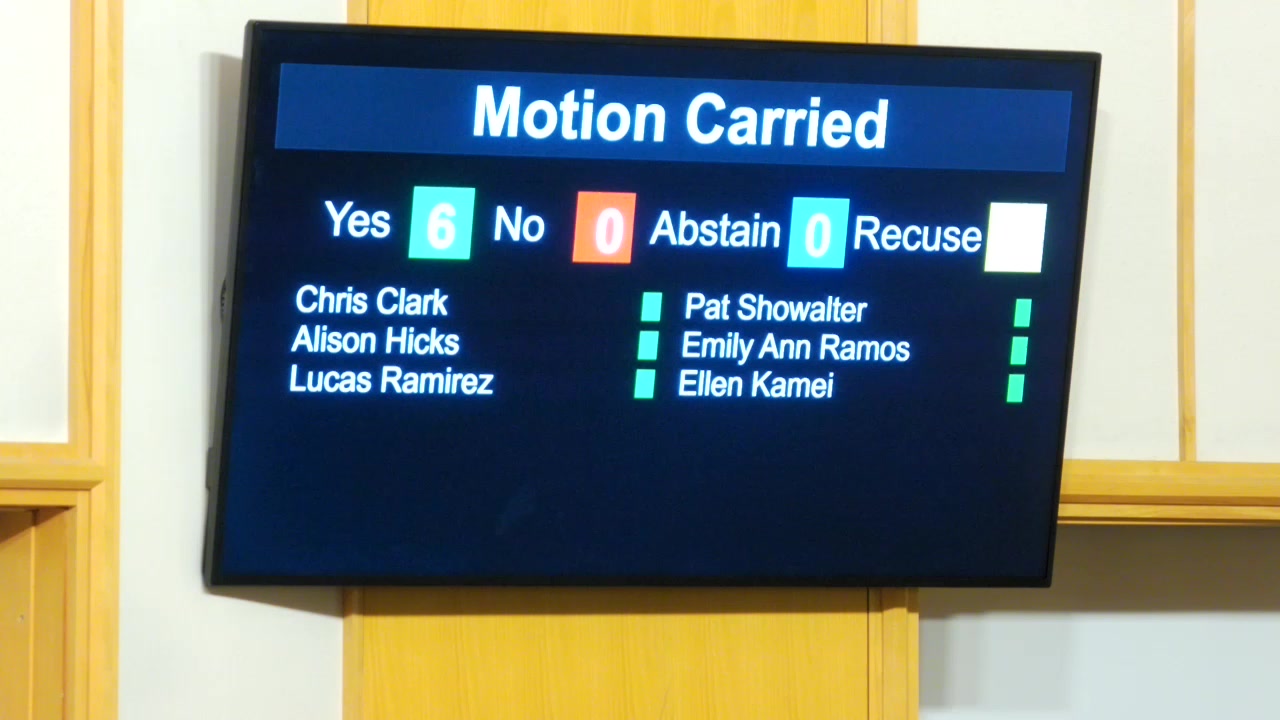
[04:34:54] Councilmember Ellen Kamei: All right, and that passes unanimously. So before we can continue, may I have a motion to continue the meeting past 10:00 PM? Okay, and that is moved by Councilmember Clark, seconded by Vice Mayor Ramos. May we vote on moving the meeting past 10:00 PM?
[04:35:22] Councilmember Ellen Kamei: Channeling Councilmember McAlister, Councilmember Ramirez votes no. I just am, and maybe we could just take a five minute break. So let's start at 10:10 please.
[04:39:38] Councilmember Ellen Kamei: All right everyone, thank you. We're going to reconvene.
[04:39:51] Councilmember Ellen Kamei: All right. So we'll move on to item 7.2, Amendments to Funding and Joint Use Agreement and Transfer of Development Rights Memorandum of Understanding with the Los Altos School District. Assistant City Manager Audrey Seymour Ramberg will present the item. If you'd like to speak on this item in person, please submit a blue speaker card to the City Clerk now. And we'll start with the staff presentation.
[04:40:21] Assistant City Manager Audrey Seymour Ramberg: Thank you, Madam Mayor, members of the Council. Audrey Seymour Ramberg, Assistant City Manager, and I'm joined in the audience by Community Services Director John Marchant and Community Development Director Christian Murdock who are available to answer questions.
[04:40:36] Assistant City Manager Audrey Seymour Ramberg: I'd also like to acknowledge and thank the Los Altos School District team led by Associate Superintendent Eric Walukovech for a constructive meet and confer process and a strong spirit of collaboration. The same amendments that are before Council tonight were presented to and adopted by the Los Altos School Board of Trustees last night.
[04:41:04] Assistant City Manager Audrey Seymour Ramberg: Through the General Plan and Precise Plans, the City states its intention to cooperate with schools to meet the community needs for educational and open space uses. In particular, the San Antonio Precise Plan, which was adopted in 2014, called for the creation of a Transfer of Development Rights or TDR program, the purpose of which was to provide funding for a new public school land purchase and development to meet the anticipated enrollment needs due to development growth and new students in that area of Mountain View.
[04:41:49] Assistant City Manager Audrey Seymour Ramberg: Three related agreements were executed in 2018 as will be discussed on the following slide. In 2019, the District purchased an 11.65 acre site in the San Antonio Center area, which is the location of the former Kohl's and Joann Fabrics. Part of this site will be a Joint Use Area that was to be constructed and made available to the community by September 30th of 2024.
[04:42:29] Assistant City Manager Audrey Seymour Ramberg: The three agreements executed in 2018 were a TDR Memorandum of Understanding or MOU, a Funding and Joint Use Agreement or FJUA, and an Open Space Park Agreement. The TDR MOU allows the School District to sell development rights for the San Antonio Center site to developers and projects in different locations.
[04:42:54] Assistant City Manager Audrey Seymour Ramberg: The City has awarded gatekeeper authorizations for eight projects under the TDR MOU, accounting for all but 30,000 of the total 610,000 square feet available. This total amount of square footage could generate up to $79.3 million in TDR proceeds.
[04:43:19] Assistant City Manager Audrey Seymour Ramberg: Through the FJUA, the City has paid $23 million to the Los Altos School District for the development and joint use of four acres of recreational and open space. The City has paid an additional $20 million for two acres of public park, and this diagram shows the conceptual design of these site elements as was presented in the environmental impact report.
[04:43:47] Assistant City Manager Audrey Seymour Ramberg: As noted, the Joint Use Area was not completed by the September 2024 deadline. The City and Los Altos School District have been in a meet and confer process since that time, discussing shared and individual interests related to maintaining the strong collaboration between the two agencies, agreeing to a new date for completion of the Joint Use Area, maximizing the community benefit to Mountain View residents in exchange for the City's financial contributions and the policy support in creating the TDR program, also recognizing the changing circumstances regarding Los Altos School District's enrollment and their need for flexibility regarding the type of school to be located at the San Antonio Center.
[04:44:43] Assistant City Manager Audrey Seymour Ramberg: In particular, Los Altos School District expressed that based on enrollment, there was not a current need for a 10th Los Altos School District school serving the surrounding neighborhood. Furthermore, the original language in the FJUA requiring the school to serve the neighborhood and be similar in size to other Los Altos schools was vague, which could make it difficult to assess and enforce.
[04:45:11] Assistant City Manager Audrey Seymour Ramberg: And the final interest was to extend the time frame for the TDR MOU to allow for additional time for TDR projects to be completed and additional receipt of TDR proceeds.
[04:45:28] Assistant City Manager Audrey Seymour Ramberg: What is proposed for adoption this evening are amendments to the FJUA and TDR MOU as follows. For the FJUA, the primary changes are to extend the delivery date for the Joint Use Area to September 30th, 2030, to provide more flexibility to the Los Altos School District regarding the school size and type using California Department of Education language and guidelines, and to split the proceeds received after October of last year 50/50 between the City and the District.
[04:46:10] Assistant City Manager Audrey Seymour Ramberg: Staff saw this last provision as a more viable way to achieve community benefit than to strengthen the language requiring a neighborhood serving school of a similar size, which was not something that the District would agree to in the meet and confer process, both based on the enrollment needs of the District and their strong interest to retain their jurisdictional authority to determine the school type.
[04:46:39] Assistant City Manager Audrey Seymour Ramberg: The revised language would allow either a neighborhood serving school or a charter school to occupy the San Antonio Center site. It is our understanding that the District is considering the possibility of a charter school. However, the Board hasn't made a decision on the school type.
[04:46:58] Assistant City Manager Audrey Seymour Ramberg: As for the school size, last night, in addition to hearing the item regarding the amendments to the FJUA and the TDR MOU, the District considered or was presented with and expressed support for a schematic design for the San Antonio site, and that would be for a TK through 8 school with a total enrollment of up to 607 students, of which they wouldn't fully program initially with an unassigned space for 81 of those 607 students.
[04:47:35] Assistant City Manager Audrey Seymour Ramberg: For the TDR MOU, the only change is to extend the time frame for projects by 10 years to a total term of January 29th, 2039. In addition to the community benefits of the two acre City park and the four acres of Joint Use Area that were originally contemplated in the 2018 City Los Altos District agreements, the amendment to the FJUA now provides the City with the potential for up to nearly $34.5 million in TDR proceeds.
[04:48:14] Assistant City Manager Audrey Seymour Ramberg: The degree to which the school itself would be a community benefit for Mountain View residents depends on the type of school ultimately placed there, which as I noted has not yet been decided and may change with the changing needs of the District over the 99 year term of the FJUA.
[04:48:33] Assistant City Manager Audrey Seymour Ramberg: So that concludes staff's presentation. These are the recommendations before you tonight to approve the first amendments to both the Funding and Joint Use Agreement and the TDR MOU, and staff is available for questions.
[04:48:50] Councilmember Ellen Kamei: Great. Thank you. Does any member of the council have a question? Councilmember Ramirez.
[04:48:55] Councilmember Lucas Ramirez: Thank you, Mayor, and thank you Audrey for the presentation. I have a couple of quick clarification questions. We've gotten some feedback from the community expressing concerns about the school size and configuration, which had been regulated under the original agreements. Can you share with us who, which agency has authority over school size and configuration, and whether the City really had any ability to enforce those restrictions to begin with?
[04:49:42] Assistant City Manager Audrey Seymour Ramberg: Thank you for the question, Councilmember Ramirez. The District has the authority and jurisdiction to determine the type of school and the size of school and the configuration of school. The fact that we are in a master planning process with them for the joint use area does give us a collaborative platform to talk about things of interest to the City such as safe circulation and other aspects of the site plan.
[04:50:17] Assistant City Manager Audrey Seymour Ramberg: But ultimately our authority is quite limited. I think that was something that the staff that were here preceding me and the team that worked with me on this negotiation, you know, they probably struggled with that as well and tried to come up with language that expressed the desire and the intent of the Council, which at that time was for a neighborhood serving school with the understanding that there was to be enrollment growth in that area and in the District as a whole.
[04:50:58] Assistant City Manager Audrey Seymour Ramberg: In fact, and you know, the opposite has happened. The enrollment in the District has gone down. And so as we looked at the language that was in the agreement, it was again, a clear statement of desire and intent, but not necessarily something that would be easily enforceable. And when we originally went into the negotiations, it was with the intent of strengthening that language so that it could be more of a guarantee that this would be a neighborhood serving school.
[04:51:35] Assistant City Manager Audrey Seymour Ramberg: But we heard a couple things back from the District at that point. One being that they did not have the enrollment for that. Another being that they had a very strong programmatic priority to have middle school campuses, not the junior high campuses that they currently have, and that gave them a desire to have flexibility around how they would utilize that school site and that that was valuable to them.
[04:52:06] Assistant City Manager Audrey Seymour Ramberg: And that got us into a whole different level of conversation of, well, if the community benefit isn't to be a neighborhood serving school, what else might the community benefit be? So it kind of took the negotiations down a different path. But also it recognized what were always likely the limitations that the City would have faced around trying to judge whether or not that neighborhood serving requirement had been met and what would it, you know, what would the consequence be for the City if it wasn't met.
[04:52:45] Assistant City Manager Audrey Seymour Ramberg: And ultimately, it's the same that are before you now. The really the only consequence that we would have would be to find that we no longer wish to be in the Funding and Joint Use Agreement with the District and no longer wish to have a joint use area and then seek, you know, through the next steps in the meet and confer process, which would result in a return of that funding to the City or that would be certainly the City's, you know, supposition and intent.
[04:53:21] Councilmember Lucas Ramirez: That's very helpful. Thank you. I guess just to be explicitly clear on this point though, let's say the Council, the original language were going to continue to govern these agreements and the Council really wanted to restrict enrollment to, you know, no more than 500 students or some other arbitrary number or to guarantee a neighborhood school with the intent to reduce or mitigate traffic impacts, for instance.
[04:54:01] Councilmember Lucas Ramirez: Our ability to enforce that, right, once the school is built is really constrained. And there really isn't much that the City can do to compel the School District to limit their student population or to have a school of a particular type. That's not really within our jurisdiction.
[04:54:21] Assistant City Manager Audrey Seymour Ramberg: That's correct. That's correct. And the District has shared that... well, one point I would make is that we do have an EIR that studied up to, it studied both a 500 student school and a 900 student school as EIRs often do, creating an envelope that is kind of the outer edges of what might be considered so that all impacts can be studied. And traffic was studied as part of the EIR.
[04:55:00] Assistant City Manager Audrey Seymour Ramberg: But as I noted in the presentation, what they are focusing on at this point is a 607 student school. So they're not looking at that outer edge of the EIR. And when you look at what the existing enrollment is for the other Los Altos School District schools, they vary what the enrollment is compared to what their built capacity is. And over time those vary where it might go over capacity, it might go under capacity.
[04:55:31] Assistant City Manager Audrey Seymour Ramberg: And certainly with the Bullis Charter schools being at the two junior high sites, those sites with the combination of the Los Altos School and the Bullis schools are over their stated enrollment.
[04:55:51] Councilmember Lucas Ramirez: Okay. Thank you very much. That was very helpful. One last question and it may be for other members of the staff, but I'm curious to know if we've heard any interest at all in the TDR market. It's been pretty quiet for a long time and the market's shifted a lot in the last few years, but I was curious to understand if you feel like we're likely limited to the universe of applicants that we've been talking to for the past several years or if with this extension you think that might unlock some additional or new interest and that there might be a possibility where all of the development capacity is ultimately sold.
[04:56:36] Community Development Director Christian Murdock: Good evening, Honorable Mayor and Council. Christian Murdock, Community Development Director. I'm not aware of significant new interest in utilization of the TDR program at this point. I am aware of one applicant whose TDR allocation expired and is interested potentially in seeking reauthorization of that.
[04:57:01] Community Development Director Christian Murdock: And so I think one thing we are considering if the Council supports this agreement this evening is to prepare regulations for Council consideration that might incentivize expired applications to come back in as one way to allow utilization of the TDR allocations and monetize that component for the benefit of Los Altos School District and the newly acquired interest the City would have in those TDR funds.
[04:57:32] Community Development Director Christian Murdock: So that's one way we're looking to perhaps increase interest and utilization of TDR. And this will remain an option for new applicants to seek potentially as well as the office market continues to rebound. I think it's unlikely in most cases that we'll see interest for residential TDR in most cases given the significant expansion in recent years for residential projects to leverage increased density through other means under state law.
[04:58:03] Community Development Director Christian Murdock: But those were a minority of the projects and the overall square footage anyways in the initial eight projects that were authorized, there were only two and they had relatively small shares of square footage. So I don't think that's likely to be a significant detriment to sort of the successful execution of this if Council supports it.
[04:58:22] Councilmember Lucas Ramirez: That's very helpful. Just to clarify, so it sounds like one option the Council may consider is not requiring the folks who have been through basically a gatekeeper authorization hearing to have to go through that hearing again. You can bypass that, resubmit an application because we've already or the previous councils have looked at that and determined that that was an appropriate project to pursue under the TDR agreement.
[04:58:50] Community Development Director Christian Murdock: I think that's one potential outcome and probably the most advantageous for utilization of these in an expedient way. We haven't done the analysis of potential options to put forward and make a recommendation at this point, pending an indication from Council that they support this approach that staff's put forward tonight.
[04:59:08] Councilmember Lucas Ramirez: Okay. That's very helpful. Thank you very much.
[04:59:11] Councilmember Alison Hicks: Yes, thank you. So we've had joint use agreements with various school districts in the area for over 60 years and they've worked well in a lot of ways. And then recently they've undergone some pretty dramatic changes because of more need for more security and fencing, people owning more dogs, and expanding after school and summer programs, making a lot of the things that we had say areas we had 60 years ago no longer available to the public on those sites that we've been working with for some time.
[04:59:59] Councilmember Alison Hicks: I'm wondering with the joint use agreement for this particular site, how, do you have any estimate in your conversations with the District on how much we'd be able to use the gym and the fields? You know, I guess we're, correct me if I'm wrong, we're paying for 50% of the upkeep. Do we expect to use them 50% of the time? 5% of the time? Only after dark when nobody can go there? What sort of estimate, have you had conversations?
[05:00:36] Community Services Director John Marchant: Good evening. John Marchant, Community Services Director. And thank you for the question, Councilmember Hicks. The conversations to date with LASD have been very similar to that with the type of program that we have with Mountain View Whisman School District. So the way that works with Mountain View Whisman School District is at their elementary school sites, the City has access to the recreational areas starting at 4:00.
[05:01:06] Community Services Director John Marchant: So they do have some afterschool programs. However, we have access to their recreational areas starting at 4:00. And then at the middle school areas, then we have access at 5:00 because they have additional sports and those types of things. That is also inclusive of the gymnasiums. So on a regular school day, we have access basically starting at 5:00 for the gymnasiums and recreational areas.
[05:01:34] Community Services Director John Marchant: In addition, we do have access during weekends, complete access, unless there's a special event, which is very nominal throughout the year. And then also those school recess times. Any day that there is not school, that we do have access to those recreational facilities during the entire day. And to date, this has been working well. We're able to provide what we see as the demand for recreational sports and then also community access as well.
[05:02:06] Councilmember Alison Hicks: And then summers, does the public have access over the summer? Are there summer programs that the school is using?
[05:02:16] Community Services Director John Marchant: Good question. And with Mountain View Whisman School District, they typically have one school site for summer school. And so we're able to work around their schedules. And summer school is typically a truncated program with a certain number of weeks of use. And then we have access to it thereafter. And so we've been able to utilize that. We have not talked with LASD specifically about utilization thereof of a summer program. So that dialogue needs to continue.
[05:02:49] Councilmember Alison Hicks: And when you say with the MVWSD, we have access after 4 or 5 depending on which type of school it is, do we use it much after 4 or 5 PM? What do we use it for?
[05:03:06] Community Services Director John Marchant: So there's a different element, whether there's lights or no lights. And so for those facilities that don't have lights, you can see if we're getting close to 5:00, 6:00 in the evening, it's starting to get dark. And so that limits our access. But then for, as an example, Crittenden Middle School fields are lit and we're able to program till 10:00 PM. And so those are heavily utilized into the evening time.
[05:03:30] Councilmember Alison Hicks: Okay. Good to know. Thank you.
[05:03:33] Councilmember Ellen Kamei: Councilmember Showalter.
[05:03:35] Councilmember Pat Showalter: Yeah, I want to thank you for all the work on this. I know it's gone on a long time and I really appreciate it. But all of the, it's my understanding that all of the negotiations to date have been with the Los Altos School District, either board member or staff. I was wondering how has the Bullis Charter School been involved?
[05:04:07] Assistant City Manager Audrey Seymour Ramberg: The discussions with the Bullis Charter School are being conducted by the Los Altos School District. That hasn't been part of the City's meet and confer process with the District.
[05:04:18] Councilmember Pat Showalter: Okay. So we don't really have firsthand knowledge of whether Bullis is interested in going to this school?
[05:04:26] Assistant City Manager Audrey Seymour Ramberg: We do not.
[05:04:27] Councilmember Pat Showalter: We do not. Okay. Then I wanted to talk, following up a little bit on some of Councilmember Ramirez's comments about traffic. The way that we largely control traffic in Mountain View is really by land use decisions. Is it not? I mean, we figure out the density of housing, the density of commercial, and the actual use of the land has a lot to do with and how those buildings are designed, has a lot to do with the traffic patterns.
[05:05:24] Councilmember Pat Showalter: It's not necessarily something that we don't, I mean, that's how we control traffic. Is that not true?
[05:05:33] Assistant City Manager Audrey Seymour Ramberg: In general, that sounds correct. In terms of a school site, we are not the regulator on the environmental impact report. They prepare the environmental impact report including an assessment of traffic impact and we comment on that. And so that is the way in which for this particular type of land use, i.e. a school site, the issue of traffic is addressed.
[05:06:08] Assistant City Manager Audrey Seymour Ramberg: And then in addition, we have collaborative relationships with all of the schools in Mountain View around Safe Routes to School and the potential for crossing guards and the ability to talk about multimodal transportation and what type of analysis they're willing to do. And if we want additional analysis beyond what they're willing to do since we don't have that same regulatory role with them, that's an option that the City could undertake.
[05:06:34] Councilmember Pat Showalter: And refresh my memory, that Safe Routes to School program, it applies to parochial and private schools as well as public schools?
[05:06:47] Assistant City Manager Audrey Seymour Ramberg: Yes, I believe that's correct.
[05:06:49] Councilmember Pat Showalter: Okay. Anyone have another answer? I think that's correct. We don't have, we have a few, but not too many. Okay. Thank you.
[05:06:59] Councilmember Ellen Kamei: Great. Does any other member of Council have any questions? All right. Not seeing any. Would any member of the public on the line like to provide a comment? If so, please click the raise hand button in Zoom or press star nine on your phone. We'll display a timer on the screen. Each speaker will have three minutes. We will start with in-person first. It is Ken Smith, Millie Gong and Nhung.
[05:07:35] Councilmember Ellen Kamei: So if you, yep. Free to come on down.
[05:07:54] Ken Smith: Good evening, Mayor and Councilmembers. My name is Ken Smith. I've been a resident of Mountain View for more than three decades. And I have some concern regarding how I feel that LASD is changing the original intent of the proposed school. They're asking in the red line to remove the requirement for the school to quote, "serve the Mountain View community surrounding the school site."
[05:08:19] Ken Smith: So why is that? It's because LASD doesn't want a community school. What they want is a place to put Bullis Charter School. They don't want to put BCS on any of the campuses that they have currently and they want them off the middle school campus. There are two primary problems with this.
[05:08:40] Ken Smith: The first is that North El Camino students need a local school. They currently go to three different schools. If you can imagine the school being built and the parents living right across the street from this school being told, "Oh no, you can't, your kids can't go to this school. They'll continue to go to Covington which is three miles away over down by Foothill because we have BCS at this school."
[05:09:12] Ken Smith: They are going to be super upset and rightfully so. The other issue is that BCS is not going to go to that site. They have 1,100 students. They are not going to fit. BCS also cannot make a preference for a geographic location. They had that when they originally started the school because it was started from a specific location and that went into a lawsuit and they dropped that requirement.
[05:09:47] Ken Smith: You can't have that requirement. It draws from the entire district and you have, you're going to have a traffic nightmare and a parking nightmare. The other issue I want to talk about is TDRs. The purpose of a TDR is for the public good. What was the public good that was the purpose of the TDRs?
[05:10:09] Ken Smith: One, get a community school. And two, share fields and a gym. Now LASD is proposing to share 50% of the sales of TDRs with the requirement that the community school be dropped from the wording. So what they're doing is they're saying, "We'll give you some of the profit as long as the whole reason for the TDRs is dropped."
[05:10:35] Ken Smith: Or maybe not the whole reason. Maybe the majority. So maybe instead of 50%, they should be paying 80%. And if they drop, if they say, "No, we don't want to share the fields," then maybe it should be 100%. I don't think we should go down the slippery path. Thank you.
[05:10:53] Councilmember Ellen Kamei: Thank you. Millie.
[05:11:09] Millie Gong: It was December 11th, 2018 and it was 2:00 AM. And Pat was there and Chris was there and many of us were there and I'm so glad you guys put limits on that. And I don't think we're going to be here till 2:00 AM, but I want to thank you for your service. Pat and Chris, you were in that room and I know others of you were on Zoom and you knew the spirit of that agreement, of why Mountain View, your council passed this priceless opportunity to have a small neighborhood school.
[05:11:39] Millie Gong: When Lenny talked about carrying his cello on his back and Pat talked about how neighborhood schools are the heart and soul and build great neighborhoods. It's changed. Totally respect that. And even if you're not an advocate of a neighborhood school, there's nothing that is part of that agreement that is in this red line agreement now. I was shocked when I read the agreement.
[05:12:05] Millie Gong: The school district can put upwards of 900, 1000 temporarily, 1,100. There are California Department Education sanctioned K through 12 or TK through 12 schools that have 1,700 kids on one school site. You have no remedy if the school district decides that. The only remedy you have is tonight. You can put a stop to this.
[05:12:30] Millie Gong: Is this kind of feeling like threading a camel through the eye of a needle? There's so much wrong with this agreement now that the clauses that benefited the Mountain View residents, the clauses that created a neighborhood, the clause that was substantially similar in size... and I brought data and I'll hand it over, I don't know if I can hand it, that shows the substantially similar sized schools that Al in Los Altos or Ally in Los Altos Hills enjoy on average 374 kids at their 10 acre sites.
[05:13:10] Millie Gong: But Alberto in Mountain View is going to be crammed on a site with 1,000, 1,100, 1,200 kids. I ask you to stand up for your Mountain View kids and don't let the school district discriminate against those kids just because they're Los Altos School District kids but they happen to have a 94040 zip code.
[05:13:29] Millie Gong: Please step back and take a minute and say is this really something that the Mountain View City Council wants to have as your legacy, that you invited a charter school or some other school to have this many kids in this area that has already had not one but two traffic fatalities? And you're going to have middle schoolers zooming about, have you seen them on their e-bikes lately? It's kind of crazy.
[05:13:59] Millie Gong: I ask you to support alternative two to go back, litigate, mediate, and terminate this facility's joint use agreement for the benefit of your school kids. Thank you.
[05:14:15] Councilmember Ellen Kamei: Thank you. The Clerk can share it with us. Thank you.
[05:14:32] Nhung: Hi. Thank you dedicated City Council. My name is Nhung and I'm a 13-year resident of Mountain View with middle school and elementary school children. I'm here to ask City Council members to reject the two recommendations passed on this agenda item and here are my reasons. A school on that area around Showers, El Camino, California, San Antonio is not safe for 607 kids.
[05:14:56] Nhung: Two weeks, like August 23rd, there was a car versus pedestrian crash that cost Gail Nakatto, an 83 year old woman her life at 3:25 PM. That's prime dismissal time for students. And this is, there are two fatalities in that same parking lot in two years. This lot is connected to the Kohl's site. Now you want to put 600 plus students there? There will be kids walking, biking to, from school.
[05:15:27] Nhung: And then if this is going to be a charter school, a public charter school where you have, you know, there will be family driving to drop off and pick up their kids. So adding all of this to the cluttery mess up in that shopping center with Walmart, Safeway, TJ, boba place, kid loves boba, you know they're gonna crossing go there.
[05:15:00] Millie Gong: So, I urge you to not build a school there, especially a commuter public school, you know, as the red light documented. I do not want to see a repeat of the vehicle versus pedestrian incident at the other end of Mountain View on Grant at El Camino on March 17, 2022, where middle schooler Andre Retana lost his life on his way to school. So putting a school around this area with increased traffic and there's just, you know, when car versus pedestrian, it just is a really bad idea. So just don't approve this deal. Especially, you know, like the new one extends to 2030. So just please do not approve this deal for, you know, just just for the sake of our kids. With LASD missing the September 30th, 2024 deadline, this is your chance. This is your chance to get out of this. This is your chance to stop this really bad idea that started in January 2019. This is your chance to right this wrong and fix this mistake. So please, for the sake of our kids, I don't want to see any more death. Thank you.
[05:16:25] Councilmember Ellen Kamei: Thank you. I think that concludes in-person public comments. So we'll move on to virtual. And I have Nick Bear.
[05:16:39] Nick Bear: Hi, good evening. And thank you, Mountain View City Council. I'm Nick Bear. I'm a 15-year resident of Mountain View. I have four school-aged kids. First, I want to just say that listening to your... listening to you tonight, I'm deeply impressed by your questions and diligence. I'm... and I also want to just say that I'm very concerned about the amendment which removes the requirement that the school should be substantially similar in size and student enrollment to that of other district schools. By removing the requirement of equitable treatment of Mountain View students and families, LASD would be allowed to cram an indefinite number of students on the San Antonio site, unequal to their numerous other spacious sites. It is disappointing that simply providing a substantially similar in size and student enrollment to that of other district schools for our Mountain View students is even a negotiation point for LASD. The desire of LASD to remove what should be an innocuous wording, substantially similar in size and student enrollment, is a strong indication that LASD does not intend to fairly serve the surrounding Mountain View neighborhoods, students, and families. A mistreatment of our Mountain View students and families that an initial agreement... that the initial agreement specifically protected against. Please serve Mountain View residents' interests by voting to return to the meet and confer process with LASD and to negotiate terms that simply retain the substantially similar treatment of all LASD students, including those from Mountain View. Thank you.
[05:18:13] Councilmember Ellen Kamei: Thank you. All right, not seeing any other in-person or virtual public comments, we'll bring the item back for Council deliberation and action. Councilmember Showalter.
[05:18:28] Councilmember Pat Showalter: Um, yes. I... I've really given this matter a great deal of thought. And um, I do appreciate the agreement that has been struck with our city staff and the Los Altos School District Board related to money. But to me, what's really important here are, one, land use and, two, neighborhood. And it's really hard to put a monetary value on those things. I was a product of public schools, neighborhood schools, and they were really the focal point of our community. People went there after school to play. People went to school there. As a small child, well after like fourth grade, I was able to get myself to school under my own steam. That was a good learning experience. Or or bike. I just feel like that... that neighborhood building is part of the tagline that we've had at heart, a community for all for, you know, for really many years. And I think that although I appreciate the fiscal issues associated with this, I don't I don't think they make up for the lack of the social one. And then the other thing is land use. We, you know, we we don't control how many kids go to a specific school or exactly or in an office building, we don't control how many people work there. The way we control the traffic patterns is by, you know, the size, we can help with the size of the structure, the density, things like that. But the specifics at any one time, they do, they vary. We don't control that. But we have found over time that these land use controls are actually pretty effective. And so I, you know, I I... I think that we need to go back to the drawing board for this. And and and not not be agreeing to these amendments tonight. Thank you.
[05:21:15] Councilmember Alison Hicks: So... so I was... not to try to get myself out of this easily, but I was not here when the original decision was made. And I was not watching on Zoom. But I did read about it in the paper and I was not particularly happy with the decision. I mean, I... and I'll say also much of the staff, the City Manager, the City Attorney, the City Clerk were not here either. Not to blame it on the couple of Councilmembers who were, one of whom just spoke. Um, there are a number of reasons that I from the beginning didn't think this was a very good decision, which I will not go into now because you'll probably like me even less. But um... but now I'm hearing that we have even less control than it appears that the Councilmembers and staff who were there at the time thought we had. And I'm wondering if we... my understanding of why we've gotten this far and why we've gotten the proposal that we have right now is that the Los Altos School District would not agree to those other things. So this was the best staff was able to get. They wanted more, but they wanted some... at the same time they wanted to come to Council and the public with some agreement. Am I wrong? Okay. So, you know, they tried for more. This was the best they could get and that's what we're presented with tonight. So one of my questions is, what... what's the scenario? I don't... I don't... just as the Councilmembers who were here that night could not foresee what happened... they didn't know how... I assume you didn't know that you would end up here tonight in this position and how little control you had. I mean, I assume you wanted a neighborhood school then and you still want one now, but you can't get one through the process. What happens next? If, like, what's the scenario? My question... because we are in the middle of this. I mean, it's not like... like things are built and so forth. So how does this actually... I don't understand how this actually unwinds and whether we end up in a worse place or not. And maybe no one knows. But I'd like to at least ask.
[05:24:22] Councilmember Ellen Kamei: Yeah, I mean, I also... I see Sandra on the the Zoom and she didn't raise her hand, but I don't know if you have any comments for Council on behalf of the Los Altos School District. I see the Superintendent on. So that might be a question to them. I'm not sure. Or if it's a question to the City... or City Staff.
[05:24:42] Councilmember Alison Hicks: I... you know, I'm just wondering legally, since we're in the middle of this, where does it go? And sure, if if she wants to say she can work with us, be a good neighbor in a kind... this doesn't feel like good neighborliness. If she can be a better neighbor, I would love to hear that.
[05:25:10] Councilmember Ellen Kamei: All right. The Superintendent, if you want to unmute.
[05:25:15] Superintendent Sandra McGonagle: Let's see. Can you hear me right now? Yes, we can. And if you don't mind just introducing yourself for those who can't see. Yeah. I was not planning to make public comment tonight, but just listening to your conversation, I think the the point I would like to make at this time is um, really thanking the staff, your staff, and our group who really tried to work through some of the challenges of this agreement and understanding your interests as well as our interests because times have changed since this original agreement has come forward hugely for us. We're looking at a 99-year agreement. And as the leader of our public school district who serves about 25% of our students are residents of the City of Mountain View, I want to maintain the maximum amount of flexibility possible, not just for the next year or two years, but we're talking about 99 years. So, I know we went through faithful meet and confer and we can certainly do that again, but that's really our main interest is that we're serving all of the students within our district, including those students within the City of Mountain View that we serve, but we're looking at the very long term of this 99-year agreement.
[05:26:50] Councilmember Ellen Kamei: Thank you. Councilmember Hicks, did you have more questions?
[05:26:55] Councilmember Alison Hicks: No, I'm just kind of wondering if we go down the road that Councilmember Showalter had said, what, you know, what... are there any implications that come to mind? Are we getting in muddier water than we're in already? Um, uh... those are my questions.
[05:27:16] Councilmember Ellen Kamei: City Attorney Logue.
[05:27:20] City Manager Kimbra McCarthy: Um, thank you. I got a... did I get a promotion? To City... Sorry, it's so late. What? Did I give you a demotion? It's late. I was gonna call you City Manager Kimbra, so... but I was like, nope. It's late. Um, thank you Mayor. Thank you Councilmember Hicks. So, a couple... couple thoughts about this. So, um, we would be back at square one, um, if we were to start this over. And I think the the biggest substantive piece of this is that things have changed considerably since 2019. Um, what underscores all of this is that we would be involved in significant, significant litigation over this. And there are just simply things that the city does not have control over. And there are simply things that the city is not able to negotiate or tell the district what to do. And there are simply things that we are not able to suggest that they do. So, um, as mentioned earlier, the EIR always contemplated a school up to 900 students. So, um, the language that was a little more vague at the time, we have discovered why it was vague, and it's because the city is unable to require the district to have a school of a certain size and um, have it look a certain way. So there's a lot of things that over the last several years and during this negotiation that legally we have um, been able to just kind of see through a different lens um, with where we're at now. So I know that both parties negotiated considerably in good faith over many, many months over this. And um, maybe it would help Council or the public to understand what the layout of this area might look like for certain safety considerations, um, which also was contemplated even back in 2019. So so that hasn't changed. It would always look like this regardless of what kind of school um, would be there. So, um, maybe perhaps the Assistant City Manager could speak very briefly about the layout of this and the fact that the city would work um, very closely with the school district on these sort of safety considerations and traffic, um, just as we would with any of the schools in our area. Um, so maybe you could speak to that briefly for the benefit of Council and the public.
[05:30:30] Assistant City Manager Audrey Seymour Ramberg: So in the Council report, there is the EIR's site map which shows um, at a very rudimentary level the circulation pattern. That is still something that the school district is designing. Just last night, they presented a a more detailed set of schematics for the site. Again, um, making it the uh, uh, specifying the TK through 8 and 607 uh, students. Um, and that process is still ahead of us to really um, as part of the master planning conversations that will continue to look at the circulation on the site, the safety for bike and ped. Also, I'd like to say that the the Walmart ingress egress will be completely separate from the school. That's something that they discussed at their school board meeting last night. So there won't be any connection between those two properties. Um, and so the kinds of things that um, are of concern around circulation will be very appropriate for the staff to continue to discuss with the the school district in the master planning process.
[05:31:30] Councilmember Ellen Kamei: Okay, great. Thank you. Councilmember Ramirez.
[05:31:35] Councilmember Lucas Ramirez: Thank you, Mayor. This was supposed to be the easy fast item. Um, so uh, I appreciate the City Manager's comments earlier. I I had um, attempted and failed to uh, share with my inaugural questions why we're sort of at the point where we are. Um, we don't... we're not the land use authority that that can provide a permit to the school, right? So if the school is built and they want to do something different than what is contemplated in the agreement, there's not a whole heck of a lot we can do, right? The as soon as the school district acquired the property, um, the district you know has has greater... has basically the the the ability to determine its own fate and destiny, right? There's there's not a lot we can do at this point. Um, if uh we if the city really wanted to uh implement some meaningful controls, maybe there there should have been a different set of parameters over the the distribution of funds early on, but we're well beyond that point. Um, and so I think the agreement... the proposed agreement that um, that the staffs of of each of our agencies have have worked on is I think a a the best outcome that we can reasonably expect. So I'm I'm um, I'll make the motion just because I am terming out and um, it's easier for me to do this than maybe for other members of the Council. Um, but I I really do... I I do think I'm I'm grateful for our staff, I'm grateful for LASD staff um, to uh and for the trustees for approving the the agreement last night for for working in good faith and and coming to as as good of an agreement as we can realistically expect at this point. It may not provide uh for the the desired outcomes that were contemplated by the Council in gosh, was it 2016 or thereabouts? 2018? I can't remember exactly when. Um, but uh there are new uh or or different factors and and um, uh I think a a there's a a better understanding of the regulatory framework uh that makes it hard for us to enforce certain provisions. Um, so that's I think that's perhaps not what um, some of our residents would like to hear, but um, it's it's the best we can do and there really isn't um, a lot of uh opportunity for us to perhaps remedy some of the some of the errors of the past, if you want to characterize it that way. Um, so I'm happy to move the staff uh recommendation. I don't see any language here to read. Um, but uh I'm happy to just the staff recommendation. Okay, happy to move that. Um, but uh I do want to encourage my my colleagues to uh to think about um, if if we're not comfortable with this agreement, then really what is it that we're hoping to achieve? What would reopening the the negotiations... what what could it reasonably conclude? Because it will not result in a neighborhood school with a very limited enrollment. Those are things that we cannot control as we understand, you know, based on the the work that's been done over the past several months. Thank you.
[05:34:30] Councilmember Ellen Kamei: Vice Mayor Ramos.
[05:34:33] Councilmember Emily Ramos: Thank you, Mayor. So I I I've really struggled with with this uh, uh, thing. Largely because first I thought like we didn't really have a choice. We we we had our negotiations, they passed their thing last night, and so at first I was just like, okay, it it, as as Councilmember Ramirez said, uh, this was supposed to be the easy item of the night. Um, because what we had as our choice is kind of gone. Um, the the alternative is is pretty much to light our relationship on fire. And sometimes, sometimes I think about it as a possibility um, and then I think about um, the sleepless nights our City Manager will face after that. Um, but I it is hard to ignore what our residents have been asking us for. It is it it it's really difficult to ignore. And I kind of wish that the school district did something more about it. It's clear that we don't have that land use authority. It's clear that we can't compel them to do the things that we initially put in in our thing. So our only option is to walk away or accept what we got. And it's not entirely bad, but it's not exactly what we want. And so that's that is where the the struggle is. Um, to some degree, pardon me, some sometimes I do uh, I I do fantasize about actually just lighting it on fire and and and be done with it. Um, but I I wish that the conversation can can continue. I think that's where we are here... hearing very clearly from our residents um, the concerns about this. Our residents are their residents in their school district as well. And so I'm hoping that that is is taken into consideration. So, um, I'll be seconding, hoping to not light things on fire um, and and trying to find a way to make everyone happy even though it's it's slightly dissatisfying.
[05:36:50] Councilmember Ellen Kamei: Thank you. Councilmember Clark.
[05:36:54] Councilmember Chris Clark: Yeah, so I'll continue my tradition of saying unpopular things. Uh, um, uh, tonight. Look, I I I was here um, in a very different time when the enrollment projections were very high. Um, a 10th site, there was a selection committee, the school district chose a site, a bond was passed. Um, we wanted to um, be part of the conversation um, because we felt that there were a lot of um, even though we weren't the ones who selected the site um, and and went through that whole process, we felt that there were possible advantages um, to Mountain View from a public park to shared facilities to being able to possibly have a community serving neighborhood school. Um, and you know, through a lot of tough negotiations, we came up with the agreement that we came up with. Um, since then, as much as I don't like it, things have changed. There was a pandemic. There was... the enrollment projections have not come to pass. Um, but LASD has chosen to move forward with the with the site um, at different different um, uh population levels or or or school enrollment um, levels than we previously thought. And um, some things changed um, outside of that including the the development environment and the TDR environment. And so um, we began... we went down this path to try and find a path forward in good faith with both parties negotiating in good faith. Um, I frankly don't think that either agency here is 100% satisfied with the agreement that was reached. But that is how negotiations work. And um, and so what we're left with tonight is to find a path forward that works um, as best as possible um, for for both parties uh with neither party getting everything that they want. Um, I think both parties recognizing what the limits of their authority are around some of these areas. And I think it's important that we respect the negotiation process that went that went forward. And do I like all of the provisions? No. Um, I don't think many of us do. But at the end of the day, the alternative is not just to go back and with an unlimited timeline and meet and confer. Um, the alternative is to uh essentially end up in a world where there is an enormous amount of uncertainty. And the world that we were in pre-2019 when there was also an enormous amount of uncertainty um, persists, you know, seven, ten years later. And I don't think that is good for anyone. I don't like spending taxpayer money on litigation and lawsuits, um, especially when two parties have met and conferred in good faith. So um, does it hurt to support this? Sure. Is it the right thing in my mind to do? Yes. And that is why I will second the motion.
[05:40:15] Councilmember Ellen Kamei: Thanks. So I see um, Councilmember Showalter in the queue, but I'd love to jump into the conversation before we go for another round. Um, kind of given the the conversation, um, just a question to staff. So should this get enough votes to go forward, do you feel that there's a possibility to provide some of the feedback and um, have ongoing conversations about how both the the city and the school district can work to help facilitate some of the concerns that are still out there for for residents and in the community? Um, do you think that that would be, you know, I don't I I don't... I don't want to be so prescriptive as to say, you know, it has to work out for example like the the neighborhood school, it feels like, but could there be some conversations about maybe educating and and maybe it would have been great to hear tonight, for example, um, just what they're doing to incorporate the community, where the the thought process might be there, or the outreach um, that aligns with our community for all vision. I think just some more opportunity to have that proactive communication or um, I know we've been doing improvements along California. I know we're doing improvements along um, you know, Packetti, that whole that whole area. Um, this came up I think when we were discussing it a couple months ago and just kind of the working with the current property owner of that site on just kind of being able to walk through the site um, in a in a safer way. I remember bringing that up then. So maybe those things that are still lingering, do you think that there's an opportunity to have that conversation?
[05:42:31] Assistant City Manager Audrey Seymour Ramberg: Absolutely, as it relates to things like outreach and circulation, um, and you know, how both the city and the school district can be good partners to that location being um, uh an asset for the community. Um, uh I think as it relates to school size and neighborhood serving, I don't think there's any degree to which further conversation on that would change that outcome.
[05:43:18] Councilmember Ellen Kamei: I think... I guess to another question on that, the it seems like, you know, 2019 the school district thought one thing, where in 2025 they think another. By the time they're ready to move forward, things may have changed again. I mean if I if I were to, you know, surmise anything, that would be the thing that I would bring forward. So um, I'm also trying to take a step back um, and and think things may change. Um, it's it's a it seems a bit flu... a fluid situation. I think the the other thing we talked about this on the pri... prior item is just the flexibility in terms of getting continual feedback from from residents particularly in that area. I don't know if we can ask or you think that they might be willing to continue to hear from our residents and their concerns or sha... I would call it shared concerns. Yeah. That's a really great point because I don't think we've really heard from residents in that area. I mean we've we've heard from from people who have concerns but but I don't think we've really heard from residents in that area. Okay. All right. So um, I'll just thank you. Uh so I'll wrap up. I think that um, there should this go forward, I think there's some room to to grow our relationship with the school district. I think there's opportunity for, you know, they had the task force, right? I think you served on it, the advisory... what was... oh Margaret did... what was it? Advisory Commission. You know, maybe that we can make sure that we're having that kind of outreach as this goes forward when the time comes when the decision is made, I don't know. I think having um, residents be able to feel like there's a they have a voice and to understand that Council's hands are, you know, we're not the property owner anymore, um, that there is a vehicle and a and a place to have that conversation is important to me um, should this go forward. I think also um, making sure that all of our residents and that includes our our youngest members, our students, um, feel like they're wanted in all of our schools is very important to me. Um, and so being able to continue to to weave that message and put that out there, I think that was what was so promising, I think um, to Councilmember Showalter's comments on a community serving neighborhood serving school. Um, and now that that may change. I mean, maybe it'll change back. I don't know. I'll I'll cross my fingers for that. Um, that we'd want students in the area to feel like they could go if go to that school if if possible. Um, I know that there's it's quite complicated. So um, and then being able to to share and coordinate on the the road improvements will be uh important too. All right, Councilmember Showalter.
[05:45:59] Councilmember Pat Showalter: Well I appreciate everybody's comments, but um, I I do think that uh, as the, you know, as the leaders of this community, um, there are a lot of things we need to consider besides just money. And um, I do think that these neighborhood and social considerations are are really quite vital. And um, so I I I... but at the same time, I recognize that we actually do have a very good relationship with the Los Altos School District, which is great. So um, I hope that continues and I for one would like to see another round or two of negotiations before this was passed. So I I'm not going to be supporting it tonight, but I don't think, you know, there's I don't think that not voting this for this tonight is equivalent to a fire. That's a I I think that's a um, you know that's an exaggeration. Uh, when you're in negotiations with people, you never really know um, that you're in the end until everything gets signed. There it's it's just always possible you're going to have another round. And um, I uh I think that I for one think we need another round or two. But um, you know we all get a vote. Thank you.
[05:47:25] Councilmember Alison Hicks: So with my previous question, I was trying to get... I was trying to trigger an answer that but I was maybe unclear, that we had how far we'd walked down this road already. That we're not at the beginning when we can evaluate and talk about a neighborhood school. I don't think we're going to get a neighborhood school. I think we've I think that ship has sailed. Um, and to some degree, if we'd researched a little more in the beginning, we would know that we didn't have the clout to get that. Um, that said, um, I we're talking about, you know, when we we just heard from the Los Altos School District that one of the reasons they want flexibility is that it's a 99-year lease. Well, there's a lot of years between now and 99 years. I'm wondering if there's some way to have an an agreement um, like I I think a lot... you can tell me that I'm wrong, but I think a lot of us don't really uh know or care whether it's a 900 person school 99 years from now. Things may be very different. Maybe every building in Mountain View will be 20 stories high. I don't know. But um, but I wonder if there's a way of nego... going back... I I hope that uh folks from the Los Altos School District have heard tonight how this what what we've come to so far in this negotiation is very far from what people wanted in the beginning and very far from what the neighborhood thought they were promised even though things have changed. And maybe there's some way of having an agreement where over the next 15 years it doesn't go over a certain size. Are there other things that can be, you know, is this really the end? Is this really the end of what negotiations? I mean we have discretion tonight. So I don't know if it's this or litigation or if it's another meeting of minds and seeing that the community and the Council wanted it to be um, wanted a few... you know, wanted a few more things from this. So so um, yeah, that's my statement or question.
[05:49:36] City Attorney Jennifer Logue: So I think I want to try to put some perspective on all of this and and how we got here. You know, if you remember there's two agreements here. There's the the Joint Use Agreement and then there's the TDR MOU. And part of the problem that we had is that we have developers who have agreements and are entering into agreements with the school district and paying TDR funds. And these two agreements are kind of tied together, you know, they walk hand in hand. And the 99 years, it's it's not a lease, it's a 99 years um, agreement that's going to give us joint use of their property for 99 years. Um, and so the other thing is they do own the property already. And backing out now or or not moving forward now leaves us with a Joint Use Agreement that is expired because that that term, you know, is or there was we didn't meet there were goals that weren't met in that agreement and created allegations of breach and sort of left us in this uncertain place. And I think staying in that uncertain place, and we did do a lot of negotiating, we did work in good faith to come to a middle ground. And we don't have control over the kind of school that they can build there. Even if this whole thing blew up, they still own the property and they can still build. And if we move forward with what we have now, we're in a middle place. We're in a place where we're getting something, they're getting something, and we're not left with a TDR MOU that um, is going to be very difficult to manage if we don't have a Joint Use Agreement. Right, that they they're going to still potentially be entering into agreements and money's going to be coming in and it's going to be unclear where that money is going to and whether or not we could even ever get it back in the end, you know, if if this whole thing blew up. So I just wanted to remind Council that that TDR MOU was a huge motivation in trying to really come to a meeting of the minds and and come to a middle ground with the school district so that we could move forward.
[05:52:30] Councilmember Ellen Kamei: Thank you. Well, um, not seeing any others in the queue, I will... there's a motion and we can see how it goes unless people would like to continue, but it's 11:21 so not sure. Okay. All right. Let's uh let's vote. All right and that passed 4-2, I believe. My screen went quickly. All right. All right. We will move on to um, thank you, thank you to staff, thank you for um, our community members who stayed with us for during this um, long um, conversation. We'll move to item eight, which is Council, Staff, and Committee Reports. Does anyone have any reports? Councilmember Showalter.
[05:54:28] Councilmember Pat Showalter: Yes, this summer I um, traveled to Columbus, Ohio to attend the National League of Cities Summer Meeting. Um, the primary reason was to go to the Energy Environment and Natural Resources Policy Committee. Um, as you've heard me say many times, we um, we put together policies that uh, resolutions that that the NLC will will advocate for and will ask member agencies to advocate for. And of course this year there's just been a um, kind of a war against um, the idea of climate change and um, protecting against climate change. So it it really kind of hit at the heart of um, of our resolutions. So there's been a great deal of discussion about changing um, some of the uh language so that the outcomes are the same, but perhaps the language isn't quite as um, argumentative to uh the uh MAGA side as um, as it it is now. Um, and one of the translations I would share with you is that instead of talking about um, climate resilience as climate resilience, we talk about it as something that leads to public safety because um, you know, if people are burning up, that's not safe, right? So um, it's a... you know, it's it's um, it's not untrue, but it is uh it's it's it's uh it's different. Anyway, one of the things I've been working on, and I want to thank the staff here for helping me a little bit and um, is a uh resolution to request that the federal government continue to fund the expertise of and of um, the people who keep us informed about weather data that's used for extreme weather events and um, and also the um, to keep those those uh those agencies going, to keep those people employed, and to keep um, keep uh us Americans informed about uh disasters that could be coming our way so that we can um, protect ourselves against them as much as possible. So I wanted to share that with you. And I went to a BASCA meeting. Um, I went to a Silicon Valley Clean Energy meeting or two. And one of the things I want to share is that um, everybody's going to be getting every every um, household is going to be getting a $40 credit um, this month uh uh because we we uh we made a little more profit this year than when we anticipated. And as a community-based organization, we feel that it's appropriate for us to share that money back with um, you know with our um, our customers. And thank you very much.
[05:56:50] Councilmember Lucas Ramirez: Thank you, Mayor. Um, since we didn't have an item eight equivalent in our last meeting, I uh do have an obligation to disclose that um, I uh attended the Summer uh Mayors Innovation Project using or benefiting from um, public funds. I forgot the Council Policy that requires that. Uh my apologies. But um, the uh the Summer MIP took place in early August um, and uh the Mayor uh attended as well. Uh and I found the the program uh as usual very uh valuable. Um, a lot of discussion about uh ways local governments can um, uh can build resilience and and uh fight back uh against some of the um, egregious actions uh taken by the federal government. Um, there was a a great um, uh panel presentation about um, climate change and and um, heat specifically, building resilience uh to address um, extreme uh heat events. Um, and there were uh like several others that I can't recall because it was a month ago already. Um, but um, it was a a great series of presentations and um, I was uh grateful to be able to go. Thank you.
[05:58:15] Councilmember Ellen Kamei: Great. Thank you. All right. So um, given the time, I'll just like disclose what I need to today, which is that I also attended the Mayors Innovation Project Summer Meeting from July 31st to August 1st. I attended the API Lead Summit in Atlanta, Georgia, which was in conjunction with with NALEO, the National Association of Latino Elected and Appointed Officials. Um, that was just happening at the same time. Um, July 22nd through the 24th. Really quickly just so folks know, we had our first Moffett quarterly meeting uh July 29th and Mountain View will be hosting the next quarterly meeting um, I think in November. And then the 129th Rescue Wing on August 2nd um, had a 5K run and open house and a community event and they're celebrating 50 years in in our city. Um, so just wanted to share that. Okay. So seeing um, no others um, in the queue, I know it's a late hour but I I find it very important. Um, for nine, for adjournment, I want to adjourn tonight's meeting in honor of our friend and former Cupertino City Councilmember Hung Wei. Our thoughts are with her family and her loved ones. Um, for myself, I had the pleasure of serving with Hung on the uh like Cities Association of Santa Clara County, on the um, League of California Cities um, Peninsula Division. Um, and um, she uh was uh very present in in our in our community. And uh Cupertino um, School Board member um, prior to that. And um, what really catapulted her
[06:00:00] Councilmember Ellen Kamei: Into um public service is um the loss of her daughter, um and that's what um spurred her into education, particularly youth wellness, and then that led to council.
[06:00:14] Councilmember Ellen Kamei: And so um just really want to say that what I learned from her I think about all the time and we talk about, particularly Mountain View we're very fortunate to have, is um you may have different perspectives but everyone um deserves an opinion and uh and respect.
[06:00:32] Councilmember Ellen Kamei: And um that that doesn't mean you can't get along on many other issues and other topics. And so I think given this current climate it's really important so just want to take a moment uh to remember her.
[06:00:44] Councilmember Ellen Kamei: I don't know if any other councilmembers want to say anything about Hung, but Councilmember Hicks.
[06:00:51] Councilmember Alison Hicks: Yeah, thank you for closing in honor of Hung Wei. I was actually Mayor at the same time that she was. And she started a meeting of four cities. It was uh Cupertino, Sunnyvale, Santa Clara, and ourselves.
[06:01:08] Councilmember Alison Hicks: Um because she thought we had a lot more in common than some of the other cities they were caucusing with, which I will not mention. Um and so it was really a pleasure to get to know her in small meetings and talk about a lot of things.
[06:01:25] Councilmember Alison Hicks: Housing development, a lot of things she wanted to learn from us and share, and transportation. And I did start phoning her um af- as kind of a thought partner after she was um, you know, both of us were no longer Mayor and she did not call me back and that's when I found out she was not well.
[06:01:45] Councilmember Alison Hicks: So um yeah, thank you for closing in her honor.
[06:01:49] Councilmember Ellen Kamei: Thank you. Councilmember Showalter.
[06:01:53] Councilmember Pat Showalter: Yeah, I would also like to add that she was really um a proponent of government civility. And um uh she had funny anec- anecdotes to share about when it didn't work and and also things to share about how valuable it was when it did. And um I uh I um I will miss her.
[06:02:18] Councilmember Ellen Kamei: Thank you. All right, thank you everyone. Um the next council meeting will be held on September 23rd, 2025. This meeting is adjourned at 11:30. Good night.